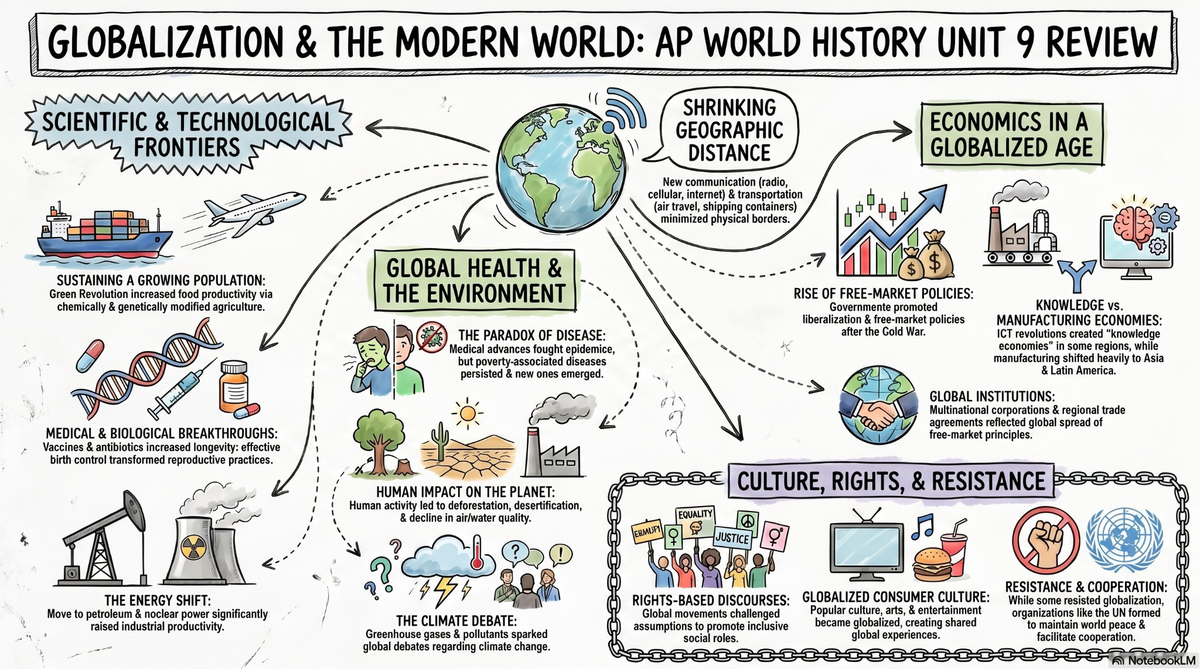
The basics
Time period: 1900–Present (focus: c. 1990–today)
Exam weight: About 8–10% of the AP World History exam
The big question: How has globalization transformed the world since 1991 — and what are its costs as well as its benefits?
The major developments
Collapse of the USSR (1991)
Soviet dissolution ended the Cold War's bipolar world; the US became the sole superpower for ~20 years; ex-Soviet republics became independent nations.
Rise of China
Post-Mao economic reforms (Deng Xiaoping, 1978+) opened China to global trade. By the 2010s, China was the world's #2 economy and a major geopolitical rival to the US.
Neoliberal Economic Order
The WTO (1995), IMF, and World Bank promoted free trade, privatization, and deregulation as the dominant global economic framework.
The Digital Revolution
The internet (1990s), mobile phones, and social media transformed communication, commerce, and politics — collapsing distances and creating new forms of connection and inequality.
Climate Change
Recognized as a global crisis since the 1990s. Paris Agreement (2015) committed nations to limit warming, but emissions continue to rise.
Arab Spring (2010–12)
Social media-fueled protests across the Arab world toppled regimes in Tunisia, Egypt, Libya. Mixed outcomes — Tunisia became democratic; Syria collapsed into civil war.
9/11 & the War on Terror
Al-Qaeda attacks (September 11, 2001) led to US invasions of Afghanistan and Iraq, reshaping Middle East politics and US global strategy for two decades.
Rise of Populism
2010s onward: populist nationalist movements in the US (Trump), UK (Brexit), Brazil, India, Hungary, and elsewhere challenged the post-WWII liberal international order.
The people you must know
- Deng Xiaoping — Chinese leader (1978–92) who opened China to market reforms while preserving Communist Party rule; architect of China's economic rise.
- Margaret Thatcher — British PM (1979–90); pioneered neoliberal policies of privatization and deregulation that spread globally.
- Ronald Reagan — US President (1981–89); his economic policies (Reaganomics) and Cold War strategy contributed to the Soviet collapse.
- Boris Yeltsin — First president of post-Soviet Russia (1991–99); oversaw chaotic transition from communism to market economy.
- Tim Berners-Lee — British scientist who invented the World Wide Web (1989); enabled the digital revolution that defines modern globalization.
- Malala Yousafzai — Pakistani activist for girls' education; shot by the Taliban (2012), became youngest Nobel Peace Prize winner.
- Greta Thunberg — Swedish climate activist whose school strikes (2018+) sparked global youth climate movements.
- Xi Jinping — Chinese leader (2012+); consolidated power and asserted China as a global power rivaling the US.
Key themes to remember
- Globalization accelerated dramatically after 1991 — Cold War ended, China opened up, and the internet emerged at almost the same time.
- Inequality is the big story — Some places (East Asia) saw massive poverty reduction; others (former Soviet states, parts of Africa) struggled or stagnated.
- Technology cuts both ways — Internet enables global commerce AND surveillance; social media enables Arab Spring AND disinformation campaigns.
- Environmental problems are global — Climate change, biodiversity loss, and ocean pollution don't respect borders, but governance does.
- Backlash is real — Populism, religious fundamentalism, and ethnic nationalism are responses to (not separate from) globalization's effects.
Common exam traps
- Globalization didn't start in 1991 — but its pace and scale transformed after the Cold War ended; be precise about what changed.
- Know the specific institutions — WTO, IMF, World Bank, UN, and NGOs each play distinct roles; don't lump them together.
- Pair climate change with the Green Revolution — the exam tests environmental consequences of 20th-century growth from both angles.
- The backlash against globalization — protectionism, nationalism, anti-globalization protest — is part of the unit, not an afterthought.