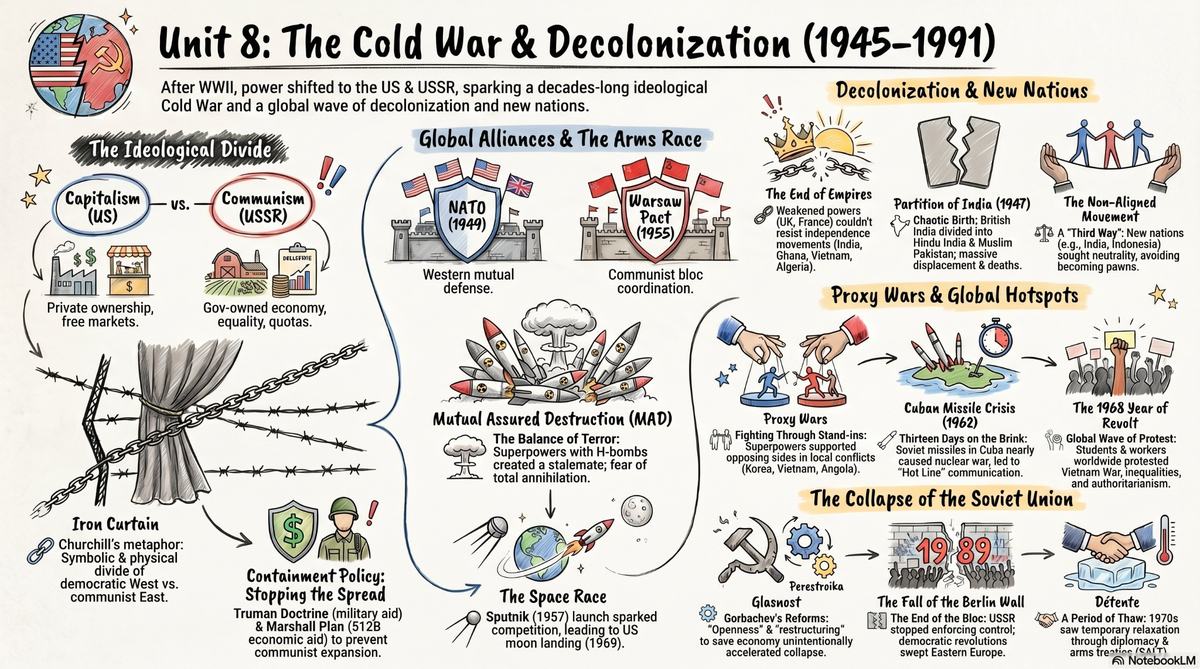
The basics
Time period: 1900–Present (focus: 1945–1991)
Exam weight: About 8–10% of the AP World History exam
The big question: How did the Cold War rivalry between the US and USSR shape global politics — and how did colonized peoples win independence in the process?
The major events
Cold War (1947–91)
Bipolar conflict between US-led NATO and Soviet-led Warsaw Pact. Defined by ideological competition, arms races, espionage, and proxy wars — but no direct US-Soviet combat.
Chinese Revolution (1949)
Mao Zedong's communists defeated the Nationalists; founded the People's Republic of China. Reshaped East Asia and added 600 million people to the communist sphere.
Indian Independence (1947)
Britain granted independence to India and Pakistan. Partition divided the subcontinent along religious lines — 15 million displaced, hundreds of thousands killed.
Korean War (1950–53)
First major Cold War proxy war. North Korea (Soviet-backed) invaded South Korea (US-backed). Ended in stalemate at the 38th parallel — still divided today.
Suez Crisis (1956)
Egypt's Nasser nationalized the Suez Canal; Britain, France, and Israel invaded. US pressure forced their withdrawal — confirmed the end of European imperialism.
Cuban Missile Crisis (1962)
The Cold War's most dangerous moment. Soviet missiles in Cuba brought superpowers within hours of nuclear war. Resolved through back-channel diplomacy.
Vietnam War (1955–75)
US fought to prevent communist North Vietnam from unifying the country. Failed — discredited US Cold War interventions and ended in unified communist Vietnam.
End of the Cold War (1989–91)
Berlin Wall fell (1989); Soviet Union dissolved (1991). Gorbachev's reforms (glasnost, perestroika) and economic stagnation ended the bipolar world.
The people you must know
- Harry Truman — US President whose 1947 doctrine of containment launched the Cold War; authorized atomic bombs and committed US to Korean War.
- Joseph Stalin — Soviet leader who established the Eastern Bloc after WWII and shaped early Cold War conflict until his death in 1953.
- Mao Zedong — Chinese Communist leader (1949–76); industrialized China through brutal campaigns (Great Leap Forward, Cultural Revolution) costing tens of millions of lives.
- Jawaharlal Nehru — India's first Prime Minister; co-founder of the Non-Aligned Movement and architect of independent India's democracy.
- Gamal Abdel Nasser — Egyptian president who nationalized the Suez Canal and championed Arab nationalism and non-alignment.
- Ho Chi Minh — Vietnamese communist leader who led independence from France and the war against US-backed South Vietnam.
- Nelson Mandela — Anti-apartheid leader imprisoned 27 years; became South Africa's first Black president in 1994.
- Mikhail Gorbachev — Last Soviet leader; his reforms (glasnost, perestroika) inadvertently led to the collapse of the USSR.
Key themes to remember
- Cold = no direct combat between US and USSR — But proxy wars in Korea, Vietnam, Angola, and Afghanistan killed millions.
- Decolonization happened FAST — Most of Africa and Asia became independent between 1945 and 1975, a remarkably rapid transformation.
- Political independence ≠ economic independence — Many newly independent nations remained economically dependent on former colonizers (neocolonialism).
- The Non-Aligned Movement was a third path — Newly independent nations led by Nehru, Nasser, and Tito refused to join either superpower bloc.
- Communism took different forms — Soviet, Chinese, and Vietnamese communism developed distinctly; Sino-Soviet split (1960s) shattered the idea of a unified communist bloc.
Common exam traps
- The Cold War was only "cold" in Europe — proxy wars in Korea, Vietnam, Afghanistan, and Angola were hot wars with massive casualties.
- Decolonization wasn't a Cold War sideshow — new nations actively played the superpowers off each other, notably through the Non-Aligned Movement.
- The communist world was not a monolith — the Sino-Soviet split divided China and the USSR from the 1960s onward.
- Gorbachev's reforms accelerated the Soviet collapse — glasnost and perestroika were meant to save the USSR, not end it.