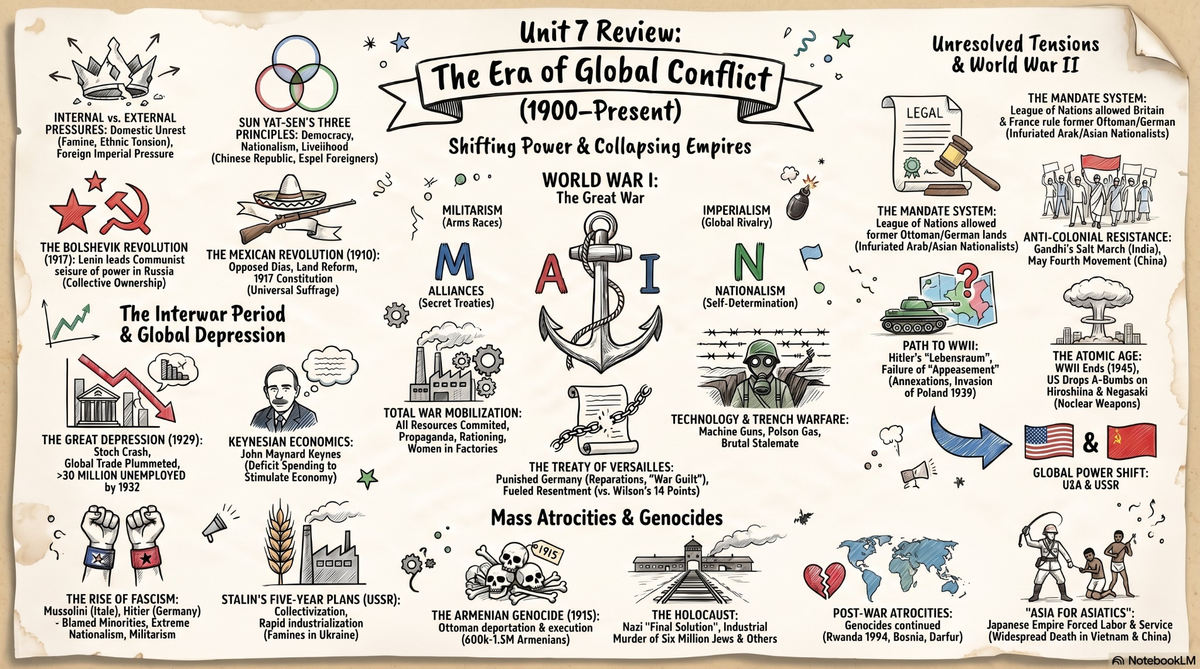
The basics
Time period: 1900–Present (focus: c. 1900–1945)
Exam weight: About 8–10% of the AP World History exam
The big question: How did two World Wars and the rise of fascism reshape the 20th-century world — and what lessons did the world try to learn from them?
The major events
World War I (1914–18)
"The Great War" — trench warfare, total war, massive casualties. Caused by MAIN: Militarism, Alliances, Imperialism, Nationalism. Ended European dominance.
Russian Revolution (1917)
Lenin and the Bolsheviks overthrew the tsar and created the world's first communist state — the Soviet Union — radically changing 20th-century politics.
Treaty of Versailles (1919)
Punished Germany with massive reparations, war guilt, and territorial losses. Created the League of Nations and the conditions for WWII.
The Great Depression (1929)
Global economic collapse beginning with the US stock market crash. Caused mass unemployment worldwide and fueled the rise of fascism.
Rise of Fascism
Mussolini's Italy (1922) and Hitler's Germany (1933) rose to power exploiting economic crisis, nationalist resentment, and weak democracies.
World War II (1939–45)
The deadliest conflict in human history — 70–85 million dead. Defeated fascism, made the US and USSR superpowers, ushered in the nuclear age.
The Holocaust
Nazi Germany's systematic genocide of six million Jews and millions of others. The most studied genocide and a touchstone for human rights.
Atomic Bomb (1945)
US dropped atomic bombs on Hiroshima and Nagasaki in August 1945, ending WWII and inaugurating the nuclear age that defines our world.
The people you must know
- Archduke Franz Ferdinand — Heir to the Austro-Hungarian throne whose 1914 assassination in Sarajevo triggered WWI.
- Woodrow Wilson — US President who entered WWI in 1917; proposed the Fourteen Points and pushed for the League of Nations.
- Vladimir Lenin — Bolshevik leader of the Russian Revolution (1917); founded the Soviet Union and established the first communist state.
- Benito Mussolini — Italian fascist dictator (1922–43); originator of fascism as a political ideology and Hitler's ally.
- Adolf Hitler — Nazi dictator of Germany (1933–45); led WWII in Europe and orchestrated the Holocaust.
- Joseph Stalin — Soviet dictator (1924–53); led the USSR through industrialization, the purges, and WWII victory over Nazi Germany.
- Franklin D. Roosevelt — US President who led America through the Great Depression and most of WWII; designed the New Deal and laid the foundation for the UN.
- Winston Churchill — British Prime Minister whose leadership and rhetoric rallied Britain through the early years of WWII.
Key themes to remember
- Total war erased the line between soldiers and civilians — Both World Wars mobilized entire societies; civilians became legitimate targets through bombing and blockades.
- Economic crisis breeds political extremism — The Great Depression directly enabled the rise of Hitler and other fascist movements.
- Technology made killing industrial — Machine guns and chemical weapons in WWI; aerial bombing, the Holocaust's gas chambers, and atomic bombs in WWII.
- WWII ended European dominance — The US and USSR emerged as superpowers; Britain and France lost their empires within two decades.
- The 20th century forced moral reckoning — The Holocaust and other genocides led to the Universal Declaration of Human Rights (1948) and the modern human rights framework.
Common exam traps
- World War I destroyed four empires — Ottoman, Austro-Hungarian, Russian, and German. Know what replaced them, especially the mandate system.
- The Treaty of Versailles didn't cause World War II by itself — combine it with the Great Depression and the rise of fascism for full credit.
- Fascism and communism are opposite ideologies — both produced totalitarian states, but don't treat them as interchangeable.
- The Holocaust and the Armenian Genocide are testable content — use specific, accurate terms and dates when writing about them.