The basics
Time period: 1750–1900 CE (the industrial age)
Exam weight: About 12–15% of the AP World History exam (one of the most heavily weighted units)
The big question: How did the Industrial Revolution transform economies, drive a new wave of imperialism, and reshape the global balance of power?
The major developments
Industrial Revolution
Began in Britain (~1760) with steam power and factories. Spread to Belgium, France, Germany, and the US — created modern industrial economies.
British Imperialism in India
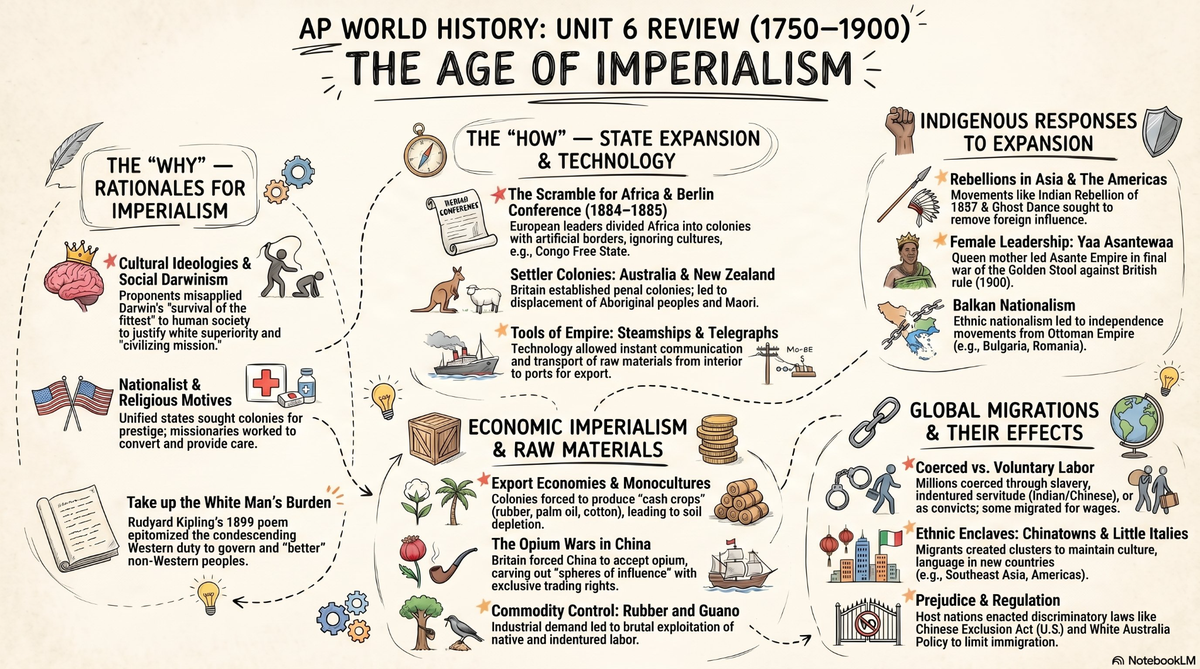
British East India Company ruled India through the Sepoy Mutiny (1857); after which the British Crown took direct control of the Raj.
Scramble for Africa
Berlin Conference (1884–85) divided Africa among European powers. By 1914, only Ethiopia and Liberia remained independent.
The Opium Wars
Britain forced China to open trade after defeating it in the First Opium War (1839–42); produced the "century of humiliation" for China.
The Meiji Restoration
Japan's 1868 transformation — rapidly industrialized, built a Western-style military, and avoided becoming a colony. Became an imperial power itself.
Marxism & Socialism
Karl Marx and Friedrich Engels' Communist Manifesto (1848) argued workers would overthrow capitalism. Inspired socialist movements worldwide.
Global Migration
European workers to the Americas; Indian and Chinese indentured laborers to British colonies; formerly enslaved people seeking freedom — reshaping global demographics.
Social Reform Movements
Abolition (Britain 1833, US 1865), women's suffrage (Seneca Falls, 1848), and labor unions — challenged industrial-era inequalities.
The people you must know
- James Watt — Scottish engineer who improved the steam engine in the 1760s, making it efficient enough to power factories and locomotives.
- Karl Marx — German philosopher and economist; co-authored The Communist Manifesto (1848) and analyzed capitalism in Das Kapital.
- Cecil Rhodes — British imperialist in southern Africa; ardent advocate of British expansion; "From Cape to Cairo" was his vision.
- Empress Dowager Cixi — De facto ruler of Qing China from 1861 to 1908; presided over the Self-Strengthening Movement and the Boxer Rebellion.
- Emperor Meiji — Symbol of Japan's modernization; under his reign Japan transformed from feudal society to industrial power (1868–1912).
- Menelik II — Ethiopian emperor whose victory at the Battle of Adwa (1896) defeated Italian invasion — preserving Ethiopian independence.
- Charles Darwin — Scientist whose theory of evolution by natural selection (1859) was later misused to justify imperialism as "Social Darwinism."
- Queen Victoria — British monarch whose long reign (1837–1901) coincided with the height of British industrial and imperial power.
Key themes to remember
- Coal + steam + iron = revolution — These three were the foundation of British industrial dominance and spread the Industrial Revolution worldwide.
- Industrial economies demanded raw materials — Rubber from the Congo, cotton from India and Egypt, oil from the Middle East — driving the Scramble for Africa and Asian colonization.
- "Civilizing mission" was the cover story — Europeans justified imperialism with rhetoric about "civilizing" non-Western peoples; the reality was economic exploitation.
- Resistance was everywhere — From the Sepoy Mutiny to Ethiopian victory at Adwa to Japan's self-modernization, colonized peoples actively fought back.
- Class struggle entered politics — Marxism, socialism, and labor unions emerged as responses to industrial inequality — and reshaped 20th-century politics.
Common exam traps
- The "new imperialism" of the late 1800s is not the colonialism of Unit 4 — it was faster, industrial-powered, and centered on Africa and Asia.
- The Berlin Conference (1884–85) partitioned Africa with no African representation — a favorite exam example.
- Japan is the exception — the Meiji Restoration (1868) turned Japan into an industrial and imperial power rather than a colonial target.
- Migration was both voluntary and coerced — indentured laborers from India and China replaced enslaved labor on many plantations after abolition.