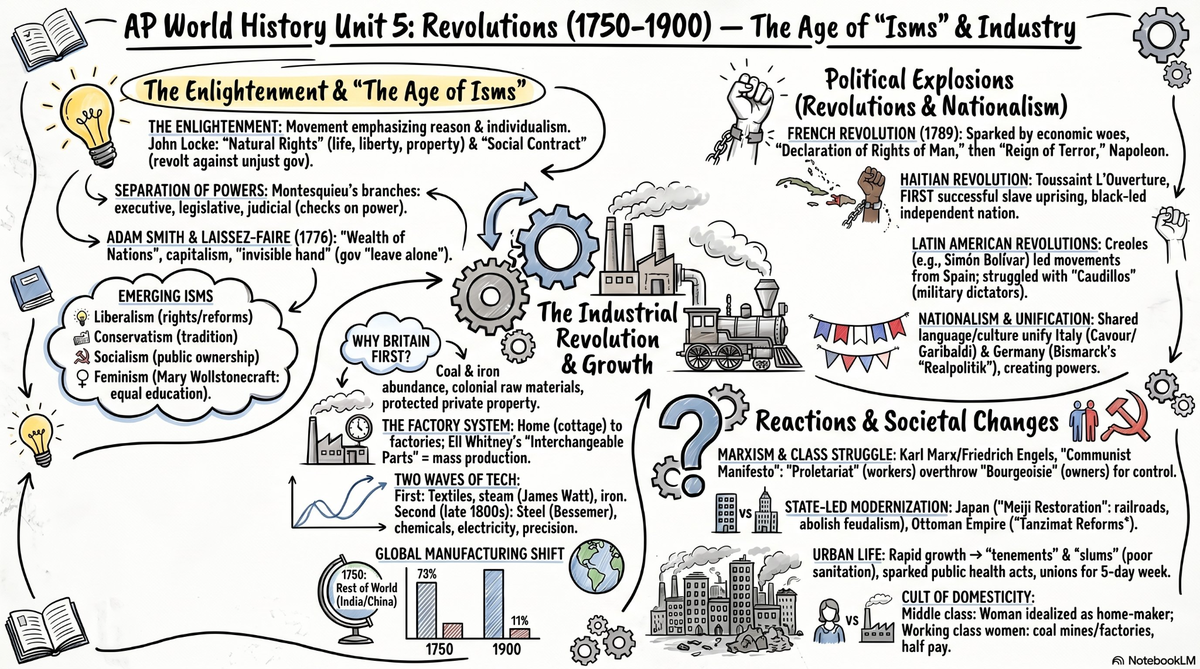
The basics
Time period: 1750–1900 CE (the age of revolutions)
Exam weight: About 12–15% of the AP World History exam (one of the most heavily weighted units)
The big question: How did Enlightenment ideas about liberty and equality reshape the political world from 1750 to 1900 — and who benefited?
The major revolutions
The Enlightenment
Intellectual movement (1685–1815) — Locke, Rousseau, Voltaire, Montesquieu. Ideas about reason, natural rights, and the social contract powered every revolution that followed.
American Revolution (1775–83)
The first successful colonial revolt. Declaration of Independence (1776) used Lockean language; U.S. Constitution (1787) created the first major republic.
French Revolution (1789–99)
Overthrew monarchy and established a republic. Declaration of the Rights of Man, the Reign of Terror, and ultimately Napoleon's rise.
Haitian Revolution (1791–1804)
The only successful slave revolt in history. Led by Toussaint L'Ouverture, it created the first Black republic and shook the Atlantic world.
Latin American Independence
Simón Bolívar ("El Libertador") and José de San Martín led independence movements (c. 1810–25) across South America against Spain.
Mexican Independence
Started by Father Hidalgo's 1810 "Grito de Dolores" rallying peasants and Indigenous people; achieved independence from Spain in 1821.
Italian & German Unification
Nationalist movements united Italy (Garibaldi, Cavour, 1861) and Germany (Bismarck, 1871) into nation-states — reshaping the European map.
Other Reform Movements
Abolition of slavery (Britain 1833, US 1865), women's suffrage, and Seneca Falls (1848) all extended revolutionary ideals to new groups.
The people you must know
- John Locke — English philosopher whose ideas about natural rights and the social contract were foundational to the American Revolution.
- Jean-Jacques Rousseau — Genevan philosopher who argued government legitimacy comes from "the general will" of the people; inspired the French Revolution.
- Thomas Jefferson — Author of the Declaration of Independence (1776); applied Lockean ideas to justify American independence.
- Maximilien Robespierre — Radical leader of the French Revolution and the Reign of Terror; executed by guillotine in 1794.
- Toussaint L'Ouverture — Formerly enslaved leader of the Haitian Revolution; brilliant military and political strategist.
- Simón Bolívar — Venezuelan general who led independence movements across South America; called "El Libertador."
- Otto von Bismarck — Prussian chancellor who unified Germany (1871) through diplomacy and three short wars.
- Elizabeth Cady Stanton — Organizer of the Seneca Falls Convention (1848); pioneer of women's rights movements.
Key themes to remember
- Ideas drove revolutions — Enlightenment thinkers gave revolutionaries the vocabulary to challenge kings, nobles, and the church.
- Revolutions were a wave — American → French → Haitian → Latin American. Each fueled the next.
- "Liberty and equality" had limits — Most revolutions extended rights to propertied white men only; women, enslaved people, and Indigenous peoples were often excluded.
- Haiti was the radical exception — The only revolution that actually delivered on ending slavery and racial hierarchy; it was punished with international isolation.
- Nationalism became the new political force — The idea that nations should govern themselves redrew the map of Europe and Latin America.
Common exam traps
- The Haitian Revolution (1791–1804) belongs in Unit 5 — not with the Maroon rebellions of Unit 4. Know the sequence: American → French → Haitian → Latin American.
- Creole-led independence ≠ social revolution — Latin American independence replaced Spanish officials with local elites; social hierarchies mostly survived.
- In the official CED, the Industrial Revolution begins in Unit 5 — expect industrialization questions mixed in with revolutions.
- Nationalism and liberalism aren't the same — Bismarck used nationalism to unify Germany while resisting liberal democracy.