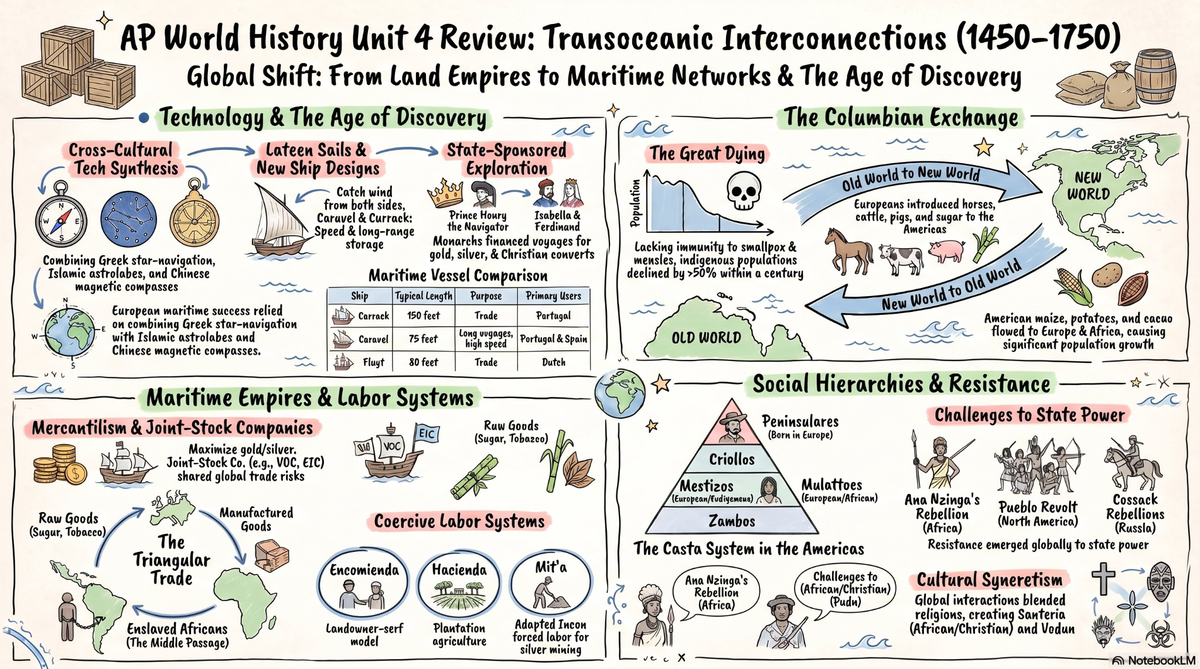
The basics
Time period: 1450–1750 CE (the early modern era)
Exam weight: About 12–15% of the AP World History exam (one of the most heavily weighted units)
The big question: How did European maritime exploration create the first truly global economy — and at what cost?
The major maritime powers
Portugal
First to systematically explore the African coast and reach India by sea (Vasco da Gama, 1498). Built a trading empire across the Indian Ocean.
Spain
Funded Columbus (1492) and conquered the Aztec (Cortés, 1521) and Inca (Pizarro, 1533) empires. Built an empire on American silver from Potosí.
The Netherlands
Pioneered the joint-stock company with the Dutch East India Company (VOC). Dominated Indian Ocean trade and the Spice Islands.
England (Britain)
Founded colonies in North America and India. The British East India Company would eventually rule the Indian subcontinent.
France
Established colonies in Canada, the Caribbean, and Louisiana. Profited from the fur trade and sugar plantations.
The Columbian Exchange
Transfer of crops (potato, maize, tomato), animals (horses, cattle), diseases (smallpox, measles), and people between Old and New Worlds — transformed everything.
The Atlantic Slave Trade
Forced transport of ~12.5 million Africans via the Middle Passage to American plantations. The defining atrocity of the era.
The Mughals at Sea
Mughal India dominated cotton textiles in global trade. Was a major economic power but didn't build a navy — leaving the seas to Europeans.
The people you must know
- Christopher Columbus — Italian explorer (sailing for Spain) whose 1492 voyage initiated sustained contact between Europe and the Americas.
- Vasco da Gama — Portuguese explorer who reached India by sea in 1498, opening the Cape Route and breaking Muslim control of the spice trade.
- Hernán Cortés — Spanish conquistador who toppled the Aztec Empire (1519–21) with disease, alliances, and superior weapons.
- Francisco Pizarro — Spanish conquistador who conquered the Inca Empire (1532–33) by capturing emperor Atahualpa.
- Bartolomé de las Casas — Spanish friar who documented atrocities against Indigenous peoples and advocated for their rights.
- Olaudah Equiano — Formerly enslaved African whose 1789 autobiography exposed the horrors of the Middle Passage and helped fuel abolition.
- Queen Nzinga — Angolan ruler (r. 1624–63) who resisted Portuguese slave-trading expansion through war and diplomacy.
Key themes to remember
- Maritime technology mattered — Caravels, the astrolabe, accurate maps, and improved cannons let small European ships reach distant continents.
- Disease was a weapon — Smallpox and measles killed 50–90% of Indigenous Americans — more than any army ever could.
- Silver tied the world together — Silver from Potosí flowed to Spain, then to China to pay for porcelain and silk, fueling a global economy.
- Coerced labor was the engine — Encomienda, then African slavery, made colonial economies possible. The wealth was built on suffering.
- Syncretism shaped colonial cultures — Indigenous, African, and European traditions blended into new religions, languages, and identities across the Americas.
Common exam traps
- Don't confuse the encomienda system (coerced Indigenous labor granted to colonists) with the chattel slavery of Africans — related but distinct labor systems.
- The Columbian Exchange is about biology — crops, animals, and disease — not just trade goods.
- Silver didn't stop in Spain — most of it ultimately flowed to China. Know the Potosí → Manila → China circuit.
- Resistance is part of Unit 4 — Maroon communities, the Pueblo Revolt (1680), and Queen Nzinga belong here; the Haitian Revolution belongs to Unit 5.