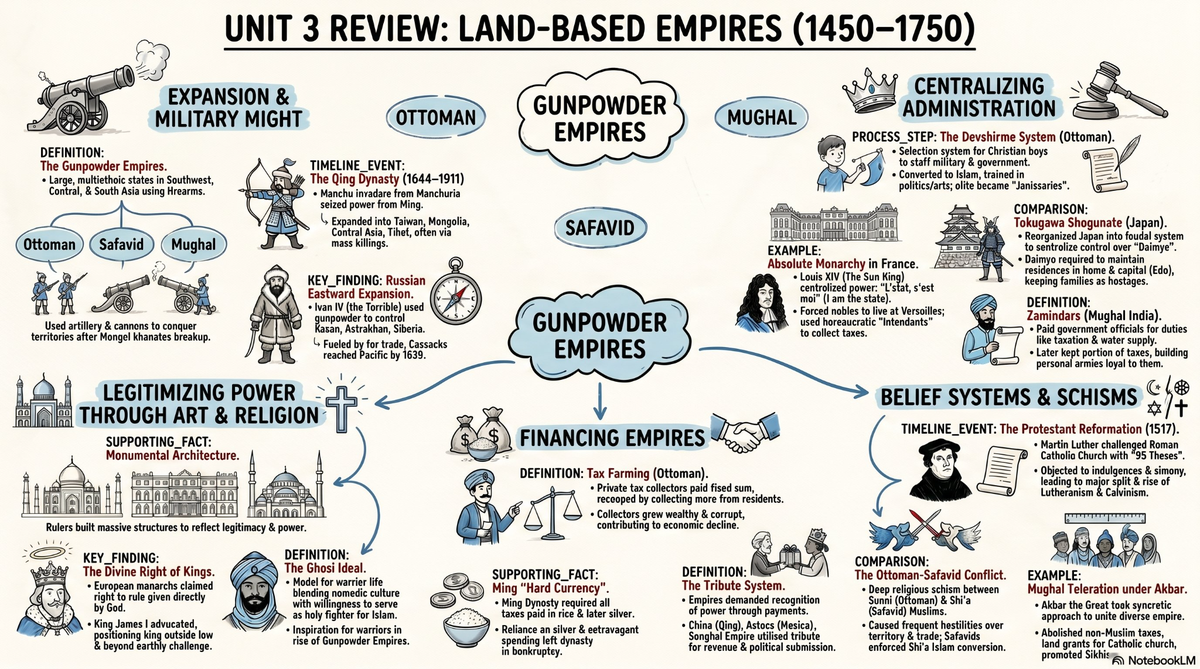
The basics
Time period: 1450–1750 CE (the early modern era)
Exam weight: About 12–15% of the AP World History exam (one of the most heavily weighted units)
The big question: How did rulers build and hold together massive territorial empires across the early modern world?
The major empires
Ottoman Empire
Sunni Islamic empire centered in Constantinople (after 1453). Used the devshirme system and Janissaries for military and administration; millet system for religious minorities.
Safavid Empire
Shia Muslim empire in Persia (Iran), 1501–1736. Made Shia Islam the state religion, creating the lasting Sunni–Shia divide with the Ottomans.
Mughal Empire
Muslim empire ruling most of India (1526–1857). Akbar promoted religious tolerance; later Aurangzeb reversed it. Famous for the Taj Mahal.
Qing Dynasty
Last imperial dynasty of China (1644–1912), led by the Manchu. Expanded territory and adopted Confucian bureaucracy while maintaining distinct Manchu identity.
Russia under the Romanovs
Expanded eastward across Siberia. Peter the Great westernized the army and government; Catherine the Great expanded territory further.
Tokugawa Japan
Centralized shogunate (1603–1868) that closed Japan to most foreign trade (sakoku) and enforced strict social hierarchy.
European Absolutism
Louis XIV of France ("L'état, c'est moi") epitomized divine-right absolutism. Spain, Austria, and Prussia built similar centralized monarchies.
Aztec & Inca (late)
Both empires existed at the start of this period and were conquered by Spain in the 1520s–30s — bridging Units 3 and 4.
The rulers you must know
- Suleiman the Magnificent — Ottoman sultan (r. 1520–66); the empire reached its peak under his elaborate legal and administrative reforms.
- Shah Abbas — Safavid ruler (r. 1588–1629) who modernized the army and made Isfahan a cultural capital.
- Akbar the Great — Mughal emperor (r. 1556–1605) who practiced religious tolerance and expanded the empire across India.
- Aurangzeb — Later Mughal emperor whose reversal of Akbar's tolerance and reimposition of jizya destabilized the empire.
- Kangxi & Qianlong — Qing emperors who expanded China to its greatest territorial extent and ruled with Confucian legitimacy.
- Louis XIV — French king (r. 1643–1715) who built Versailles and embodied divine-right absolutism.
- Peter the Great — Russian tsar who forcibly westernized Russian government, military, and culture.
Key themes to remember
- Gunpowder changed everything — Cannons and muskets let these empires conquer cavalry-based opponents and hold vast territories.
- Religion = legitimacy — Sultans, shahs, emperors, and kings all justified their rule in religious terms, but each in different ways.
- Diverse populations required creative governance — Millet system, sulh-i-kull, Confucian bureaucracy — no single model worked everywhere.
- Centralized power was the goal — From Versailles to Topkapi to the Forbidden City, rulers tried to concentrate authority.
- Religious conflict shaped Europe — The Protestant Reformation and Thirty Years' War reshaped European states and led to Westphalian sovereignty.
Common exam traps
- The Ottoman, Safavid, and Mughal empires are the "gunpowder empires" — but Qing China and even European monarchies belong in Unit 3 too.
- Akbar and Aurangzeb had opposite religious policies — don't confuse them. Akbar = tolerance; Aurangzeb = persecution.
- The Sunni–Shia divide wasn't new in this period, but the Ottoman–Safavid rivalry made it geopolitically central.
- Manchu vs. Han — the Qing were Manchu rulers of a mostly Han Chinese empire; they kept their identity while adopting Chinese systems.
- The Peace of Westphalia (1648) ended religious wars and established state sovereignty — the foundation of the modern state system.