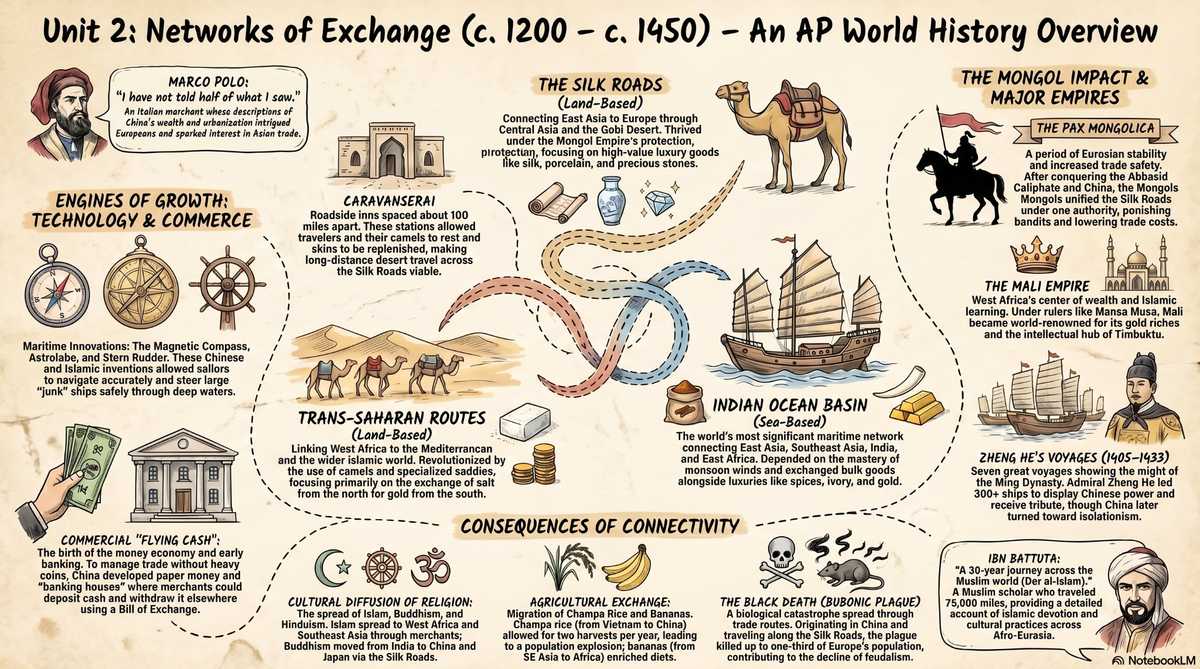
The basics
Time period: 1200–1450 CE (the post-classical era)
Exam weight: About 8–10% of the AP World History exam
The big question: How did trade networks reshape the medieval world — moving goods, religions, technologies, and diseases across vast distances?
The major trade networks
Silk Roads
Overland routes from China across Central Asia to the Mediterranean. Moved silk, porcelain, paper, gunpowder — and the Black Death. Boosted by the Pax Mongolica.
Indian Ocean Network
Maritime trade powered by monsoon winds. Connected East Africa, Arabia, India, and Southeast Asia. Spread Islam to Indonesia.
Trans-Saharan Trade
Camel caravans across the Sahara linking Mali and West Africa to North Africa and the Mediterranean. Moved gold north, salt south.
Mediterranean Trade
Italian city-states (Venice, Genoa) dominated; the Hanseatic League linked northern Europe. Connected Europe to the rest of the network.
The Mongol Empire
The largest contiguous empire ever. Created the Pax Mongolica, protected merchants, used the yam relay system for communication.
The Yuan Dynasty
Mongol-ruled China (1271–1368). Reopened Silk Road trade, welcomed Marco Polo, integrated China into the wider Mongol world.
Swahili Coast
East African city-states (Kilwa, Mombasa) that brokered African gold into Indian Ocean trade. Swahili culture blended Bantu and Arab.
The Mali Empire
Mansa Musa's gold fueled trans-Saharan trade. Timbuktu became a center of Islamic scholarship.
The travelers you must know
- Marco Polo — Venetian merchant who traveled to Kublai Khan's court in China; his book sparked European interest in Asia.
- Ibn Battuta — Moroccan Muslim who traveled ~75,000 miles across the Islamic world; recorded life in Mali, Kilwa, India, China.
- Rabban Bar Sauma — Nestorian Christian monk who traveled the opposite direction, from China to Rome and Paris.
- Margery Kempe — English mystic whose pilgrimages show European religious mobility within the network.
- Zheng He — Ming Dynasty admiral whose 1405–33 voyages projected Chinese power across the Indian Ocean.
Key themes to remember
- Trade networks moved more than goods — Religions, technologies, languages, crops, and diseases all traveled with merchants.
- The Mongols accelerated everything — They created the conditions for the most connected medieval world.
- Disease followed trade — The Black Death's path is a map of Eurasian trade routes.
- Islam spread through commerce — Sufi missionaries and Muslim merchants, not armies, brought Islam to West Africa and Southeast Asia.
- Connectivity had winners and losers — Some societies were enriched; others (like Baghdad in 1258) were devastated.
Common exam traps
- The Mongols destroyed AND connected — they're not just bad guys. Their conquests killed millions but also enabled the most connected medieval world.
- The Pax Mongolica doesn't mean the Mongols were peaceful — it means trade was peaceful under their protection.
- The Black Death came from Asia along trade routes — it's a consequence of connectivity, not just a European catastrophe.
- Don't confuse the Yuan Dynasty (Mongol rule of China) with later Chinese dynasties — it ended in 1368.
- Zheng He's voyages (1405–33) show Chinese maritime power BEFORE European exploration — chronology matters.