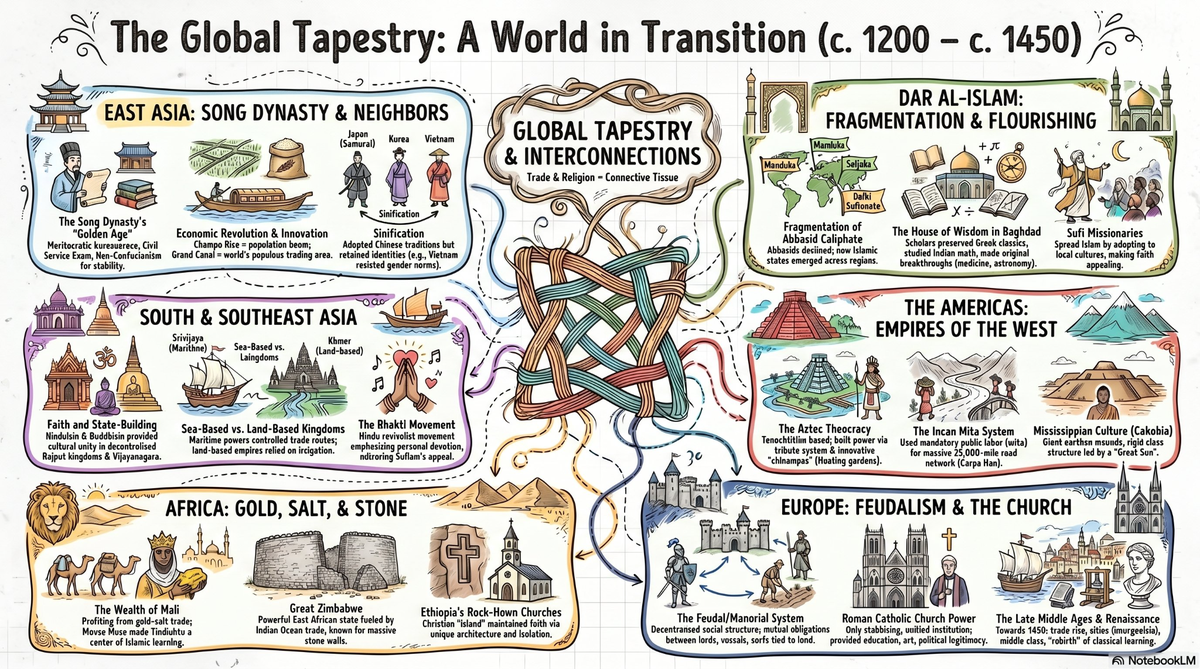
The basics
Time period: 1200–1450 CE (the post-classical era)
Exam weight: About 8–10% of the AP World History exam
The big question: How did different civilizations develop their own political, economic, and social systems before the world became globally connected?
Major civilizations by region
East Asia
Song Dynasty (China) — Tech powerhouse. Printing, gunpowder, compass, Champa rice. Neo-Confucianism revives.
Dar al-Islam
Abbasid Caliphate in decline, but Islamic culture, trade, and scholarship dominate from Spain to Southeast Asia.
South Asia
Delhi Sultanate spreads Islam into Hindu-majority India. Bhakti movement emphasizes personal devotion.
Southeast Asia
Khmer Empire (Angkor Wat), Srivijaya, and the spread of Hinduism, Buddhism, and Islam through trade.
Africa
Mali Empire — gold, salt, Mansa Musa's hajj. Swahili Coast — Indian Ocean trade cities. Great Zimbabwe in the south.
Europe
Byzantine Empire (Eastern Christianity), feudal Western Europe, growing trade cities in Italy and northern Europe.
Americas
Aztec/Mexica (Mesoamerica, tribute system), Inca (Andes, mit'a labor), Cahokia (North America).
Oceania
Polynesian navigators settle the Pacific using sophisticated wayfinding and outrigger canoes.
The 5 major belief systems
- Islam — Spreading rapidly through trade, conquest, and Sufi missionaries. Defining religion of the era.
- Christianity — Eastern Orthodox (Byzantine) and Roman Catholic (Western European) branches.
- Buddhism — Theravada in Southeast Asia, Mahayana in East Asia, Vajrayana in Tibet.
- Hinduism — Dominant in India; Bhakti movement makes it more accessible to all castes.
- Confucianism — Revived as Neo-Confucianism in Song China; reinforces social hierarchy.
Key themes to remember
- State building — Different civilizations used religion + bureaucracy + military to maintain order in different ways.
- Religion shapes everything — Law, gender roles, art, trade, political legitimacy.
- Technology drives growth — Champa rice, gunpowder, printing, the compass all start here.
- Patriarchy reinforced — Neo-Confucianism, foot binding, Islamic law, feudal obligation all subordinate women.
- Americas develop independently — Complex political and agricultural systems with no Afro-Eurasian contact.
Common exam traps
- Don't confuse the Song Dynasty (960–1279, before Mongols) with later Chinese dynasties.
- The Mongol Empire is technically Unit 2, but its rise begins late in Unit 1.
- Mansa Musa's pilgrimage was 1324 — he's Unit 1, not Unit 2.
- Remember the Aztec and Inca empires existed before Europeans — they're Unit 1.
- The Bhakti movement in India is about devotion replacing caste-based ritual, not a separate religion.