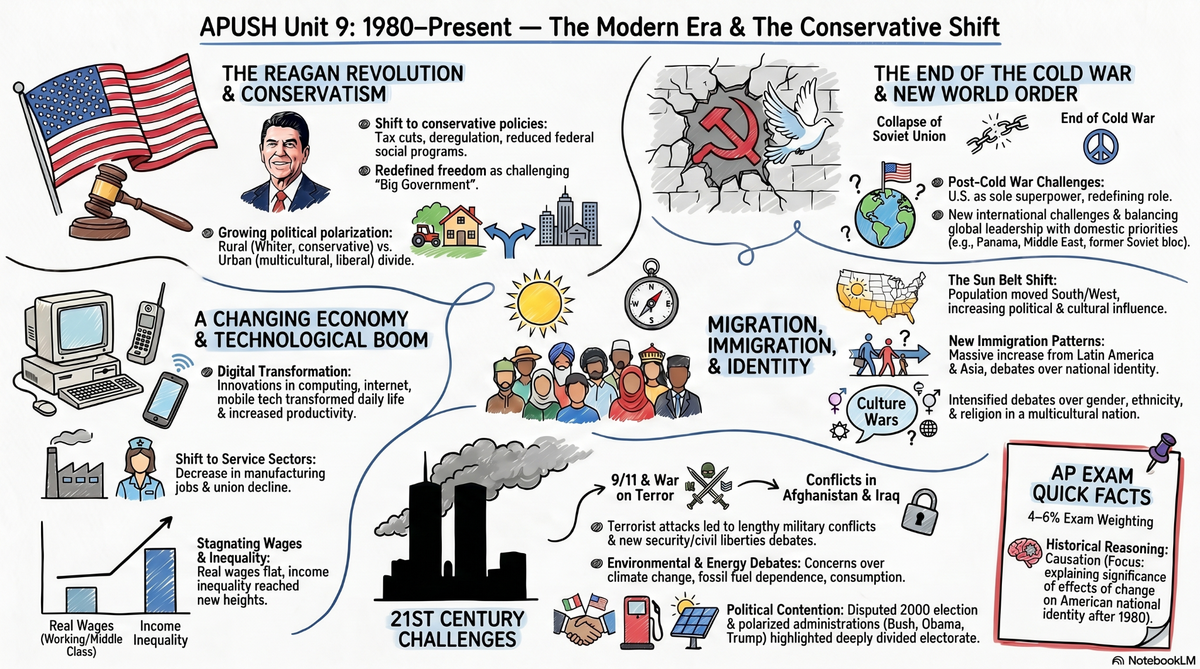
The basics
Time period: 1980–Present (the conservative revolution, the end of the Cold War, and globalization)
Exam weight: About 4–6% of the AP US History exam
The big question: How did the Reagan Revolution, the end of the Cold War, globalization, and 9/11 reshape America's economy, politics, and place in the world?
Key topics at a glance
Reagan & the New Right
Reagan's 1980 election ended New Deal liberalism; Reaganomics (supply-side, deregulation, tax cuts); the Moral Majority mobilized evangelicals.
End of the Cold War
Gorbachev's glasnost and perestroika; fall of the Berlin Wall (1989); Soviet collapse (1991) — left the U.S. as the world's sole superpower.
Globalization
NAFTA (1994), the WTO (1995), and the rise of multinational corporations integrated the U.S. into a global economy — boosting trade but accelerating outsourcing.
Digital Revolution
Personal computing, the internet (1990s), mobile phones (2000s), and social media transformed work, communication, and the economy — creating new tech giants.
Great Recession (2008)
Subprime mortgage collapse triggered the worst financial crisis since the Great Depression; led to TARP bailout and Obama's stimulus; exposed deep inequality.
9/11 & War on Terror
2001 al-Qaeda attacks killed ~3,000 Americans; led to invasions of Afghanistan (2001) and Iraq (2003); the PATRIOT Act expanded surveillance.
Demographic Change
The 1965 Immigration Act opened the door to Latino and Asian immigration; Hispanics became the largest U.S. minority by 2003; Sun Belt growth shifted political power.
21st Century Society
Obama's election (2008), the Affordable Care Act (2010), Obergefell v. Hodges (2015), Black Lives Matter, and the COVID-19 pandemic.
The key terms you must know
- Reagan Revolution — Conservative political shift from 1980; rejected New Deal liberalism for free markets, lower taxes, and traditional values.
- End of the Cold War (1991) — Soviet Union dissolved in December 1991, ending 45 years of U.S.-Soviet conflict.
- NAFTA (1994) — Free-trade agreement with Canada and Mexico; symbol of globalization's benefits and costs.
- September 11 Attacks (2001) — Al-Qaeda attacks transformed U.S. foreign and domestic policy; launched the War on Terror.
- Affordable Care Act (2010) — Obama's healthcare reform; the largest healthcare expansion since Medicare.
Key themes to remember
- Conservatism became the dominant political force after 1980 — Even Democrats (Clinton, Obama) shifted right on trade, deficits, and welfare.
- The end of the Cold War left the U.S. as the sole superpower — But also raised questions about how to use that power, especially after 9/11.
- Globalization brought prosperity and inequality — Stock market gains, tech wealth, and cheap goods coincided with manufacturing decline, stagnant wages, and the 2008 crisis.
- Immigration transformed American demographics — Latino and Asian populations grew dramatically; race and immigration became central political issues.
- Political polarization deepened — Partisan divides, Tea Party, Obama backlash, Trump's election, January 6th — the country grew more divided than at any time since the Civil War.
Common exam traps
- Reagan didn't single-handedly end the Cold War — Gorbachev's reforms, Soviet economic problems, and Eastern European revolutions all played critical roles. Don't credit only Reagan.
- NAFTA was bipartisan — Negotiated under George H.W. Bush, passed under Bill Clinton, supported by mainstream Republicans and Democrats. The backlash came later.
- The Iraq War (2003) wasn't about 9/11 — Bush's stated rationale was Saddam Hussein's alleged WMDs; the connection to 9/11 was disputed and the WMDs were never found.
- The Affordable Care Act is also known as Obamacare — Originally Republican-influenced (modeled partly on Romney's Massachusetts plan), but became deeply polarizing.
- Period 9 is only 4–6% of the exam — Smaller weight than Units 3–8, but Period 9 themes appear in broader thematic essays and continuity/change questions.