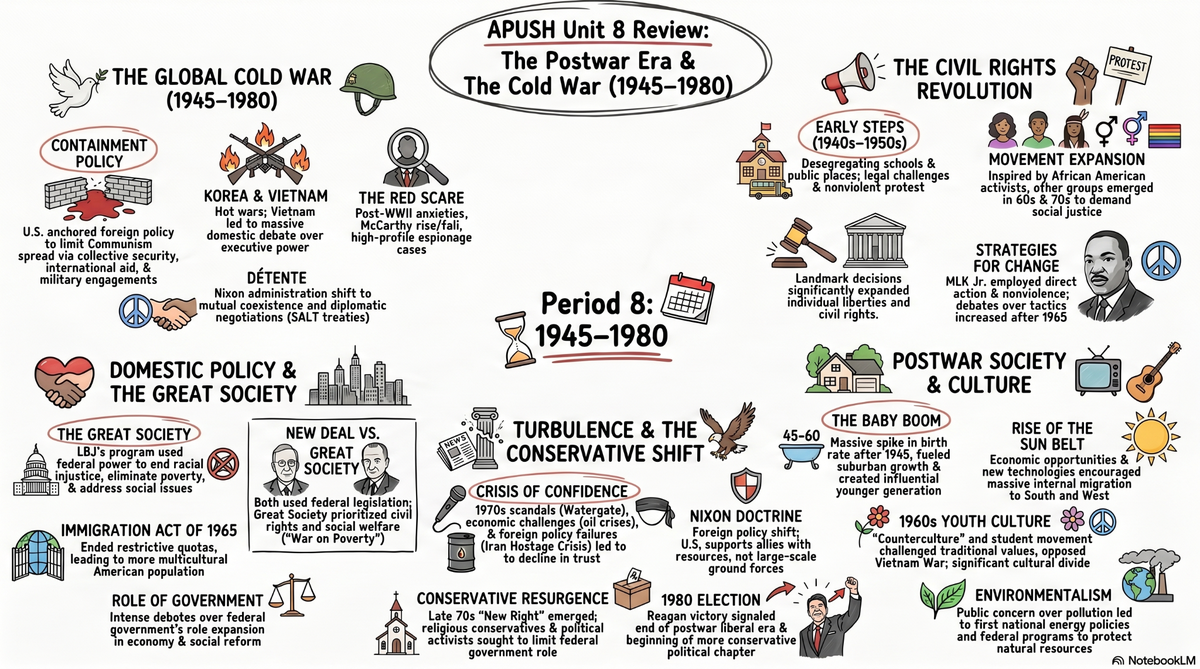
The basics
Time period: 1945–1980 (the Cold War era and the Civil Rights Movement)
Exam weight: About 10–17% of the AP US History exam
The big question: How did America navigate the Cold War abroad while transforming itself through the Civil Rights Movement and the Great Society at home?
Key topics at a glance
Origins of the Cold War
Containment (Kennan), the Truman Doctrine (1947), the Marshall Plan (1948), and NATO (1949) established America's permanent global engagement.
Korean War & Hot Wars
Korean War (1950–53) ended in stalemate at the 38th parallel; the Cold War would be fought through proxy wars, not direct U.SUSSR combat.
The Red Scare
McCarthyism (1950–54), HUAC, the Hollywood blacklist, and loyalty oaths defined anti-communist hysteria at home.
Postwar Boom
GI Bill, baby boom, Levittowns and suburbs, the Interstate Highway Act (1956), and consumer culture defined a prosperous middle class.
Civil Rights Movement
Brown v. Board (1954), Montgomery Bus Boycott (1955–56), MLK's nonviolent campaign, the Civil Rights Act (1964), and the Voting Rights Act (1965).
Vietnam War
The Gulf of Tonkin Resolution (1964), escalation under LBJ, the Tet Offensive (1968), antiwar protests, and Nixon's gradual withdrawal — 58,000 U.S. dead.
Great Society
LBJ's program created Medicare, Medicaid, Head Start, food stamps, and federal education aid — the biggest welfare expansion since the New Deal.
Crises of the 1970s
Watergate (1972–74), stagflation, the 1973 oil embargo, the Iran Hostage Crisis (1979–81) — destroyed trust in government.
The key terms you must know
- Containment — U.S. Cold War policy of stopping communism's spread (Kennan, Truman Doctrine).
- Brown v. Board of Education — 1954 Supreme Court ruling that ended legal school segregation.
- Civil Rights Act (1964) — Landmark law banning discrimination in employment and public accommodations.
- Great Society — LBJ's 1964–66 program creating Medicare, Medicaid, and the modern welfare state.
- Watergate — 1972–74 scandal forcing Nixon's resignation — the only U.S. president to resign.
Key themes to remember
- The Cold War shaped everything — Foreign policy, domestic anti-communism, the highway system, even the space program were all justified as Cold War necessities.
- The Civil Rights Movement worked through all three branches — Brown v. Board (courts), Civil Rights Act (Congress), and executive action (Eisenhower in Little Rock; LBJ on voting rights).
- The Great Society was the biggest welfare expansion since FDR — But Vietnam undermined funding and political support, and Reagan would later attack many of its programs.
- Vietnam destroyed liberal consensus — The war split Democrats, fueled antiwar protests, eroded trust in government, and shifted the country rightward.
- The 1970s set up the conservative revolution — Watergate, stagflation, Iran hostages, and energy crises convinced Americans that government couldn't solve problems — opening the door for Reagan.
Common exam traps
- Containment, NOT rollback — U.S. policy was to stop communism's spread, not roll it back. Eisenhower talked about rollback but practiced containment.
- Brown v. Board didn't immediately desegregate schools — "Massive resistance" delayed real integration for years; many Southern schools weren't actually integrated until the 1970s.
- The Civil Rights Movement included radicals AND moderates — Don't reduce it to MLK. Malcolm X, Stokely Carmichael, the Black Panthers, and the SNCC all played essential roles.
- The Tet Offensive was a military U.S. victory but a psychological defeat — The shock of seeing massive enemy attacks on TV — including in Saigon — turned the public against the war.
- The Great Society included Vietnam funding — LBJ tried to fight both "the war on poverty" and "the war in Vietnam." Vietnam's costs eventually starved Great Society programs.