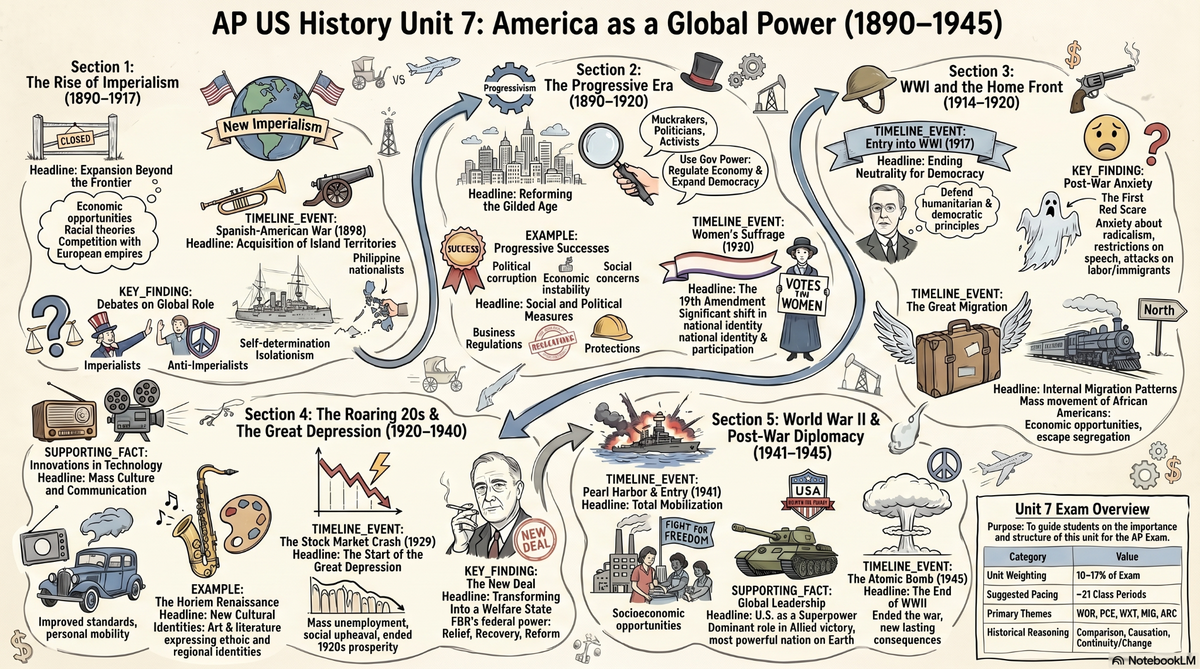
The basics
Time period: 1890–1945 (the rise of America as a global superpower)
Exam weight: About 10–17% of the AP US History exam
The big question: How did the U.S. transform from an isolated republic into a global superpower with an activist federal government — through reform, depression, and two world wars?
Key topics at a glance
Imperialism & the Spanish-American War
The Spanish-American War (1898) gave the U.S. Puerto Rico, Guam, the Philippines, and control of Cuba; the Open Door Policy secured access to China.
The Progressive Era
Muckrakers exposed abuses; Theodore Roosevelt's Square Deal busted trusts and regulated business; Constitutional amendments (16th income tax, 17th direct senate election, 18th Prohibition, 19th women's suffrage) transformed government.
World War I
Triggered by U-boats and the Zimmermann Telegram; Wilson's Fourteen Points shaped peace talks; Senate rejected the Treaty of Versailles and the League of Nations.
Red Scare & Nativism
Post-WWI Palmer Raids targeted suspected radicals; the National Origins Act (1924) drastically restricted immigration from Southern/Eastern Europe and banned most Asians.
The Roaring Twenties
The Harlem Renaissance, Prohibition, the Scopes Trial, jazz, flappers, consumer culture — but also the Klan's resurgence and intense cultural conflicts.
The Great Depression
The 1929 stock market crash triggered economic collapse; the Dust Bowl devastated the Plains; 25% unemployment; Hoover's response failed.
The New Deal
FDR's "3 R's" — Relief (CCC, WPA), Recovery (NIRA, AAA), Reform (Social Security, Wagner Act) — built the modern welfare state.
World War II
Pearl Harbor (Dec 7, 1941) brought the U.S. into the war; total mobilization ended the Depression; Japanese internment; atomic bombs on Hiroshima and Nagasaki ended the war.
The key terms you must know
- Progressivism — Early-1900s reform movement attacking industrial-era abuses; produced the 16th–19th Amendments and Theodore Roosevelt's Square Deal.
- Spanish-American War — 1898 war that made the U.S. a global empire (Puerto Rico, Guam, Philippines, Cuba).
- Treaty of Versailles — 1919 treaty Senate rejected because of opposition to the League of Nations; U.S. retreated to isolationism.
- New Deal — FDR's 1933+ program of Relief, Recovery, and Reform; built the modern welfare state via Social Security and labor protections.
- Pearl Harbor — Dec 7, 1941 Japanese attack that brought the U.S. into WWII and ended the Depression through wartime mobilization.
Key themes to remember
- The U.S. became a global superpower — From isolation to empire to world leader in 55 years; military, economic, and atomic dominance by 1945.
- Federal government expanded radically — Progressive amendments, WWI mobilization, New Deal alphabet agencies, WWII total mobilization — each phase enlarged Washington's role permanently.
- Reform succeeded — partially — Progressives won big victories (suffrage, income tax, direct elections) but failed on race relations and labor's full protection.
- Society modernized but conflicted — The 1920s clashed urban modernism against rural traditionalism; the Klan and the Harlem Renaissance both rose at once.
- War expanded opportunity, but unevenly — WWI and WWII opened factory jobs to women and Black Americans and fueled the Great Migration, but Jim Crow persisted and Japanese Americans were imprisoned even as the U.S. fought for freedom abroad.
Common exam traps
- The U.S. didn't enter WWI until 1917 — Wilson kept the U.S. neutral for nearly 3 years; the Zimmermann Telegram and unrestricted submarine warfare changed that.
- The League of Nations was Wilson's idea, but the U.S. didn't join — The Senate rejected the Treaty of Versailles largely because of the League.
- Prohibition was a constitutional amendment, not just a law — The 18th Amendment (1919) banned alcohol; only the 21st Amendment (1933) could repeal it.
- The New Deal didn't end the Depression — WWII did — Massive wartime spending finally returned full employment; the New Deal mitigated suffering but unemployment was still 14% in 1940.
- Japanese American internment included U.S. citizens — About two-thirds of the 120,000 interned were American citizens (Nisei); Korematsu v. U.S. (1944) shamefully upheld it.