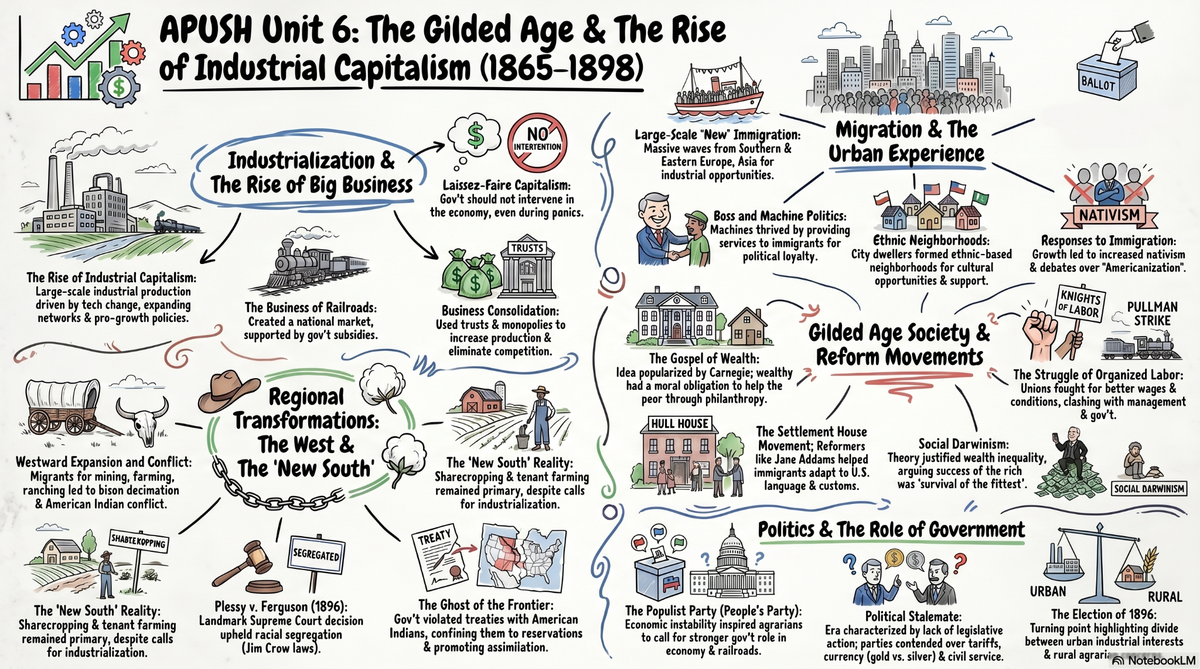
The basics
Time period: 1865–1898 (end of Reconstruction to the eve of the Spanish-American War)
Exam weight: About 10–17% of the AP US History exam
The big question: How did industrial capitalism transform American life — economically, socially, and politically — and how did Americans respond?
Key topics at a glance
Westward Expansion
Transcontinental Railroad (1869), the Homestead Act, mining and ranching booms, and millions migrating west — devastating Plains Native peoples.
Native America Crushed
Dawes Act (1887) broke up reservations to force assimilation; Battle of Wounded Knee (1890) marked the symbolic end of Native armed resistance.
The Second Industrial Revolution
Bessemer steel, electricity, the telephone, refrigerated railcars, skyscrapers — technology transformed American life and made the U.S. the world's largest economy.
Robber Barons & Trusts
Carnegie (steel), Rockefeller (oil), Morgan (banking), Vanderbilt (rail) used trusts and vertical/horizontal integration to build monopolies.
Social Darwinism & Gospel of Wealth
Sumner's Social Darwinism justified inequality; Carnegie's Gospel of Wealth urged philanthropy by the rich; laissez-faire dominated.
Labor Unrest
Knights of Labor (all workers) collapsed after the 1886 Haymarket Affair; AFL (Gompers, skilled workers) endured; Homestead (1892) and Pullman (1894) strikes were brutally suppressed.
New Immigration & Nativism
Southern and Eastern Europeans (Italians, Poles, Russian Jews) flooded cities; the Chinese Exclusion Act (1882) restricted Chinese immigration; settlement houses (Hull House) aided assimilation.
Populism & 1896 Election
People's Party demanded free silver, government ownership of railroads, income tax; Bryan's "Cross of Gold" speech energized but lost to McKinley.
The key terms you must know
- Transcontinental Railroad — 1869 completion bound the nation together and accelerated westward expansion and industrial growth.
- Robber Barons / Captains of Industry — Carnegie, Rockefeller, Morgan, Vanderbilt; titans of steel, oil, banking, and railroads.
- Trust — Rockefeller-pioneered business arrangement enabling one entity to control multiple corporations — creating monopolies.
- Haymarket Affair — 1886 bombing during Chicago labor rally; destroyed the Knights of Labor and tied unions to radicalism in public opinion.
- Populism — 1890s farmer-led movement (People's Party); demanded free silver, government ownership of railroads, income tax, direct election of senators.
Key themes to remember
- Industrial capitalism made America rich and unequal — The biggest wealth boom in history happened alongside the worst poverty, child labor, and corruption.
- Labor and Populism challenged laissez-faire — and lost — Unions and the People's Party demanded change, but Gilded Age courts, presidents, and police usually sided with capital.
- Immigration transformed American cities — Southern and Eastern Europeans, Asians, and Black Americans migrating north reshaped urban America — and sparked the first major federal immigration restrictions.
- Westward expansion destroyed Native life — The closing of the frontier, the Dawes Act, and Wounded Knee marked the violent end of Native autonomy on the Great Plains.
Common exam traps
- "Robber barons" and "captains of industry" are the same people — Just labeled differently depending on the writer's view. Both terms refer to Carnegie, Rockefeller, etc.
- The Sherman Antitrust Act was barely used against monopolies in the Gilded Age — It was used more against unions until Theodore Roosevelt revived it during the Progressive Era.
- Populism failed but its ideas succeeded — The People's Party died after 1896, but income tax (16th Amendment), direct senator election (17th), and railroad regulation all happened in the Progressive Era.
- The Dawes Act was assimilation policy, not Indian rights — It broke up tribal lands and tried to destroy Native culture. Don't confuse it with later, more genuine Indian rights efforts.
- The "Gilded Age" was Mark Twain's insult, not a compliment — Gilded means thinly gold-plated. Twain meant the era was rotten beneath a shiny surface.