The basics
Time period: 1844–1877 (Manifest Destiny through the end of Reconstruction)
Exam weight: About 10–17% of the AP US History exam
The big question: How did expansion and slavery cause the Civil War, and how successful was Reconstruction in remaking the nation?
Key topics at a glance
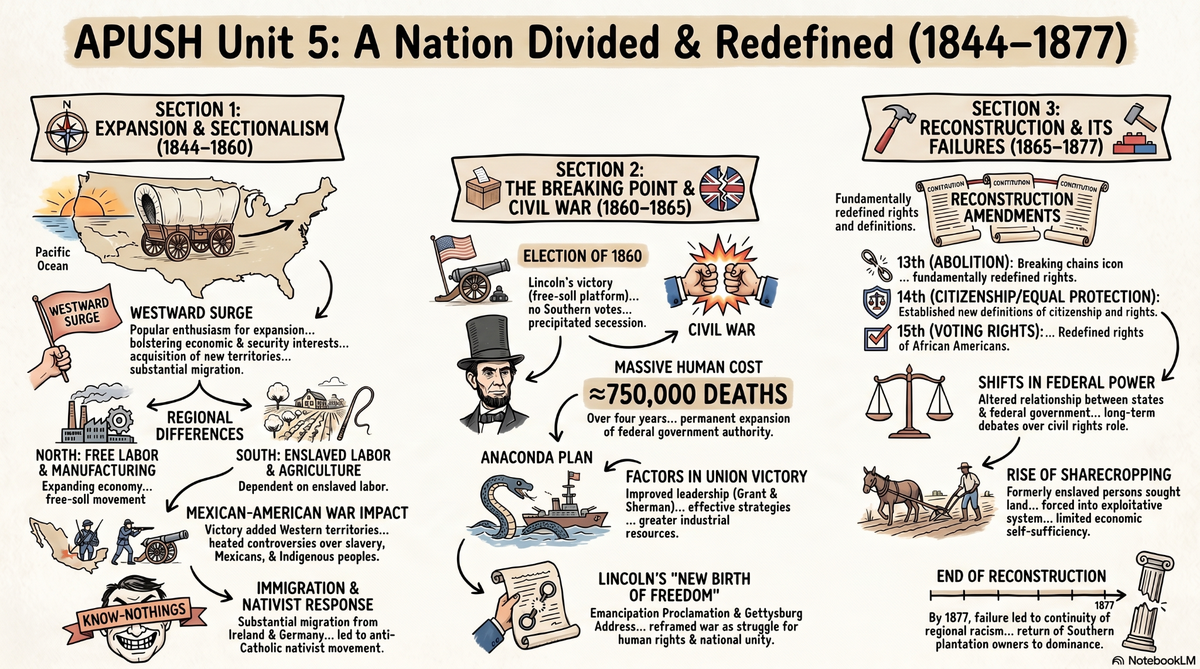
Manifest Destiny & Mexican-American War
O'Sullivan's 1845 idea that America was destined to span the continent; the Treaty of Guadalupe Hidalgo (1848) added California, Arizona, New Mexico, and more.
Compromise of 1850
Henry Clay's deal: California free, popular sovereignty in Utah/NM, no DC slave trade, harsh Fugitive Slave Act — temporary peace that radicalized Northerners.
Sectional Crisis
The Kansas-Nebraska Act (1854) shattered the Missouri Compromise; "Bleeding Kansas" brought guerrilla war; the Republican Party formed in opposition.
Dred Scott (1857)
Supreme Court ruled enslaved people were property, not citizens, and that Congress could not ban slavery in any territory — making compromise impossible.
1860 Election & Secession
Lincoln won without any Southern electoral votes; 11 Southern states seceded, beginning with South Carolina, forming the Confederate States of America.
The Civil War
Fort Sumter (1861), Antietam (1862), the Emancipation Proclamation (1863), Gettysburg (1863), Lee's surrender at Appomattox (1865).
Reconstruction
The 13th, 14th, and 15th Amendments ended slavery, granted citizenship, and protected Black male voting; the Freedmen's Bureau aided freedpeople.
Failure of Reconstruction
Black Codes, KKK violence, Supreme Court rollbacks, and the Compromise of 1877 ended federal occupation; sharecropping created near-slavery conditions.
The key terms you must know
- Manifest Destiny — 19th-century belief America was divinely ordained to span the continent; justified the Mexican-American War.
- Compromise of 1850 — Henry Clay's deal with California free, popular sovereignty in Utah/NM, and a harsh new Fugitive Slave Act.
- Kansas-Nebraska Act — 1854 law allowing popular sovereignty in those territories; repealed the Missouri Compromise and created the Republican Party.
- Emancipation Proclamation — Lincoln's January 1863 executive order freeing enslaved people in Confederate states; made ending slavery a war aim.
- Reconstruction Amendments — 13th abolished slavery, 14th guaranteed citizenship and equal protection, 15th protected Black men's voting rights.
Key themes to remember
- Expansion drove sectional conflict — Every new territory forced the slavery question. The Mexican Cession, Kansas, and California all triggered new battles.
- Compromise eventually failed — The system that managed slavery's expansion for 70 years broke down completely between 1850 and 1860.
- The war revolutionized federal power — Income tax, draft, national currency, Homestead Act, expanded executive power all began with the Civil War.
- The 14th Amendment redefined citizenship — All persons born in the U.S. became citizens with equal protection — a transformation whose full meaning the Civil Rights Movement would later complete.
- Reconstruction's failure shaped a century of race relations — The collapse of multiracial democracy in the South created the Jim Crow era that lasted until 1965.
Common exam traps
- The Civil War was about slavery — Don't say it was "about states' rights." Southerners themselves declared slavery the reason in their secession documents.
- The Emancipation Proclamation only freed slaves in Confederate states — Not in the border states or Union-controlled areas. Slavery legally ended with the 13th Amendment in December 1865.
- Lincoln didn't initially run on abolition — He pledged only to stop slavery's expansion, not to end it where it existed. The war transformed both Lincoln and the nation.
- Reconstruction didn't end with Lincoln's assassination — That just changed who led it. Reconstruction ran 1865–1877, and Congress (the Radical Republicans) drove most of it after 1866.
- Sharecropping wasn't the same as slavery — But it kept many freedpeople in debt and dependency. Be careful with the analogy on the exam.