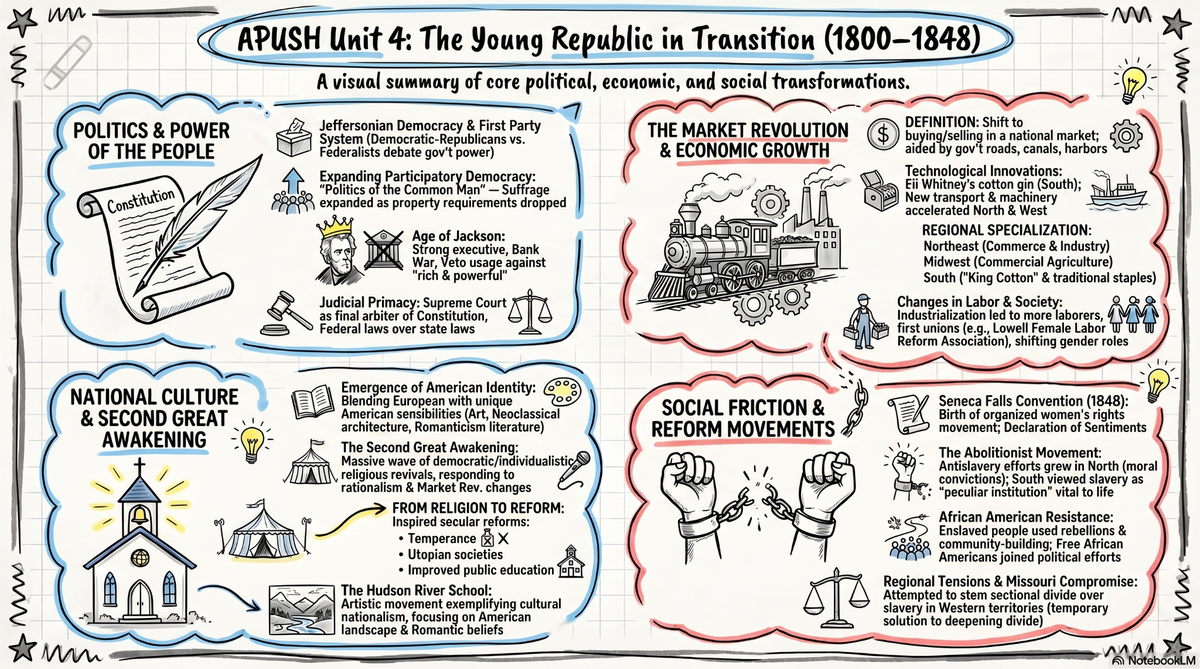
The basics
Time period: 1800–1848 (Jefferson's "Revolution of 1800" through the eve of the Mexican-American War)
Exam weight: About 10–17% of the AP US History exam
The big question: How did America transform — economically, politically, and socially — between Jefferson and Polk, and how did expansion and reform reshape national identity?
Key topics at a glance
Jeffersonian Era
Louisiana Purchase (1803) doubled U.S. size; Marbury v. Madison (1803) established judicial review; Lewis & Clark mapped the West.
War of 1812
Stalemate war against Britain over impressment and frontier issues; killed the Federalist Party (Hartford Convention) and produced surging American nationalism.
Monroe Doctrine (1823)
Declared European powers must stay out of the Western Hemisphere; established U.S. regional dominance and shaped foreign policy for a century.
Missouri Compromise (1820)
Henry Clay's deal: Missouri slave state + Maine free state + slavery banned north of 36°30'. Temporarily contained sectional tensions over slavery.
Market Revolution
Erie Canal, railroads, steamboats, the cotton gin, and factories tied the nation into a national market — but pushed regions in different directions.
Jacksonian Democracy
Universal white male suffrage, mass political parties, populism, the Bank War, and the Nullification Crisis defined Jackson's two terms (1829–37).
Indian Removal & Trail of Tears
1830 Indian Removal Act forced Native nations west of the Mississippi; the Cherokee Trail of Tears (1838–39) killed about 4,000 of 15,000 forced migrants.
Second Great Awakening & Reform
Religious revival sparked abolitionism, temperance, women's rights (Seneca Falls 1848), prison reform, and public education — built on the perfectibility of society.
The key terms you must know
- Louisiana Purchase — 1803 acquisition from France doubling U.S. size; constitutionally controversial but transformative.
- Marbury v. Madison — 1803 Supreme Court case establishing judicial review under Chief Justice John Marshall.
- Market Revolution — Early 1800s shift from local subsistence to a national market economy via canals, railroads, factories, and the cotton gin.
- Jacksonian Democracy — Era of universal white male suffrage, mass parties, populist appeal, and hostility to elite institutions.
- Seneca Falls Convention — 1848 first women's rights convention; the "Declaration of Sentiments" demanded women's equality including suffrage.
Key themes to remember
- The Market Revolution reshaped American life — Where you lived, what you did for work, and how families functioned all changed; men's market work and women's domestic sphere became distinct.
- Democracy expanded for white men, not others — Property requirements fell for white men, but women, free Black men, and Native Americans were explicitly excluded.
- The Second Great Awakening fueled reform — Religious revival's idea of human perfectibility inspired abolition, temperance, women's rights, and dozens of other movements.
- Slavery became more entrenched, not less — The cotton gin made slavery hugely profitable; the enslaved population grew from 700,000 (1790) to 4 million (1860); Southerners defended slavery as a "positive good."
- Regional differences hardened — Industrial North, cotton South, expanding West — three increasingly distinct sections heading toward conflict over slavery's expansion.
Common exam traps
- Democracy expanded only for white men — Don't claim universal suffrage. Women, free Black men, and Native Americans were excluded or actively disenfranchised.
- The Trail of Tears happened AFTER Worcester v. Georgia ruled FOR the Cherokee — Jackson defied the Supreme Court (or famously was said to: "John Marshall has made his decision, now let him enforce it").
- The Missouri Compromise didn't end the slavery debate — It only postponed it. Both sides came away convinced the other was conspiring against them.
- The Market Revolution didn't industrialize the South — Cotton kept the South agricultural and dependent on enslaved labor; only the North industrialized.
- Jacksonian populism wasn't progressive — Jackson was anti-bank and pro-common-white-man, but he was also pro-slavery and pursued violent Indian removal.