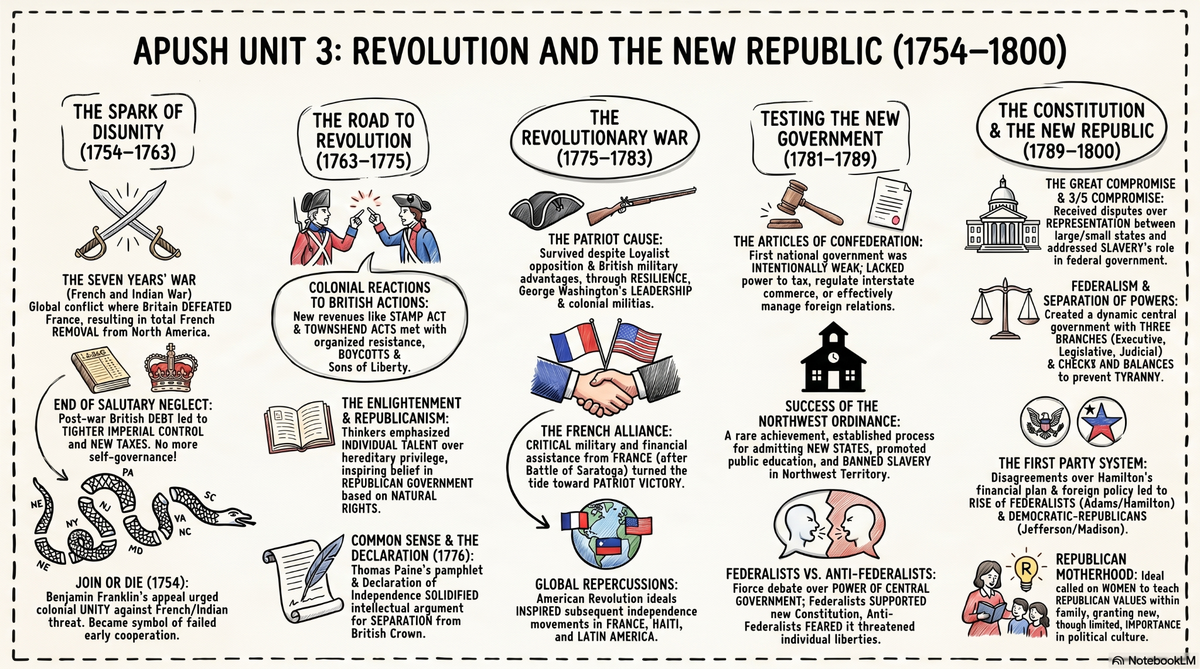
The basics
Time period: 1754–1800 (French and Indian War through Washington's Farewell)
Exam weight: About 10–17% of the AP US History exam
The big question: How did 13 colonies become a unified republic with a constitutional government, and what compromises shaped that government?
Key topics at a glance
French & Indian War (1754–1763)
British victory ended French power in North America but left massive debt; led to new taxes on colonists and the Proclamation of 1763 banning western settlement.
Road to Revolution
Stamp Act (1765), Townshend Acts (1767), Boston Massacre (1770), Boston Tea Party (1773), and the Intolerable Acts (1774) escalated tensions.
Declaration of Independence (1776)
Jefferson's document based on Locke's natural rights theory: all men created equal, government by consent, right to revolt against tyranny.
Revolutionary War
Key victory at Saratoga (1777) brought French alliance; Treaty of Paris (1783) recognized U.S. independence and granted territory to the Mississippi.
Articles of Confederation
First U.S. constitution (1781); weak central government couldn't tax or regulate commerce; Shays' Rebellion exposed its inadequacy.
The Constitution (1787)
Great Compromise (bicameral legislature) and Three-Fifths Compromise on slavery; Federalists vs. Anti-Federalists debated ratification.
Bill of Rights (1791)
First 10 amendments guarantee free speech, religion, due process, and other rights — added to satisfy Anti-Federalists.
Early Republic
Hamilton's Financial Plan (national bank, assumption of debts) created first political parties; Washington's Farewell Address warned against parties and foreign alliances.
The key terms you must know
- Declaration of Independence — Jefferson's 1776 document grounding independence in Locke's natural rights theory and consent of the governed.
- Articles of Confederation — First U.S. constitution (1781); weak federal government that couldn't tax or raise an army.
- Great Compromise — Created the bicameral Congress: House by population, Senate equal per state.
- Three-Fifths Compromise — Counted each enslaved person as 3/5 for representation and taxation; preserved slavery in the Constitution.
- Federalists vs. Anti-Federalists — Pro-Constitution (strong central government) vs. anti-Constitution (states' rights); Anti-Federalists demanded the Bill of Rights.
Key themes to remember
- Enlightenment ideas shaped the revolution — Locke's natural rights and consent theory provided the intellectual framework for independence.
- "No taxation without representation" was the rallying cry — Colonists were defending established self-government, not inventing new rights.
- The Articles failed; the Constitution succeeded — The first constitution couldn't tax, raise armies, or regulate commerce; the second one solved these problems through federalism and compromise.
- The Constitution preserved slavery — The Three-Fifths Compromise and the Slave Trade Clause embedded slavery into the founding document.
- Political parties emerged immediately — Federalists (Hamilton) and Democratic-Republicans (Jefferson) split over federal power, banking, and foreign policy.
Common exam traps
- The Declaration is not the Constitution — The Declaration (1776) explained why we left Britain; the Constitution (1787) created the U.S. government 11 years later.
- The Articles came BEFORE the Constitution — We had a federal government under them from 1781 to 1789.
- Federalists supported the Constitution — Don't confuse them with the later Federalist Party of Hamilton (though there's overlap).
- The Bill of Rights wasn't in the original Constitution — It was added in 1791 as the first 10 amendments to satisfy Anti-Federalists.
- Shays' Rebellion (1786–87) showed Articles' weakness; Whiskey Rebellion (1794) showed Constitution's strength — Don't confuse the two.