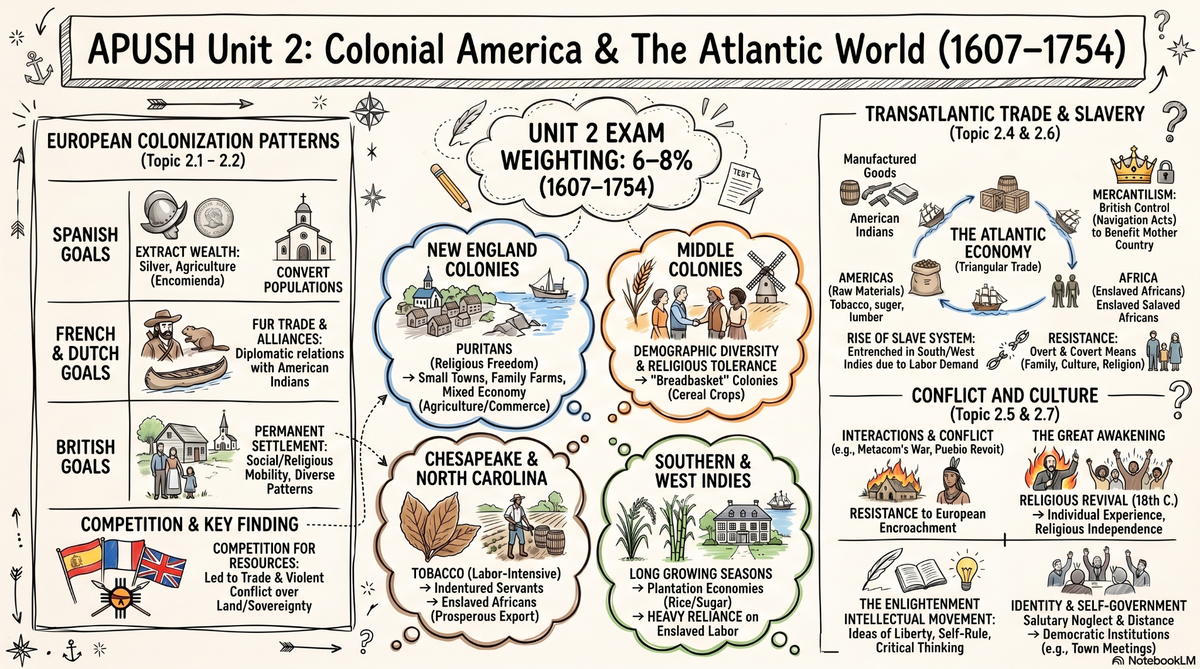
The basics
Time period: 1607–1754 (founding of Jamestown to the eve of the French and Indian War)
Exam weight: About 6–8% of the AP US History exam
The big question: How did English colonization develop three distinct regional societies, and how did labor systems and self-government evolve?
Key topics at a glance
Jamestown (1607)
First permanent English colony in Virginia; survived the Starving Time through tobacco cultivation; established the House of Burgesses in 1619.
New England Colonies
Puritan-dominated region of small farms, town meetings, fishing, and trade; founded as a 'city upon a hill' under John Winthrop.
Middle Colonies
Religiously diverse and tolerant; William Penn's Pennsylvania as a 'holy experiment'; wheat farming and the cities of New York and Philadelphia.
Chesapeake & Southern
Tobacco and rice plantations dependent on indentured servants then enslaved Africans; rigid social hierarchy.
Atlantic Slave Trade
Middle Passage brought millions of enslaved Africans to the Americas; mortality rates of 10–20%; foundational to Southern economies.
Bacon's Rebellion (1676)
Frontier settlers and former indentured servants vs. Virginia's elite; accelerated the shift from indentured servitude to racial slavery.
Mercantilism & Navigation Acts
Colonies existed to enrich England via raw materials and protected trade; salutary neglect meant loose enforcement and de facto self-government.
Great Awakening
1730s–40s religious revival led by Jonathan Edwards and George Whitefield; challenged established churches and unified the colonies in shared experience.
The key terms you must know
- House of Burgesses — First representative assembly in English America (1619, Virginia); set the precedent for colonial self-government.
- Mayflower Compact — 1620 agreement among Pilgrims establishing self-government in Plymouth — an early consent-based document.
- Indentured servitude — Labor contracts of 4–7 years exchanged for passage to America; the original Chesapeake labor system.
- Slave codes — Colonial laws (starting Virginia, 1660s) defining slavery as racial and hereditary, codifying lifelong subjugation.
- Salutary neglect — Britain's pre-1763 policy of loose enforcement that gave colonies de facto self-government.
Key themes to remember
- Geography shaped society — Climate, soil, and resources created different economies (commerce/family farms in New England, plantations in the South).
- Race-based slavery became permanent — Indentured servitude gave way to lifelong, hereditary slavery after Bacon's Rebellion (1676).
- Colonial self-government grew during salutary neglect — Assemblies became accustomed to controlling taxation and local affairs.
- Religious and intellectual revivals reshaped identity — The Great Awakening and Enlightenment ideas spread across colonies.
- Atlantic trade tied the colonies together — Triangular trade integrated New England merchants, Southern planters, and African slavers into one Atlantic economy.
Common exam traps
- Don't confuse Pilgrims and Puritans — Pilgrims (Plymouth, 1620) were Separatists; Puritans (Massachusetts Bay, 1630) wanted to reform the Church of England from within.
- Bacon's Rebellion is about class, not just race — It was poor frontier settlers vs. the planter elite, and its aftermath shifted Virginia toward racial slavery.
- The Middle Colonies are the most diverse — Don't assume all colonies were uniformly English; Pennsylvania, New York, and New Jersey had Germans, Dutch, Scots-Irish, and Quakers.
- Mercantilism isn't the same as capitalism — Mercantilism saw wealth as a fixed pie; colonies existed to enrich the mother country, not free trade.
- The Great Awakening was emotional, not Enlightenment — It emphasized personal conversion and emotion, distinct from rational Enlightenment thinking that arose alongside it.