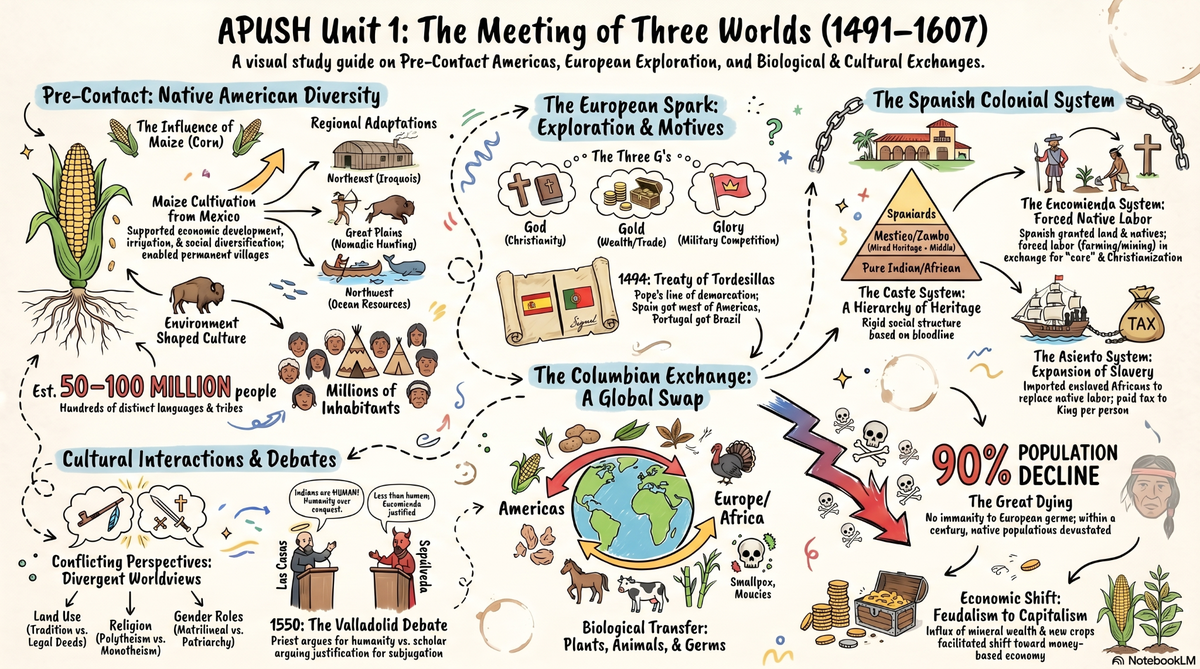
The basics
Time period: 1491–1607 (contact and early colonization)
Exam weight: About 4–6% of the AP US History exam
The big question: How did contact between Europe, Africa, and the Americas after 1492 transform all three continents?
Key topics at a glance
Pre-Columbian Americas
Maya, Aztec/Mexica, Inca in Mesoamerica and the Andes; Mississippian, Pueblo, Iroquois in North America. Sophisticated, diverse civilizations.
Motives for Exploration
The "3 G's": God, Glory, Gold. Spreading Christianity, national/personal honor, and the search for wealth drove European voyages.
Columbus & 1492
Columbus's voyage opened permanent contact between the hemispheres, launching the Columbian Exchange and centuries of colonization.
The Columbian Exchange
Transfer of plants, animals, people, and disease between hemispheres. Devastating epidemics; transformative new crops worldwide.
Spanish Colonization
Conquistadors conquer the Aztec and Inca. The encomienda system extracts forced Indigenous labor; the casta hierarchy organizes society.
Demographic Catastrophe
European diseases (smallpox, measles) killed an estimated 50–90% of Indigenous Americans — one of history's greatest demographic collapses.
Labor Systems
As Indigenous populations collapsed, Europeans turned to the African slave trade, beginning the forced migration that would define later periods.
Colonial Models
Spain: conquest & extraction. France: fur trade & Indigenous alliances. England: settlement colonies displacing Native peoples.
The key terms you must know
- Columbian Exchange — Transfer of plants, animals, disease, and people between Eastern and Western Hemispheres after 1492.
- Encomienda system — Spanish labor system granting colonizers the right to extract labor and tribute from Indigenous peoples.
- Conquistadors — Spanish conquerors (Cortés, Pizarro) who toppled the Aztec and Inca empires through force, alliances, and disease.
- Casta system — Spanish colonial racial hierarchy, with peninsulares at the top and Indigenous and enslaved Africans at the bottom.
- Joint-stock company — Business pooling investor capital to fund colonial ventures (e.g., the Virginia Company), spreading financial risk.
Key themes to remember
- Contact transformed everyone — The Columbian Exchange reshaped diets, economies, and populations on every continent.
- Disease was the deadliest weapon — Biological catastrophe, not just military force, enabled European conquest.
- Labor systems evolved — From the encomienda to Indigenous slavery to the African slave trade as Native populations collapsed.
- Colonizers differed — Spanish extraction, French trade alliances, and English settlement created very different societies.
- Resistance was constant — Indigenous peoples resisted through revolt (Pueblo Revolt), adaptation, and cultural survival.
Common exam traps
- Don't call the Americas a "New World" uncritically — it reflects European perspective, not the reality of diverse, established civilizations.
- The Columbian Exchange went both ways — remember crops moving to Europe (potatoes, maize) and to the Americas (horses, wheat, pigs).
- Disease, not just weapons, drove the demographic collapse — this is the most-tested cause of conquest.
- Know the differences between Spanish, French, and English colonization — comparison questions are very common.
- The Pueblo Revolt (1680) shows Indigenous resistance succeeded, at least temporarily — don't portray Native peoples as passive.