AP World History AP Human Geography AP US History Start studying free →
🌍 AP Human Geography

Your complete
AP Human Geography guide

All 7 College Board units covered — podcast episodes, flashcards, essential terms, unit Cheat Sheets, and visual reviews for every key concept.

7 units covered
7 resource types per unit
College Board aligned
Free for all students
Each unit includes: 🗺 Cheat Sheet The Essentials 🎨 Visual Reviews 🗂 Flashcards 🎙 Podcast ✍️ FRQ Practice📝 MC Practice
1
Unit 1

Thinking Geographically

Foundational concepts · approx. 8–10% of exam
🎙

Unit 1: Thinking Geographically

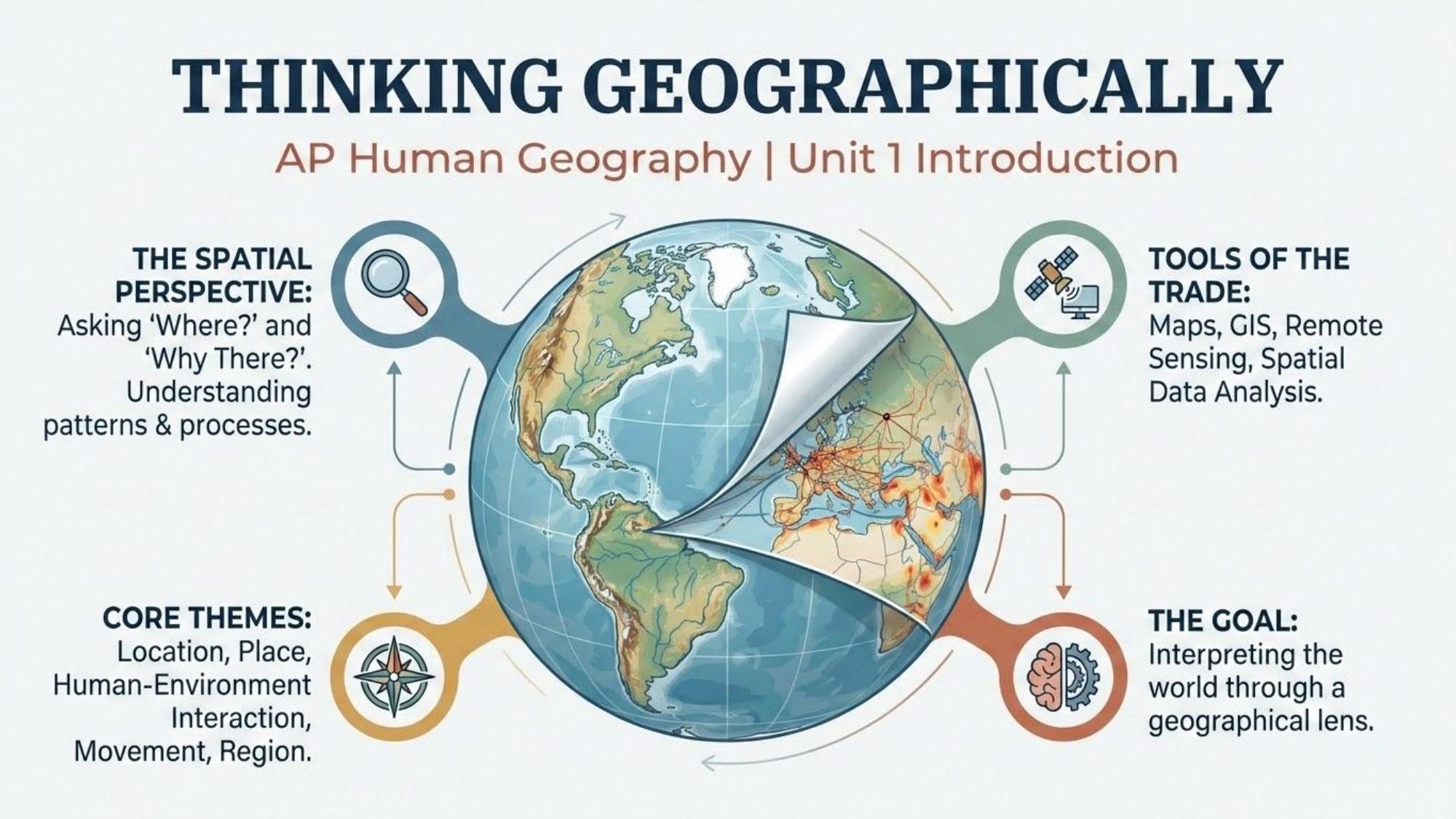
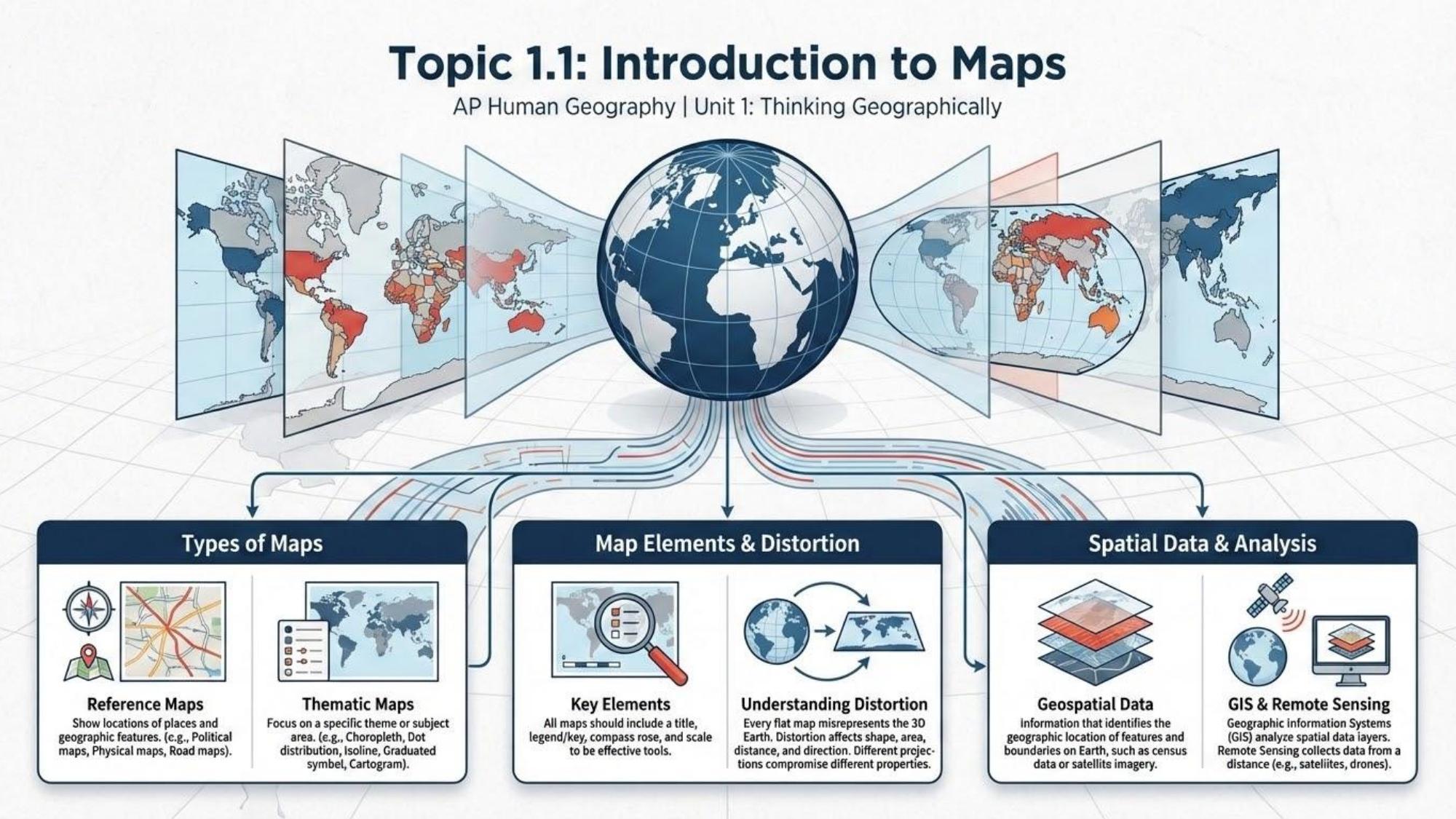
Maps, geographic data, spatial patterns, and the tools geographers use to analyze the world.

🎙 Episode 1  ·  23:47
0:0023:47
Question
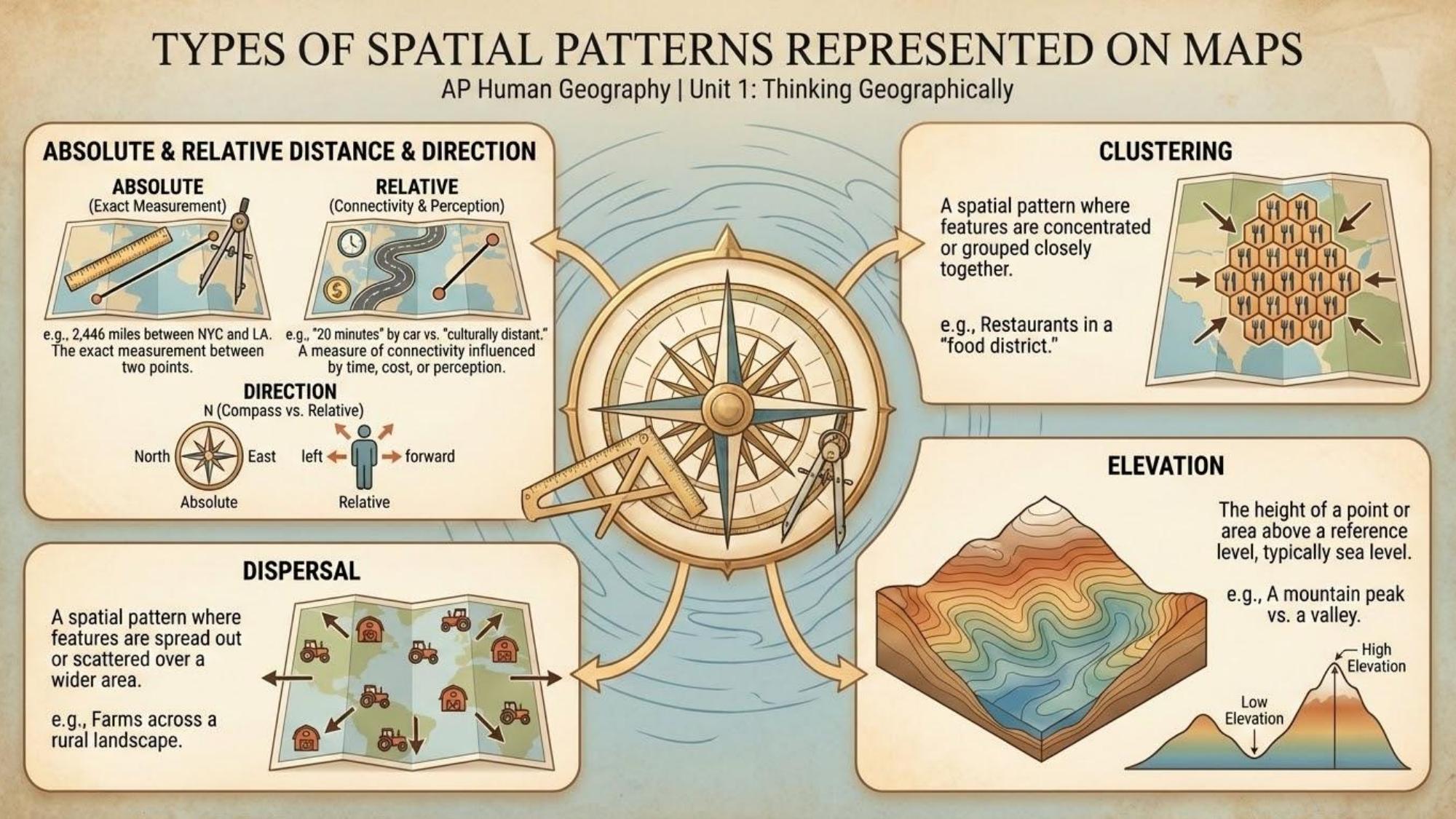
What is the difference between absolute and relative location?
Unit 1 · Thinking Geographically
tap to flip
Answer
Absolute location gives an exact position using coordinates (latitude/longitude). Relative location describes a place in relation to other places (e.g., "north of the river").
Card 1 of 12
Question 1 of 5 Score: 0/5
Absolute Location
Exact position on Earth using a coordinate system such as latitude and longitude.
Geographic Concepts
Relative Location
Position of a place in relation to other places or features.
Geographic Concepts
Sense of Place
Subjective feelings and emotional attachments people have toward a location.
Place & Space
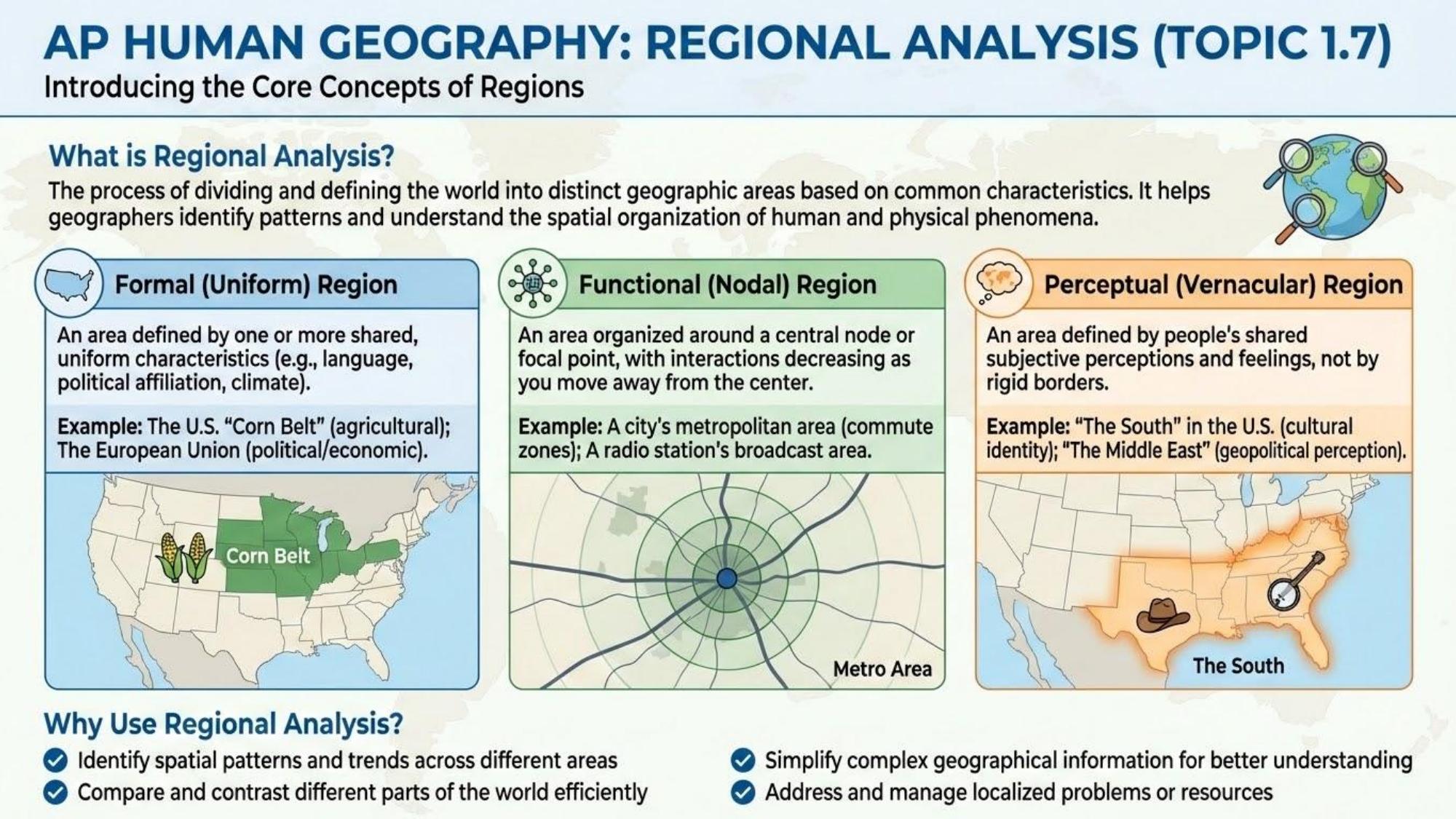
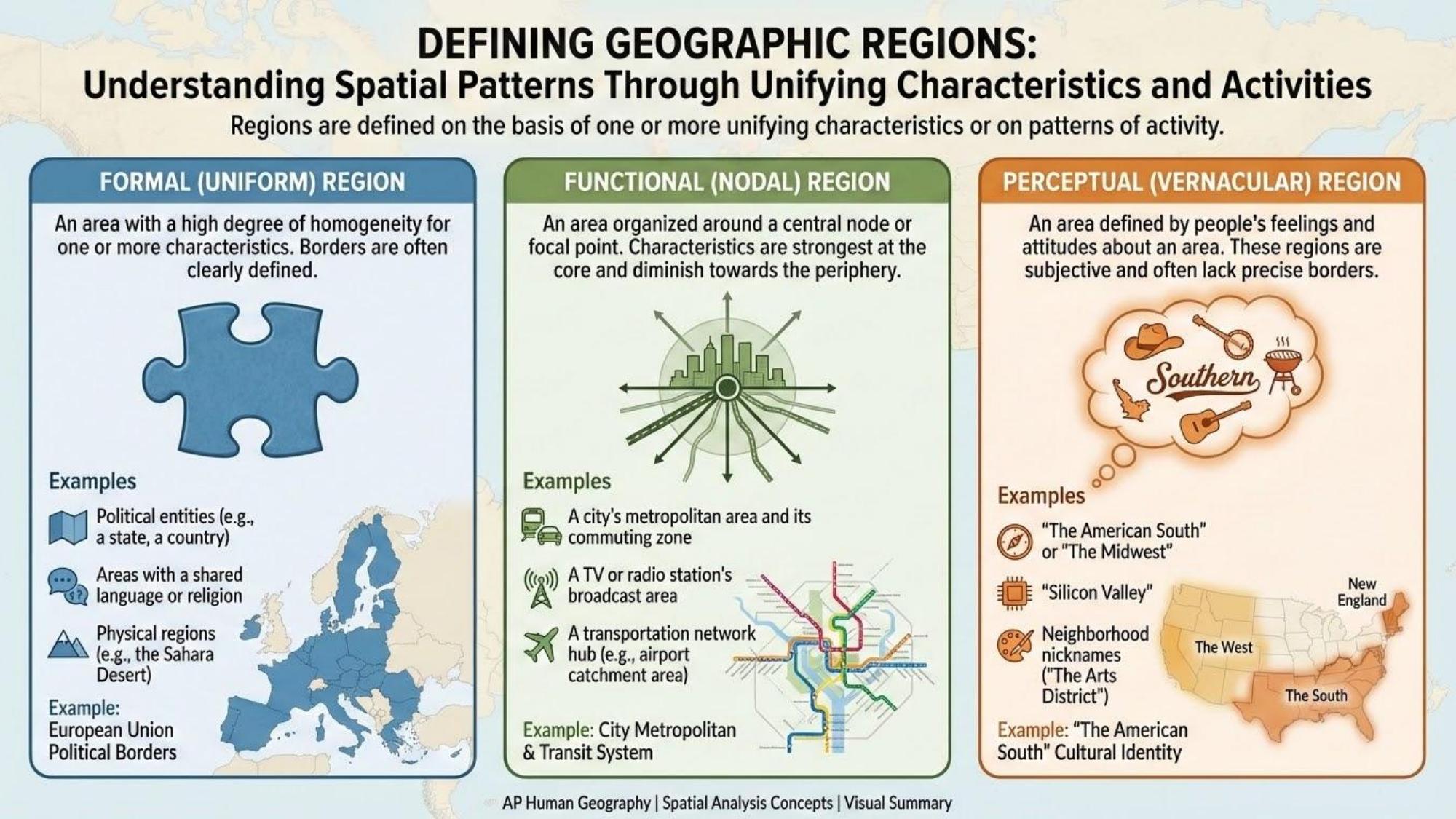
Region
Area sharing one or more common characteristics — formal, functional, or vernacular.
Geographic Concepts
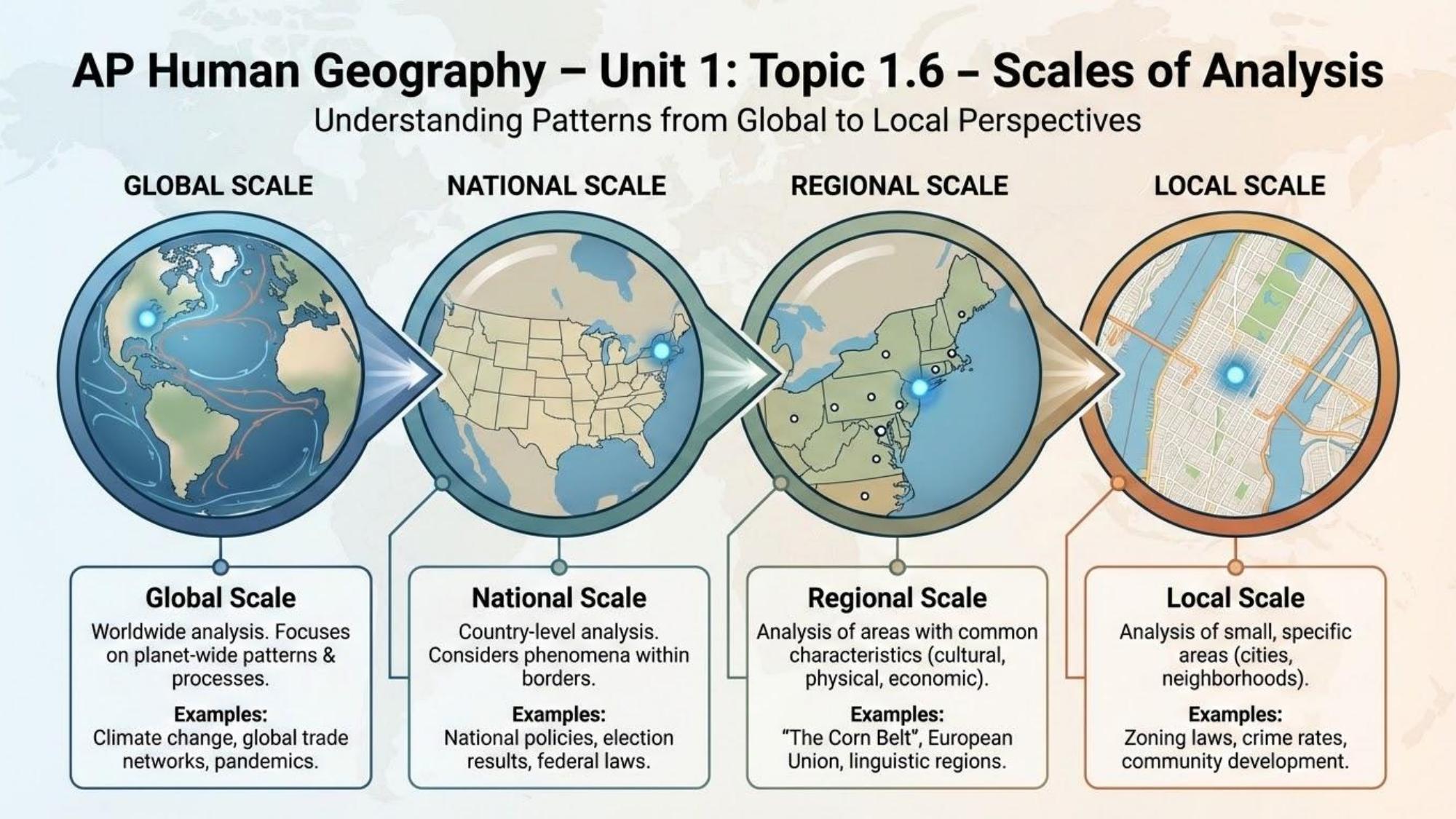
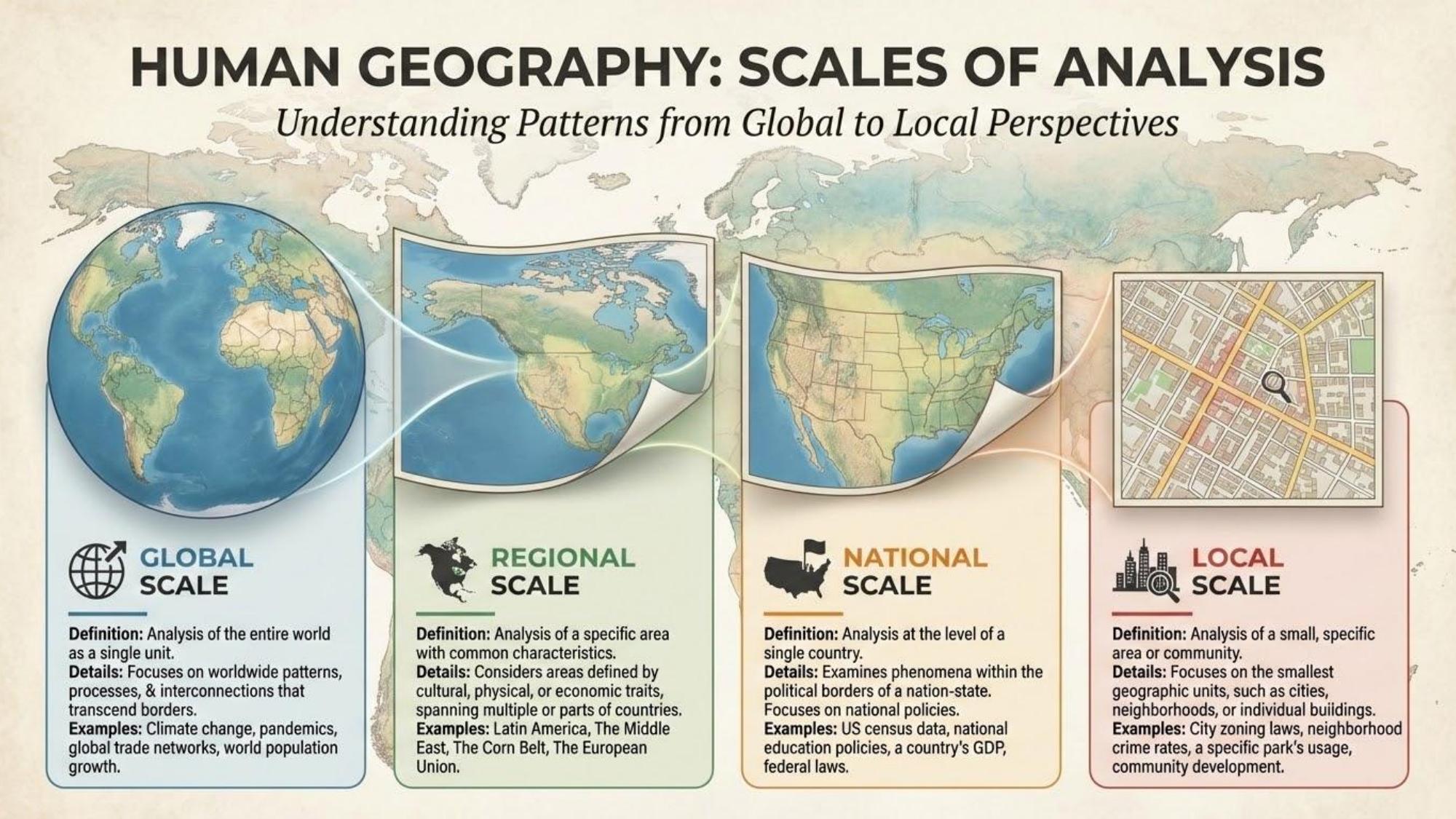
Scale of Analysis
The level (local, national, global) at which geographic phenomena are examined.
Geographic Tools
GIS (Geographic Information System)
Computer system for storing, analyzing, and displaying geographic data in layered maps.
Geographic Tools
Remote Sensing
Collecting data about Earth's surface from satellites or aircraft without direct contact.
Geographic Tools
GPS (Global Positioning System)
Satellite-based navigation system that provides precise location data.
Geographic Tools
Spatial Distribution
The arrangement of phenomena across Earth's surface; described by density, concentration, and pattern.
Spatial Concepts
Distance Decay
The decrease in interaction between two places as the distance between them increases.
Spatial Concepts
Diffusion
The spread of an idea, innovation, or cultural practice from its origin to other locations.
Spatial Concepts
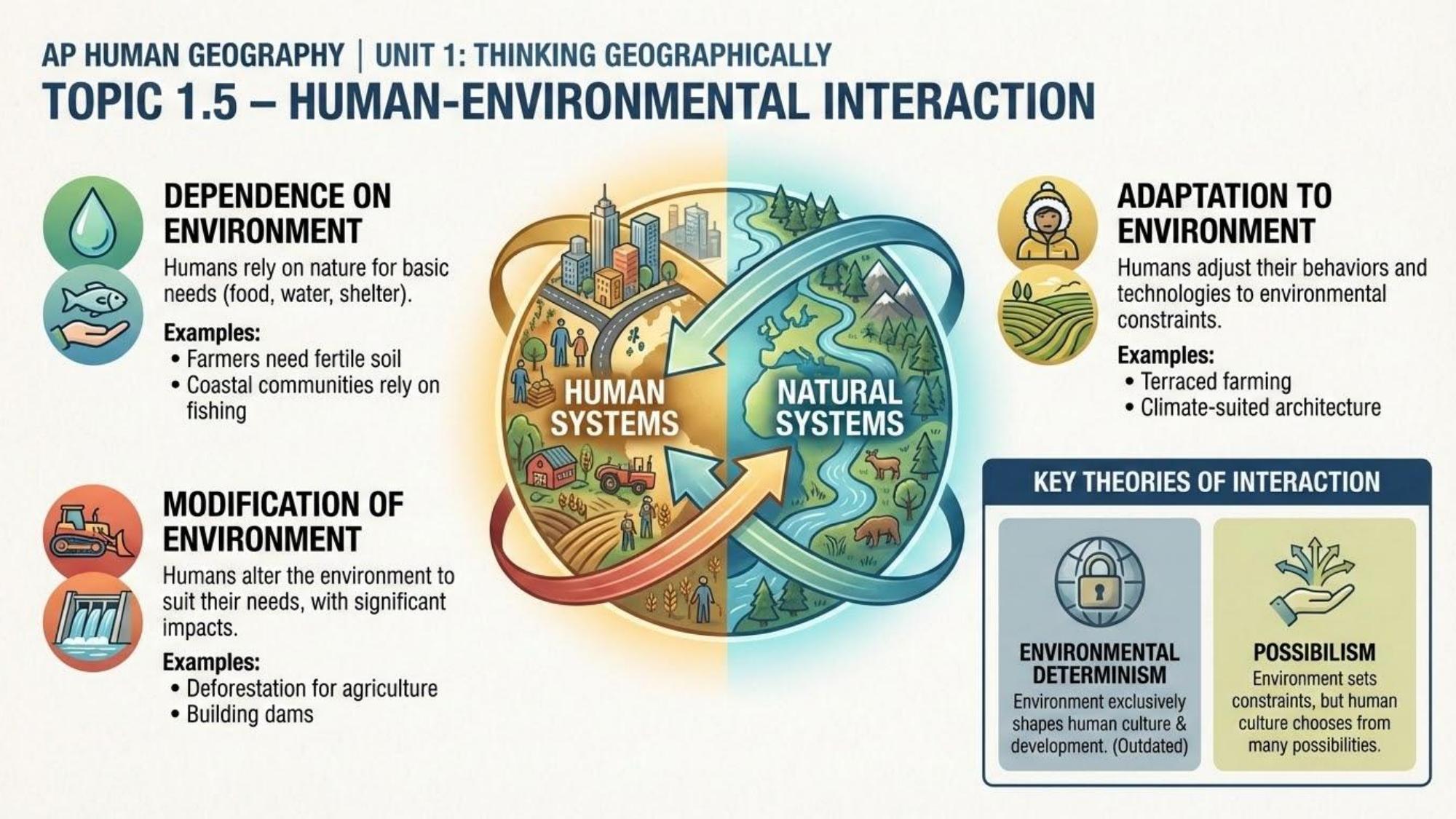
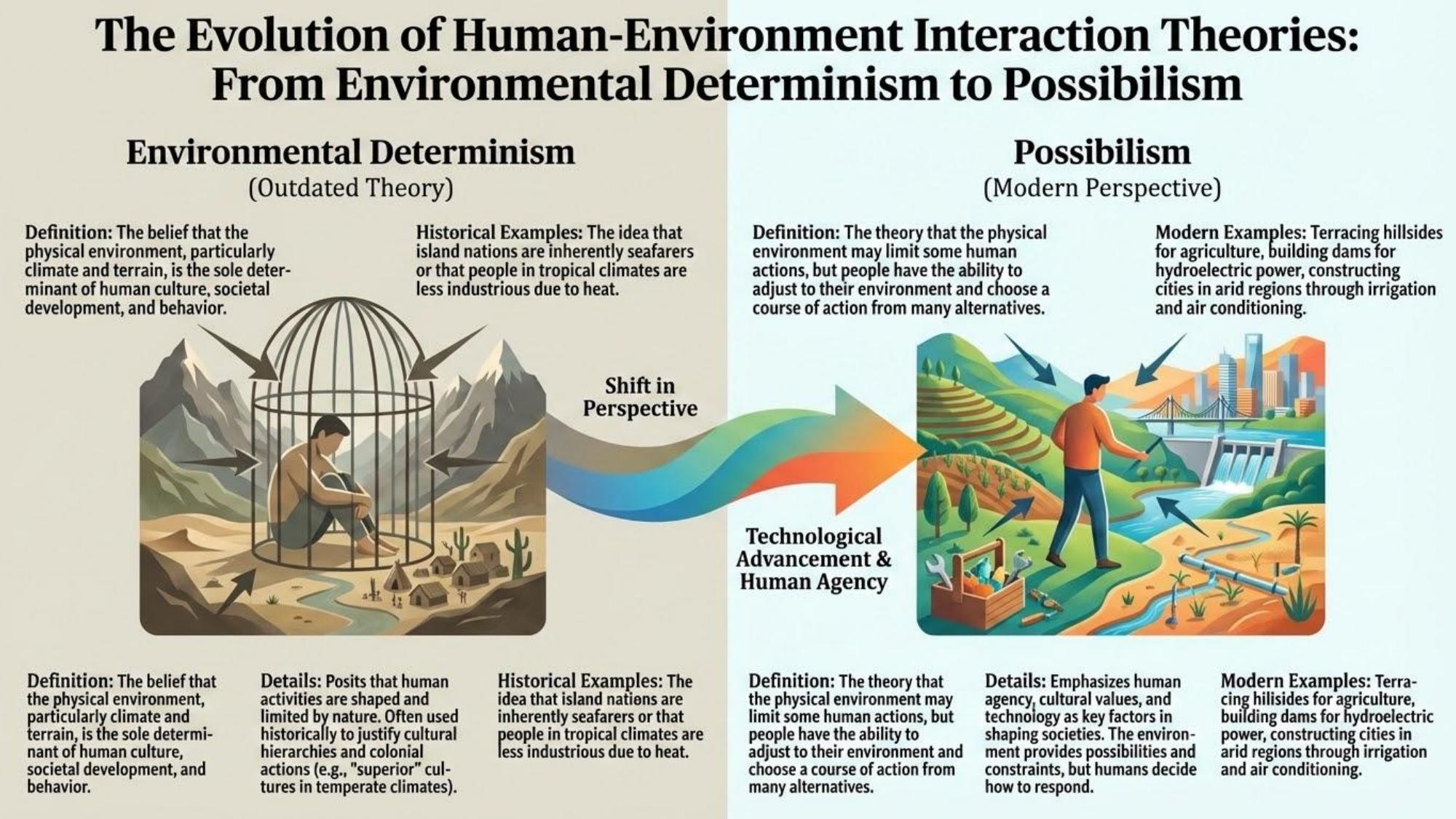
Environmental Determinism
Discredited theory that the physical environment controls human behavior and development.
Theories
Possibilism
Theory that the environment limits but does not determine human action — humans adapt and choose.
Theories
Cartogram
Map that distorts geographic area proportionally to a variable such as population or GDP.
Geographic Tools
Big Idea 1
Geographers study where things are and why they are there
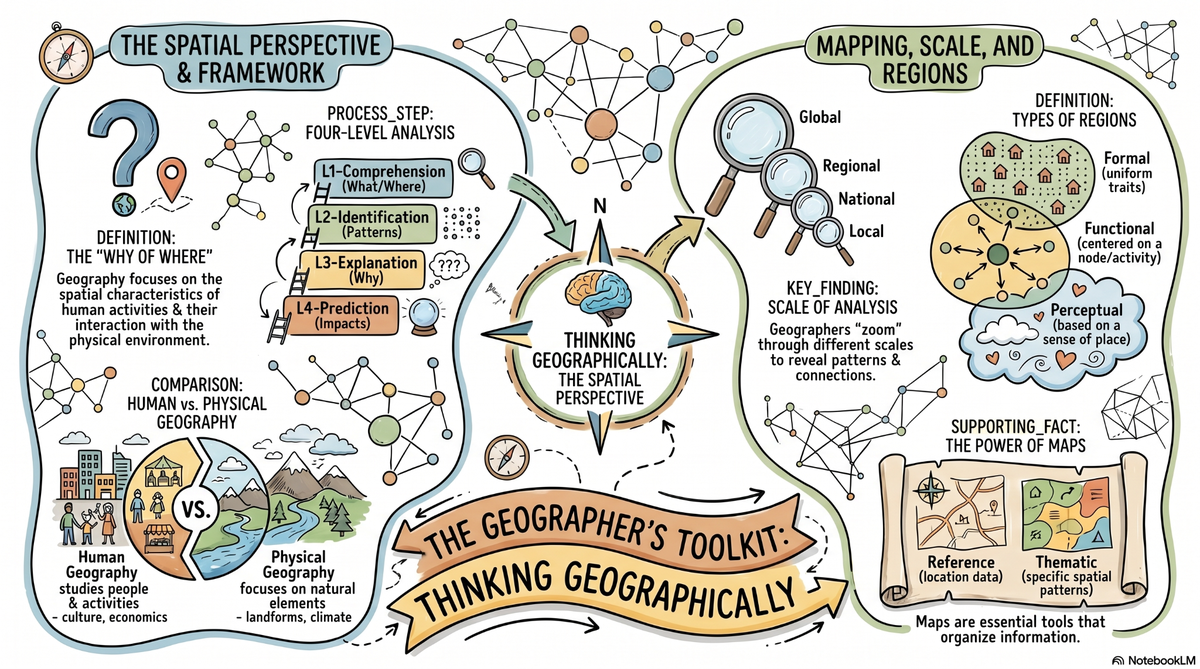
Geography is fundamentally about spatial thinking — understanding why phenomena are located where they are, how they are distributed, and how location affects human and physical systems. Every AP Human Geography question ultimately asks you to think spatially.
Spatial Thinking Location Pattern
Big Idea 2
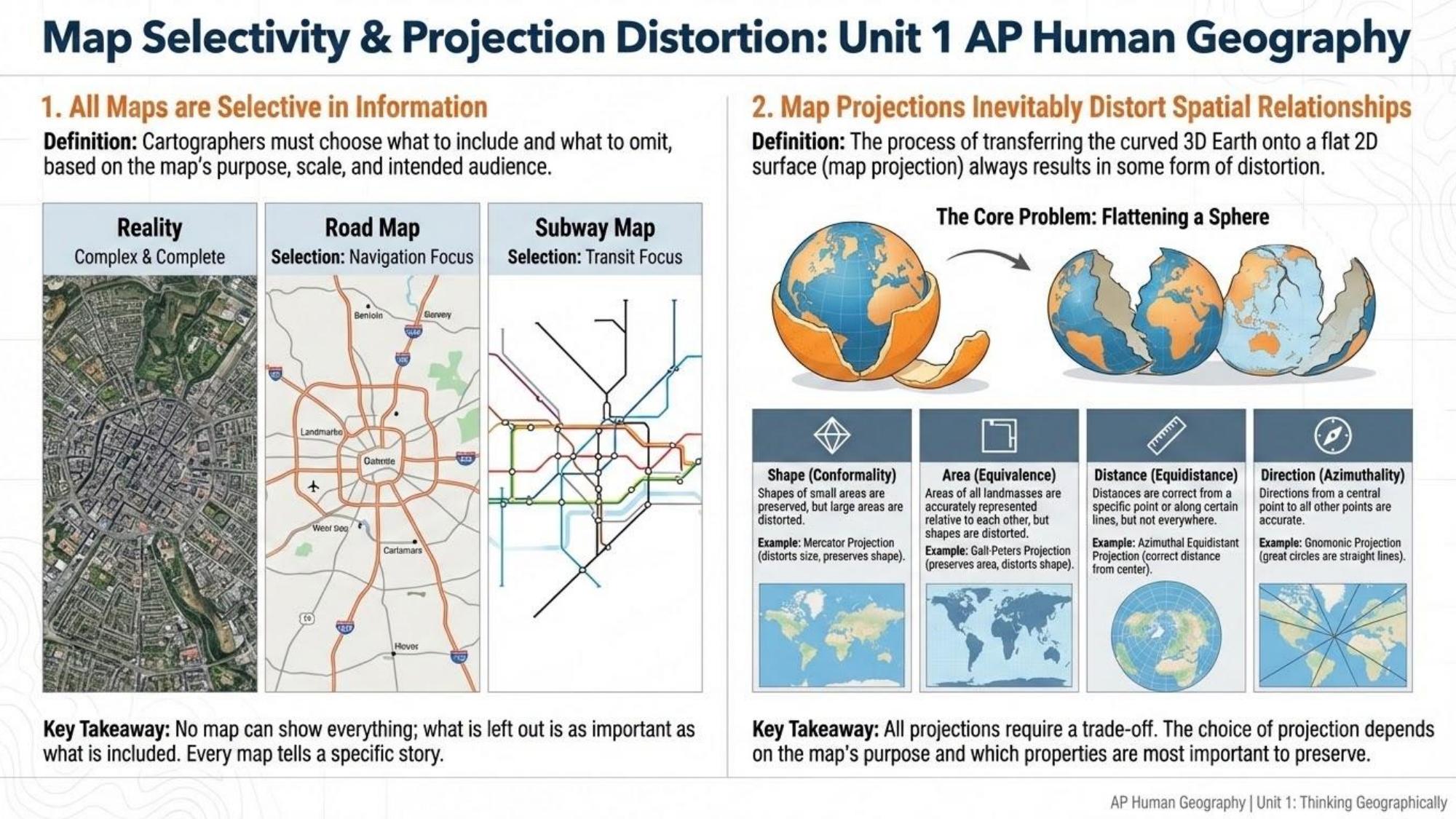
Maps are powerful tools — and powerful distortions
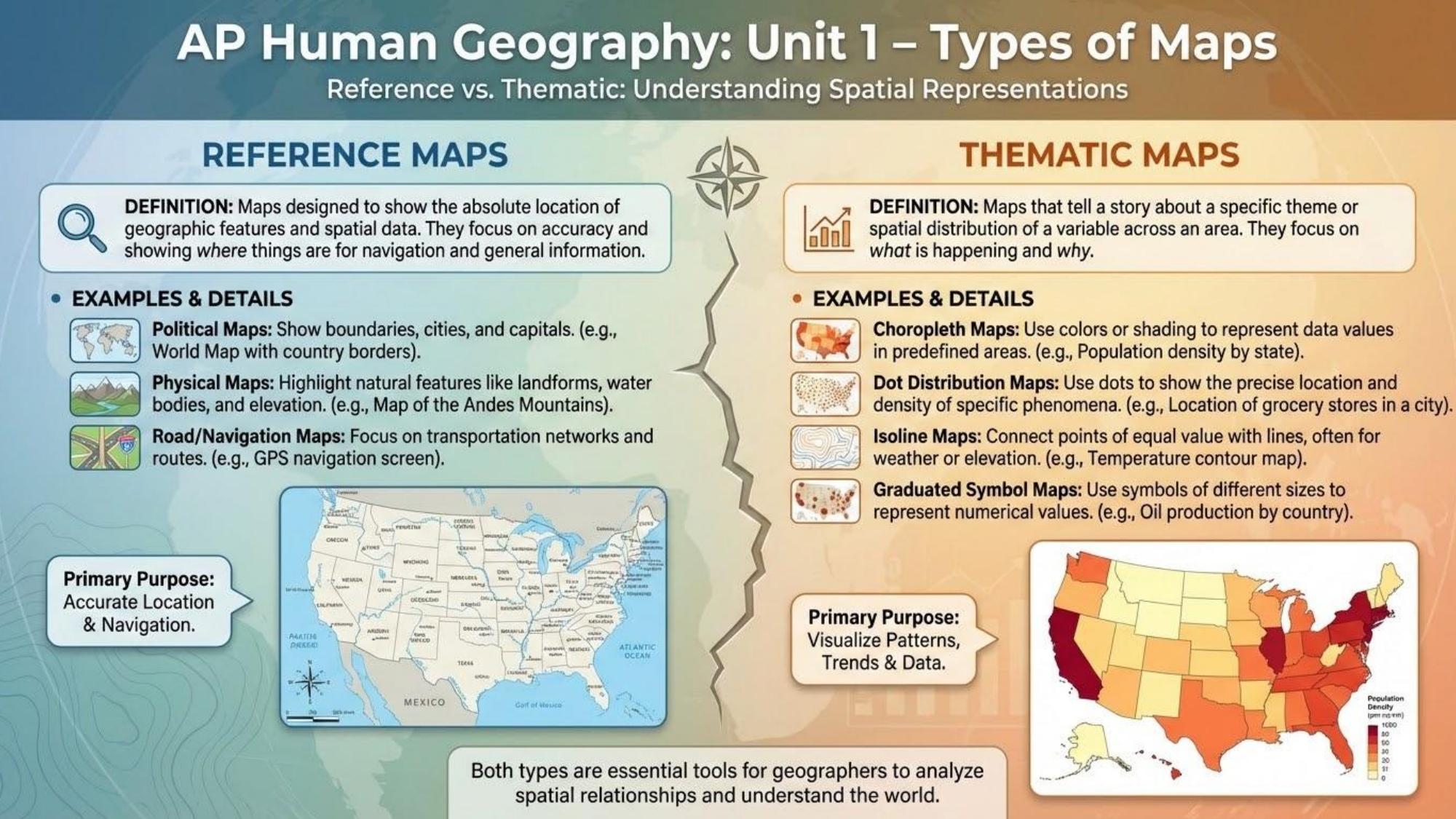
Every map projection distorts reality in some way (area, shape, distance, or direction). Understanding map types and their limitations is essential — a cartogram showing GDP looks nothing like a physical map, but both reveal important truths about the world.
Maps Projections Representation
Big Idea 3
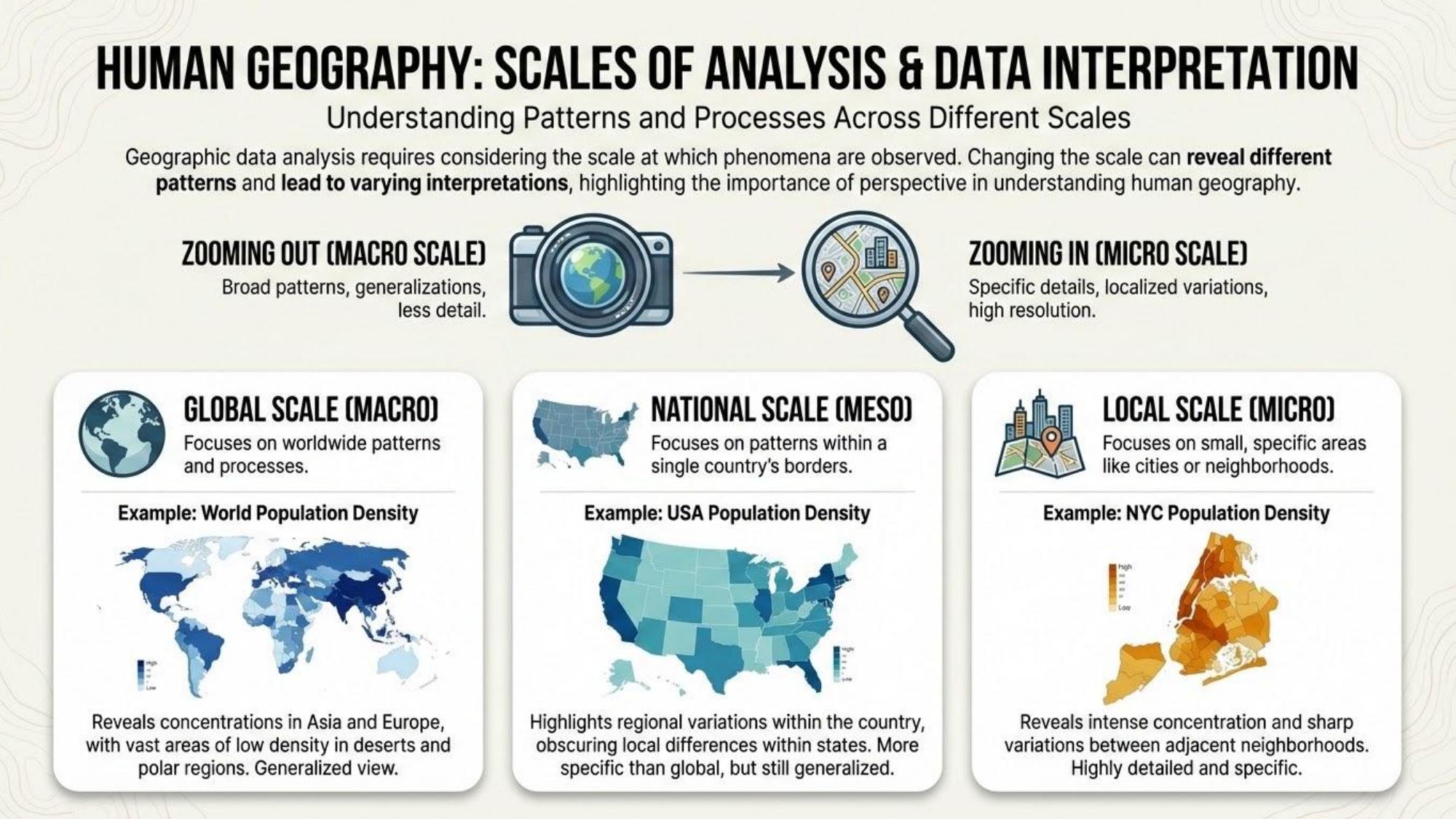
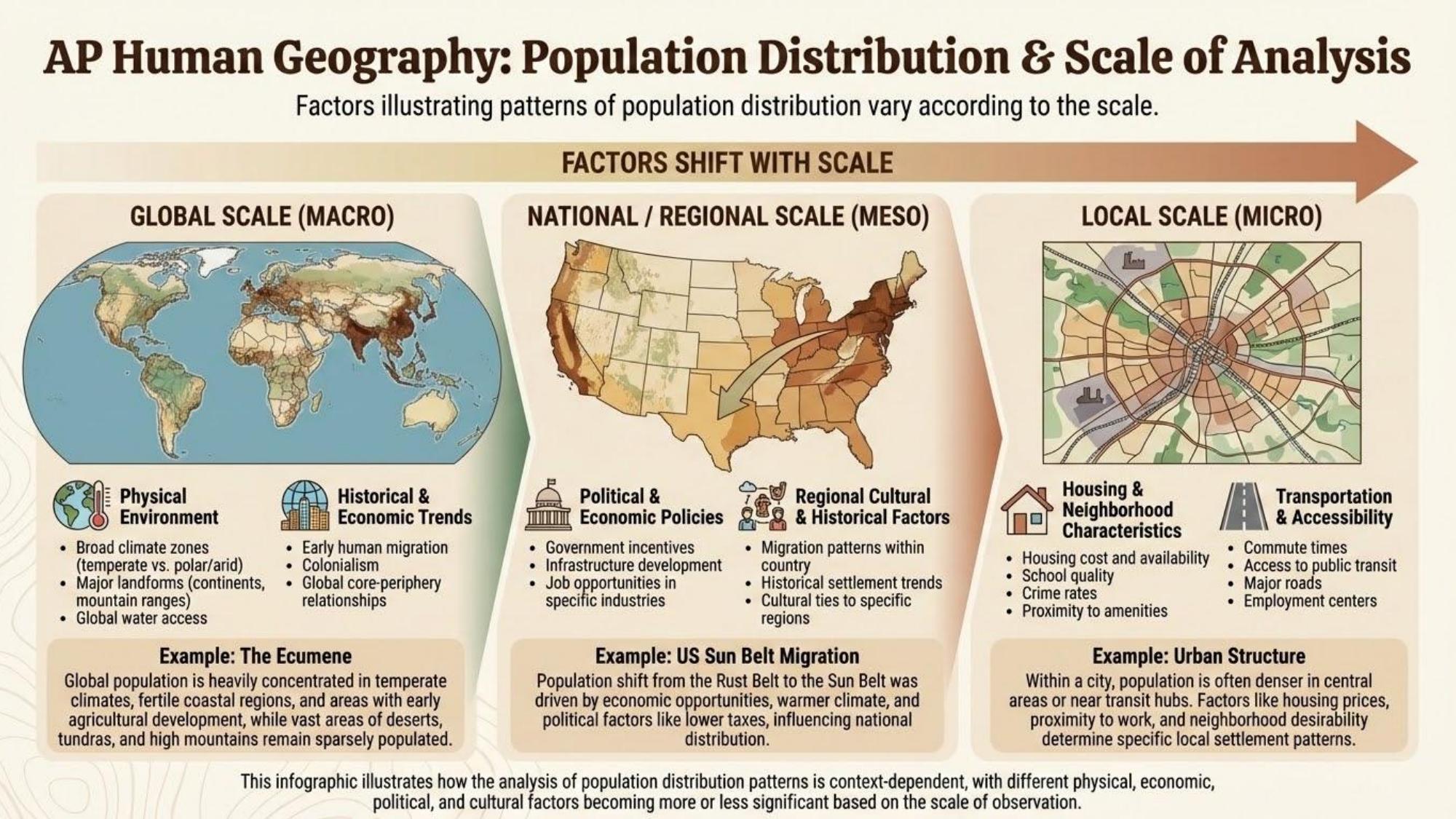
Scale matters — what you see depends on where you look from
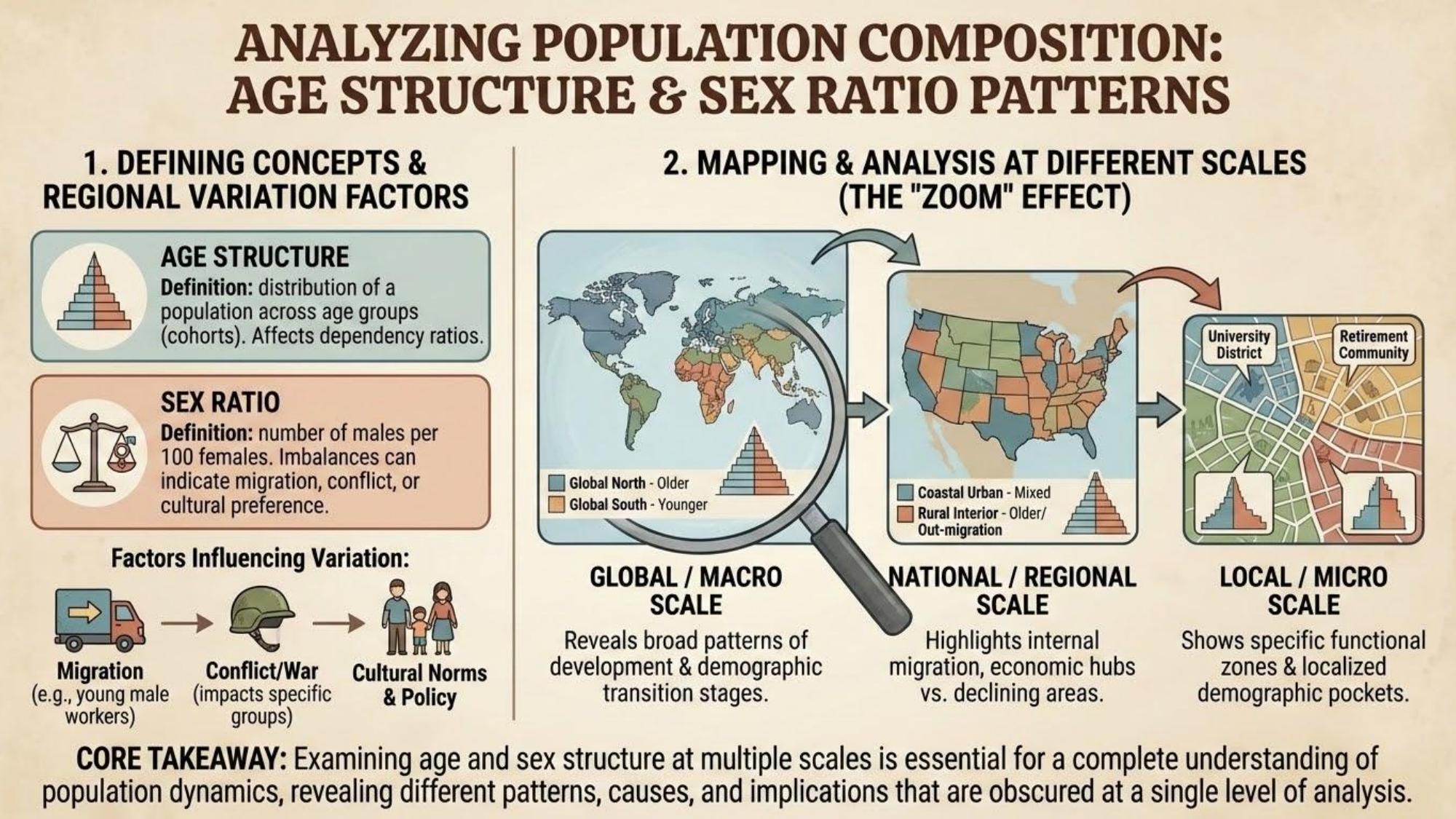
Geographic patterns look different at different scales. Urban poverty might not be visible at a national scale but is stark at the neighborhood level. Choosing the right scale of analysis is essential for geographic understanding.
Scale Analysis Perspective
Big Idea 4
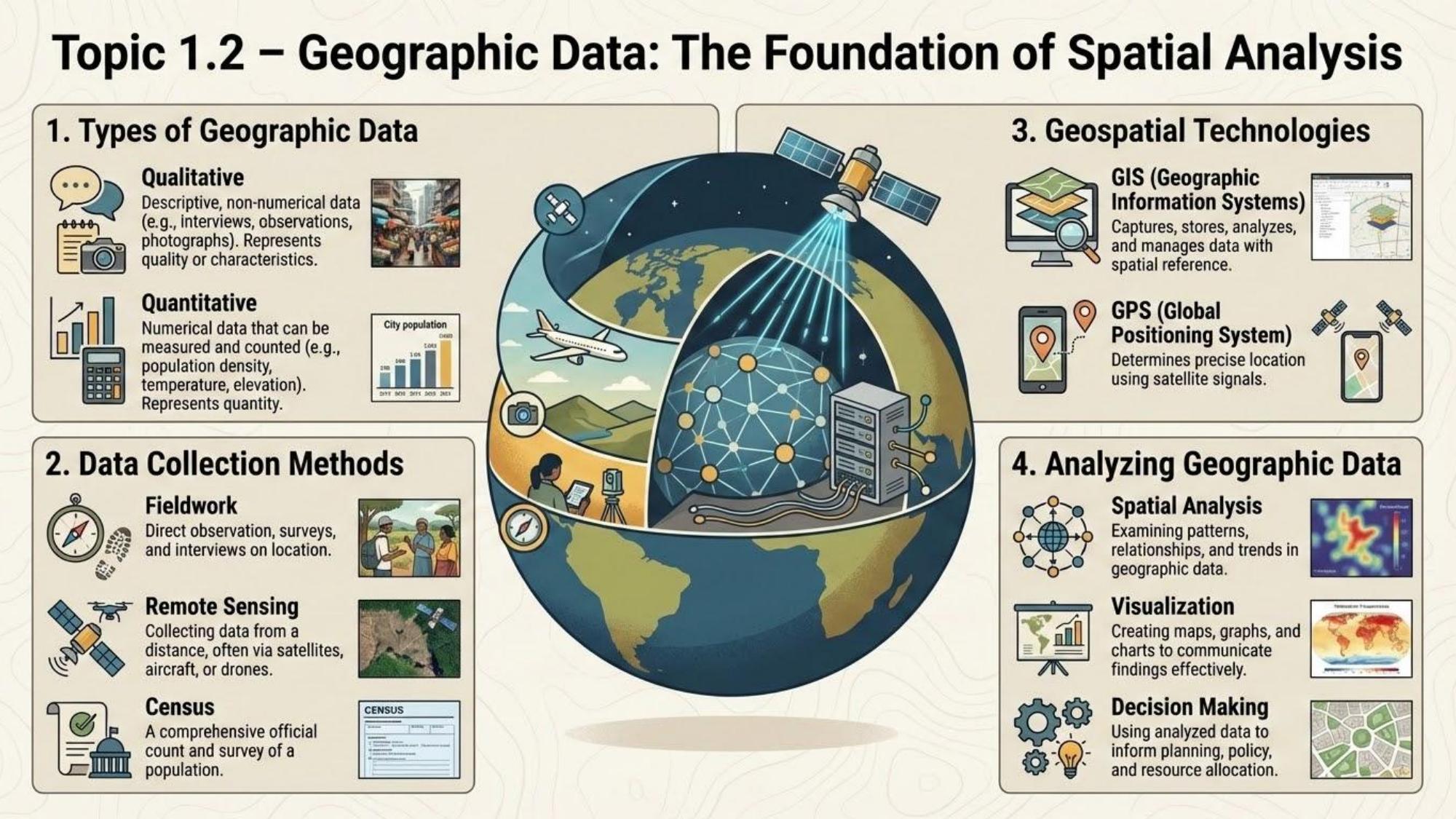
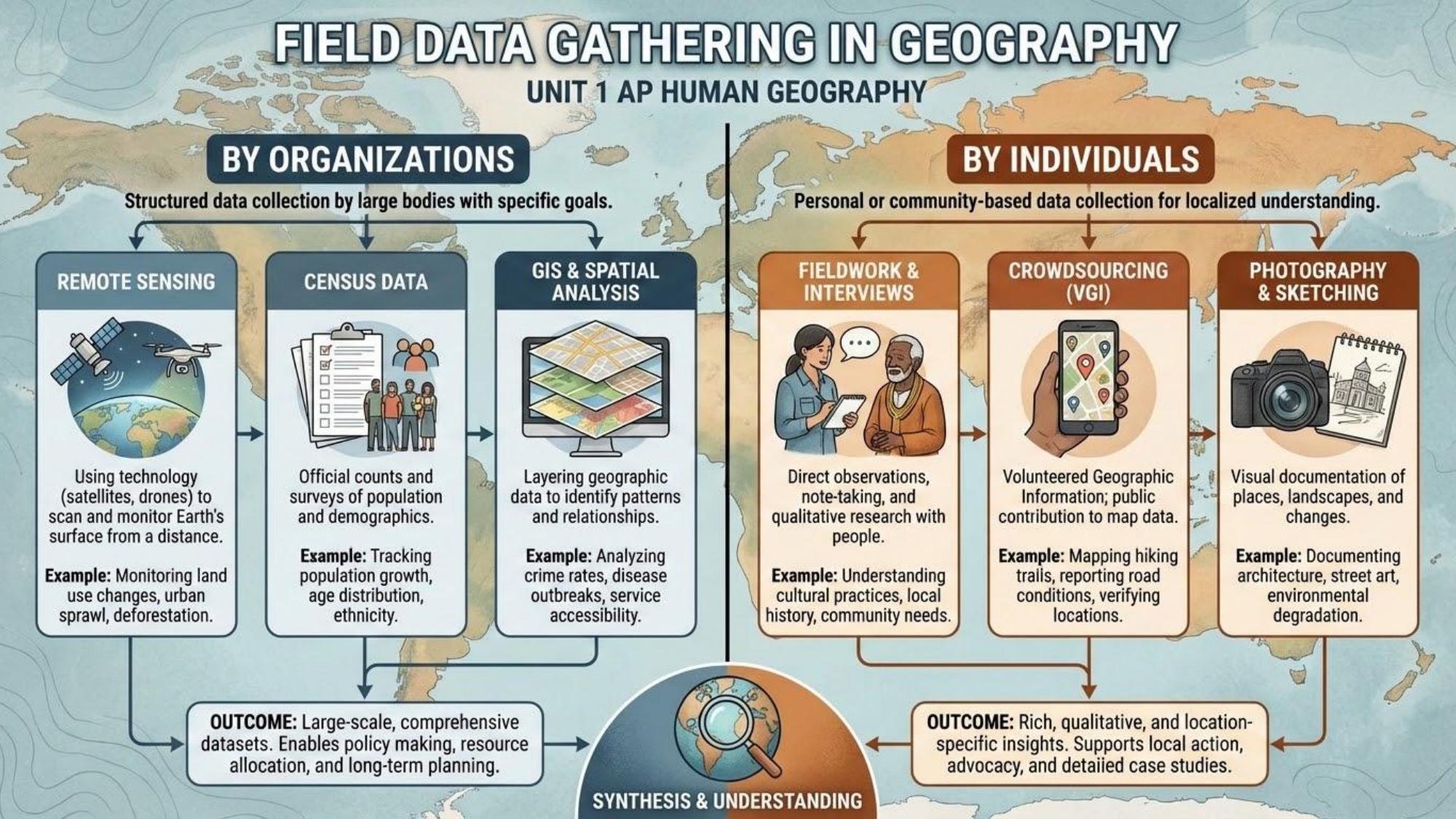
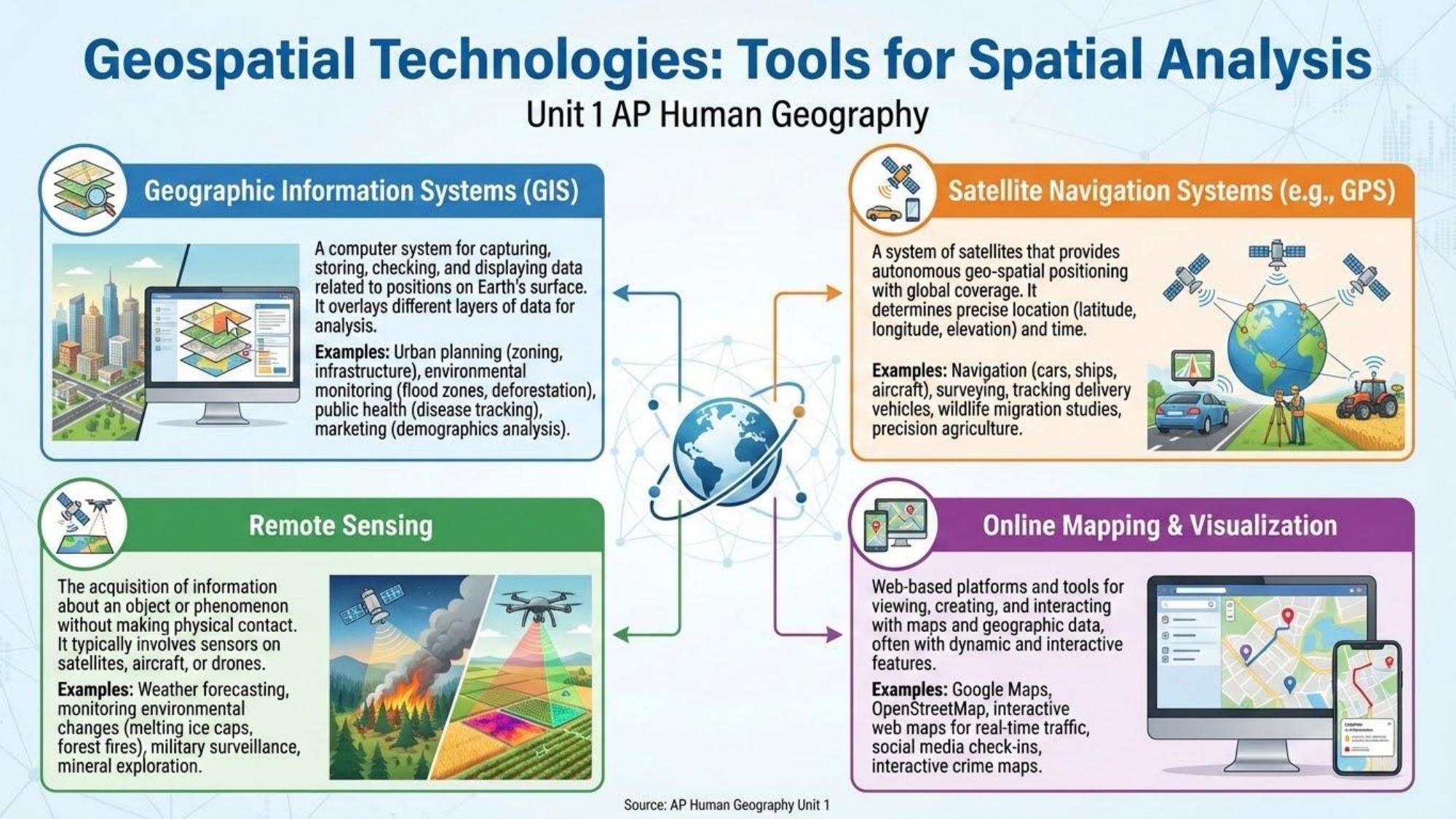
Geographic data and technology have transformed how we understand the world
GIS, remote sensing, and GPS have revolutionized geography, allowing analysis of massive spatial datasets. These tools power everything from disaster response to urban planning to election mapping.
GIS Technology Data
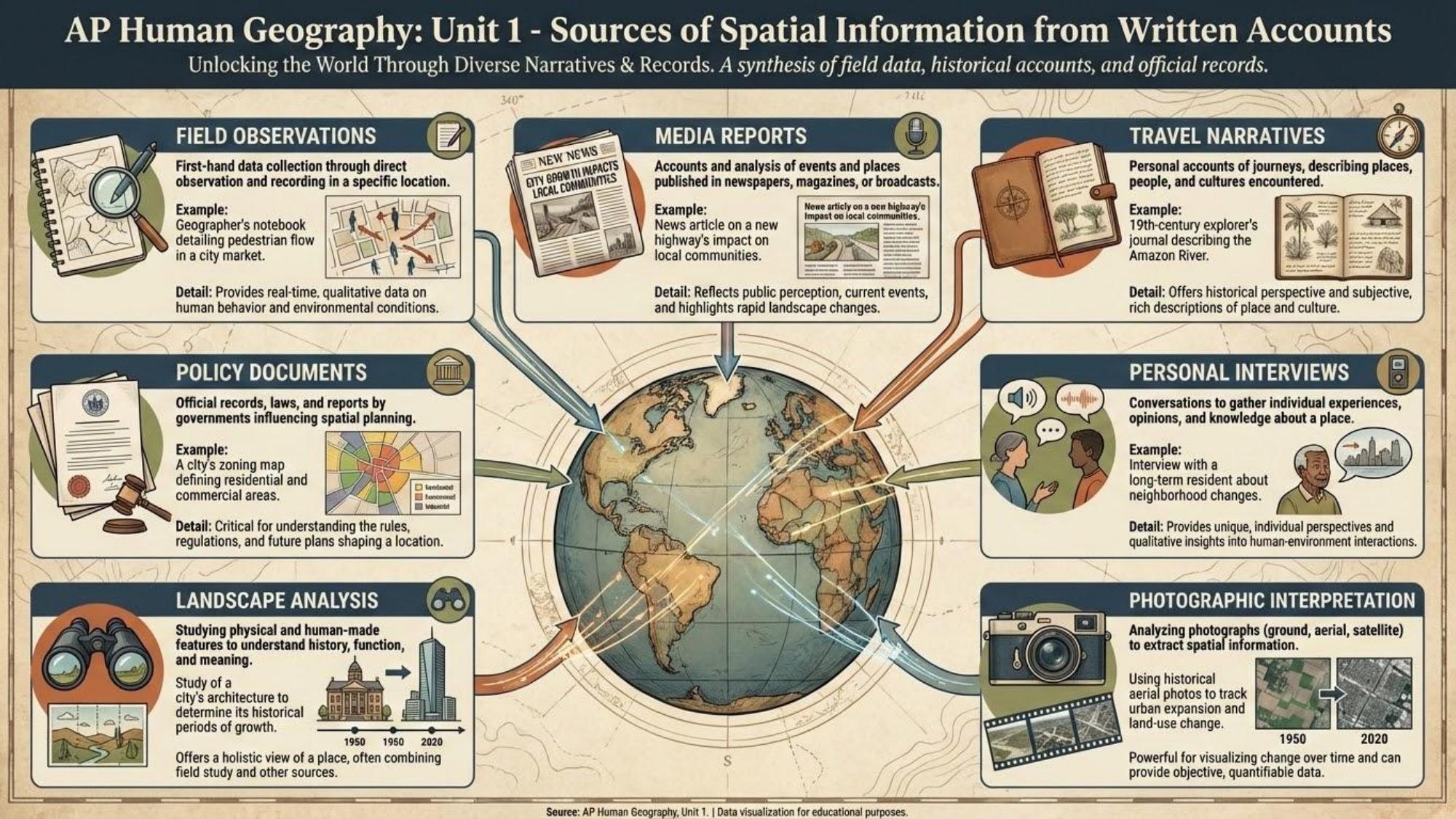
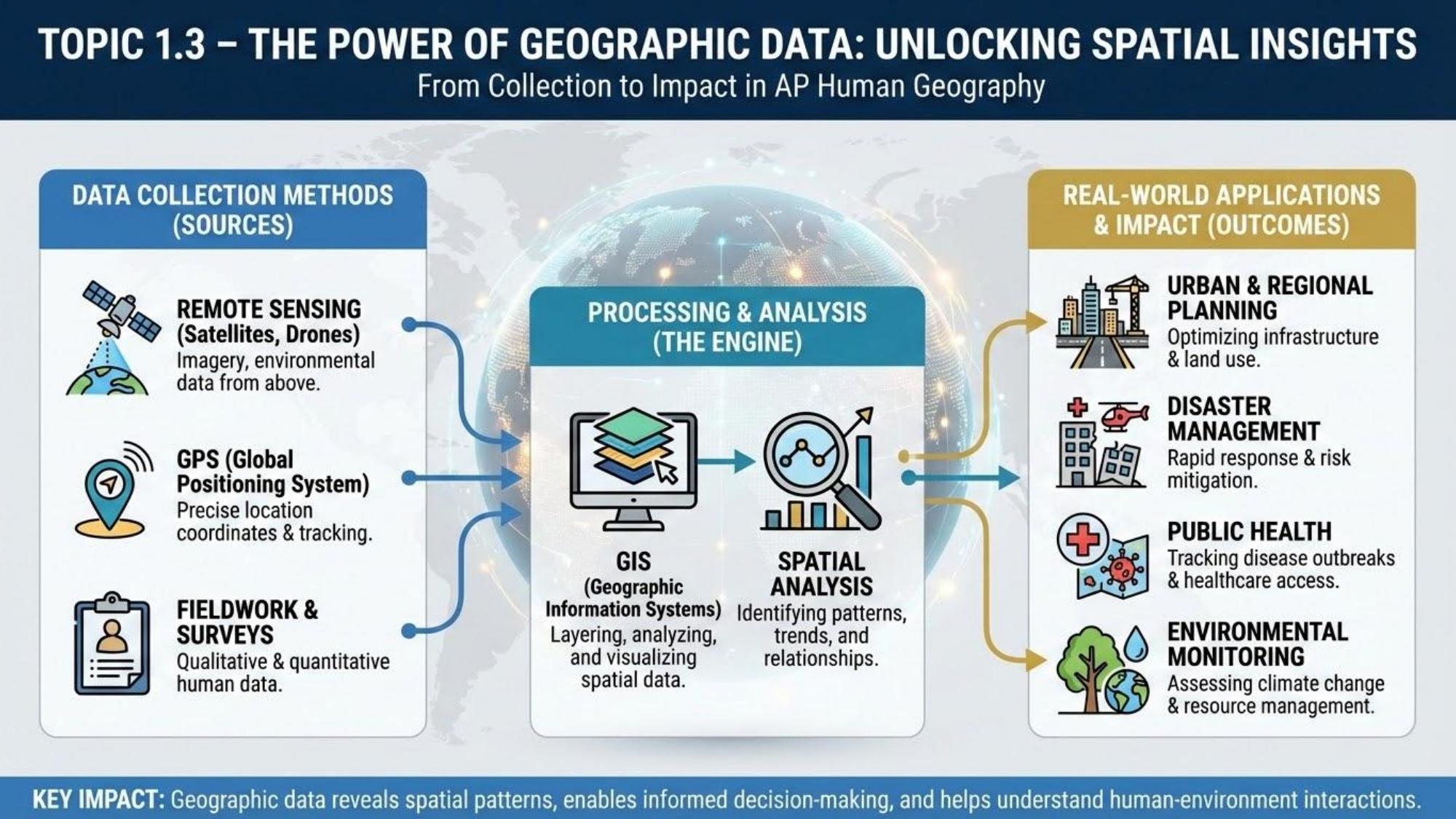
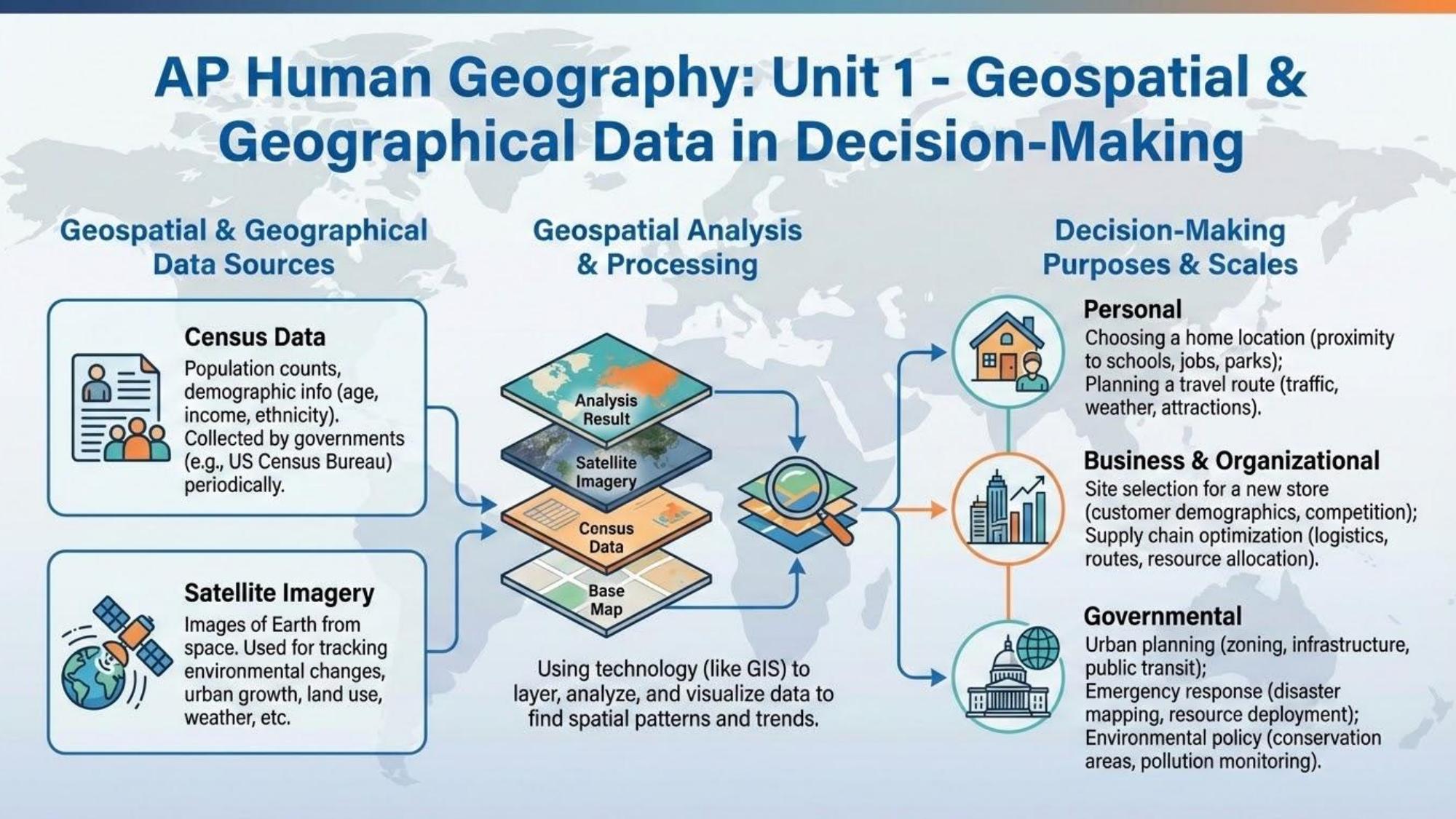
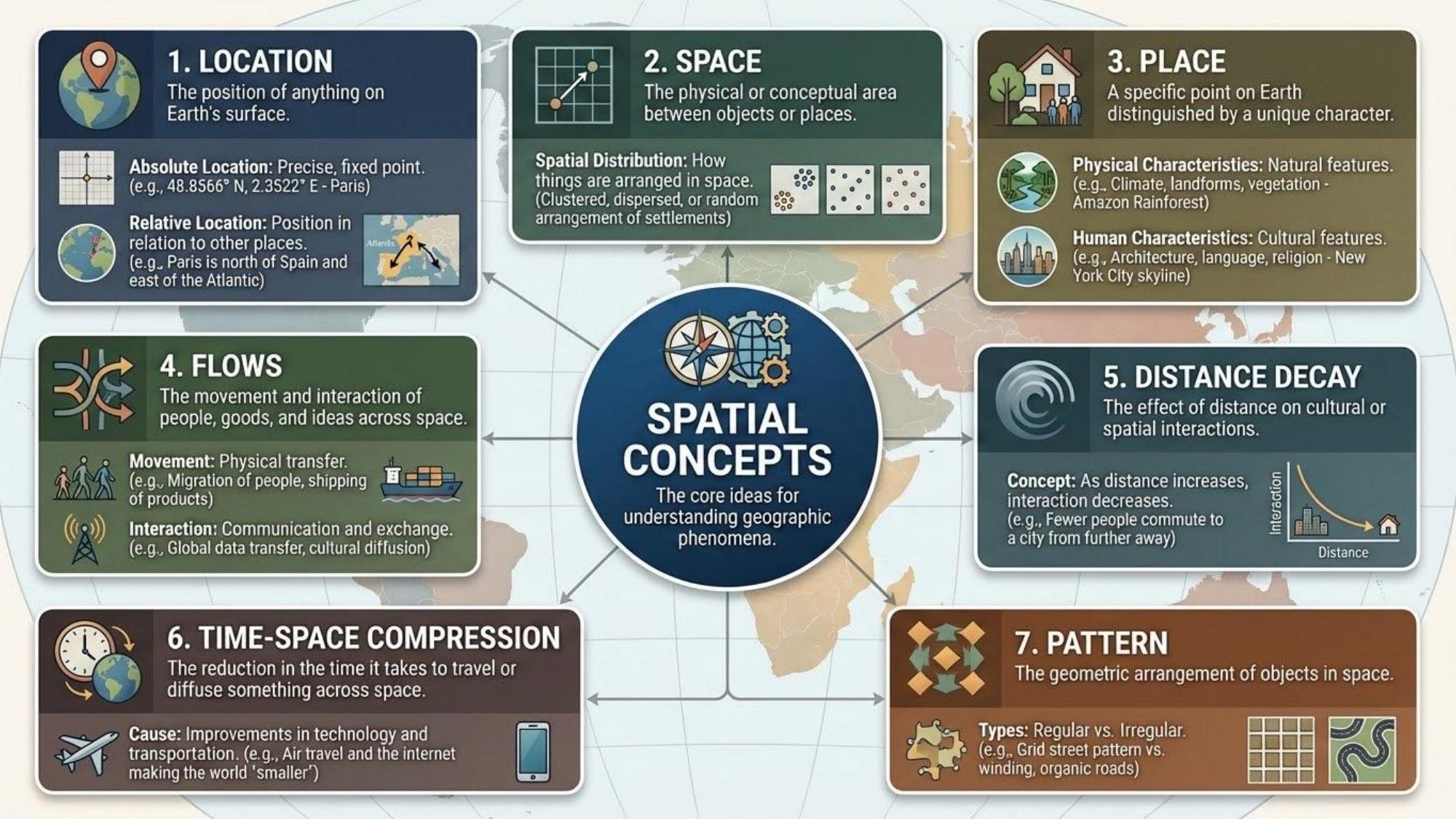
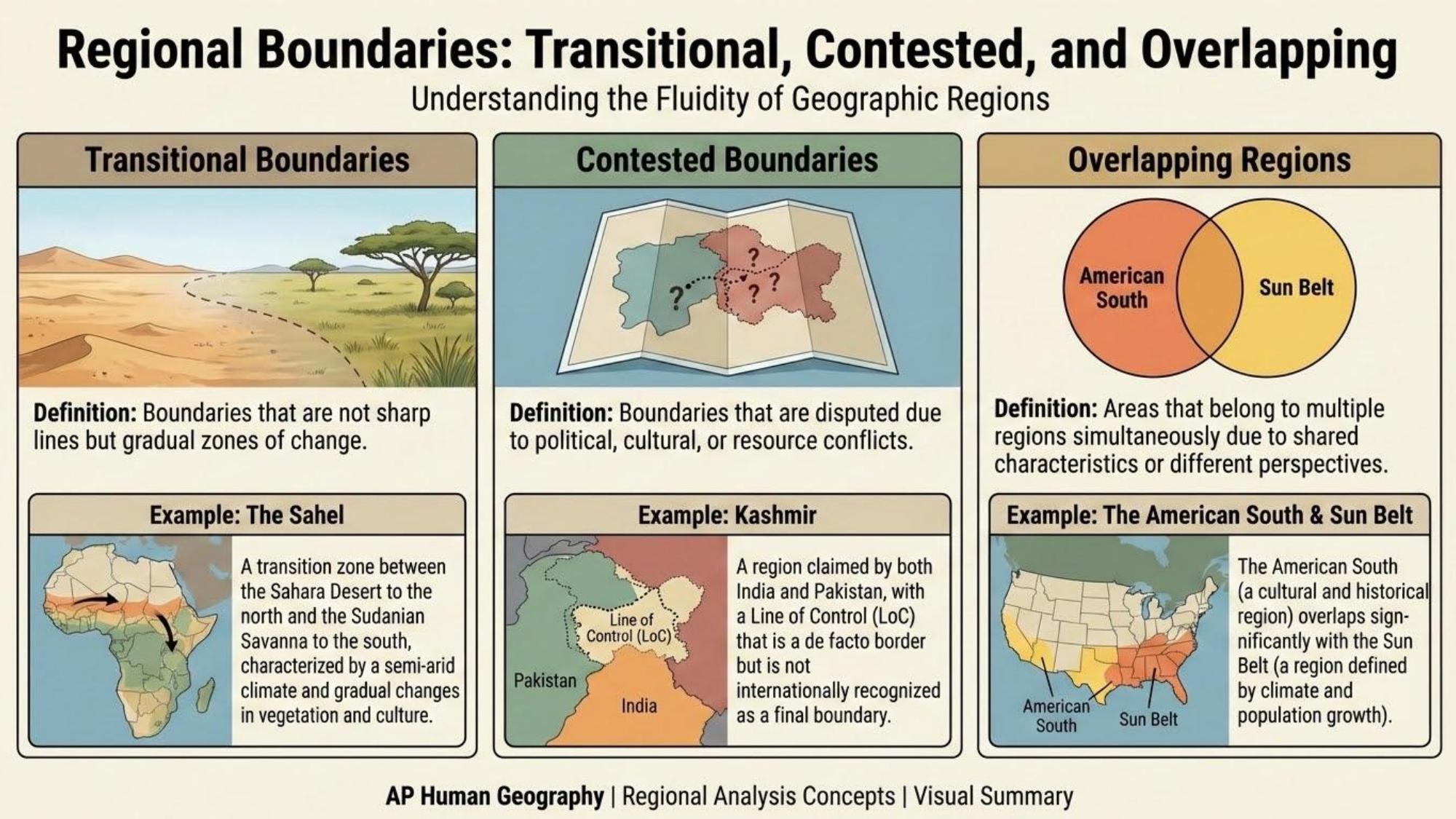
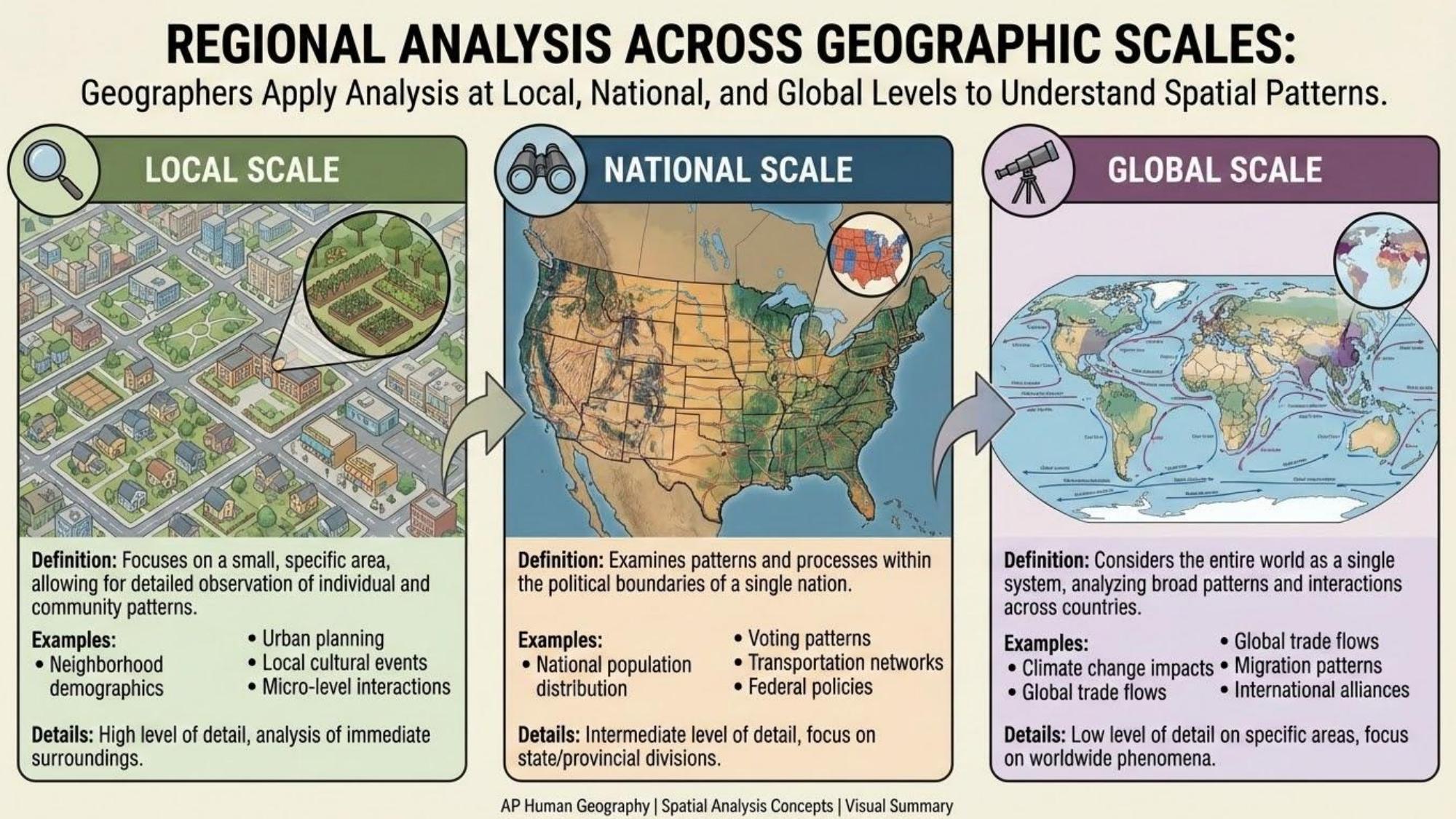
Unit 1: Thinking Geographically infographic
Unit visual review slide 1 Unit visual review slide 2 Unit visual review slide 3 Unit visual review slide 4 Unit visual review slide 5 Unit visual review slide 6 Unit visual review slide 7 Unit visual review slide 8 Unit visual review slide 9 Unit visual review slide 10 Unit visual review slide 11 Unit visual review slide 12 Unit visual review slide 13 Unit visual review slide 14 Unit visual review slide 15 Unit visual review slide 16 Unit visual review slide 17 Unit visual review slide 18 Unit visual review slide 19 Unit visual review slide 20 Unit visual review slide 21 Unit visual review slide 22
1 / 22
2
Unit 2

Population & Migration Patterns and Processes

approx. 12–17% of exam
🎙

Unit 2: Population & Migration Patterns and Processes

Population distribution, demographic transition, migration push/pull factors, and global population patterns.

🎙 Episode 2  ·  25:12
0:0025:12
Question
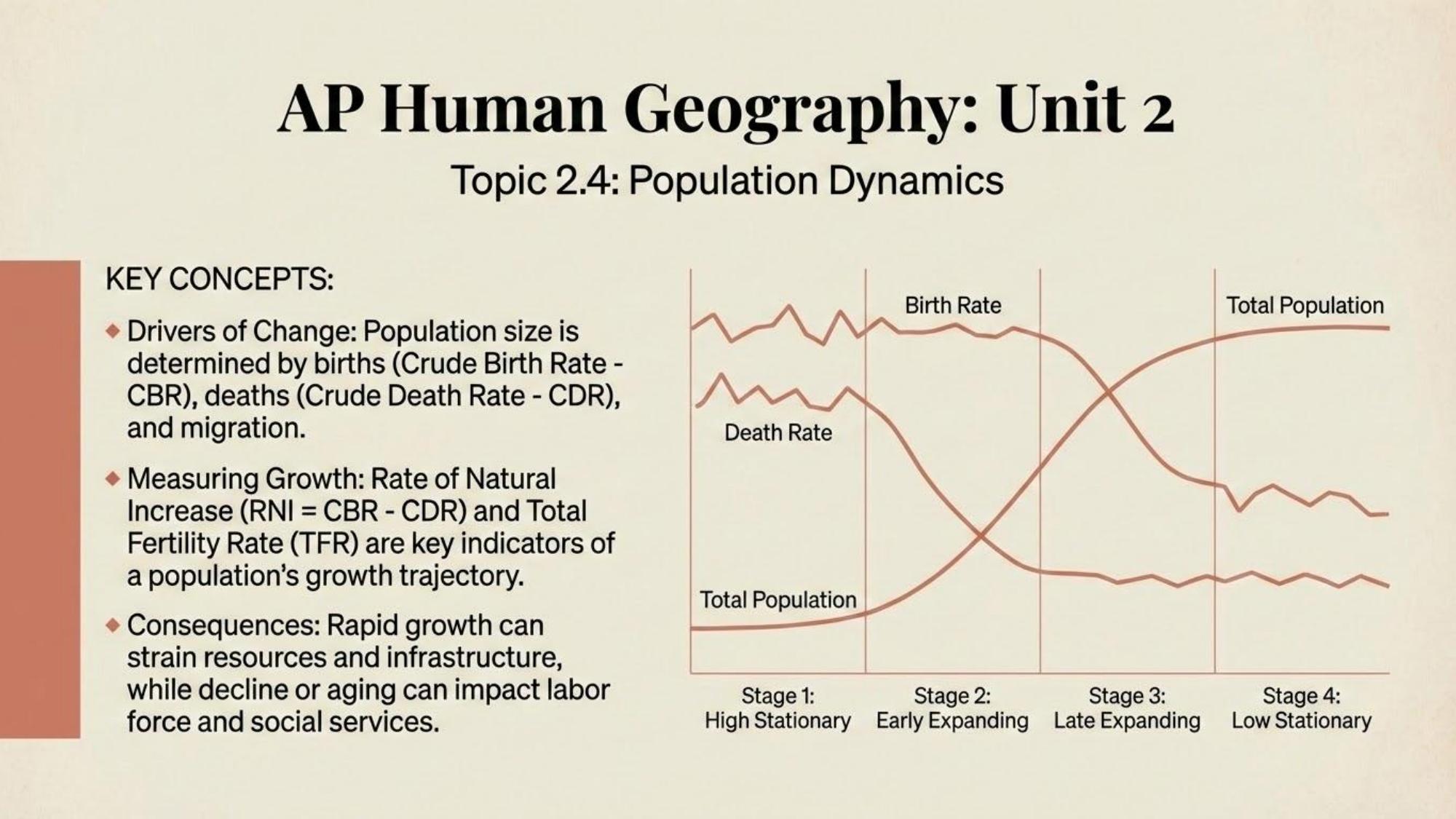
What is the Demographic Transition Model (DTM)?
Unit 2 · Population & Migration Pattern
tap to flip
Answer
A model showing how birth rates, death rates, and population growth change as a country develops economically through five stages.
Card 1 of 12
Question 1 of 5 Score: 0/5
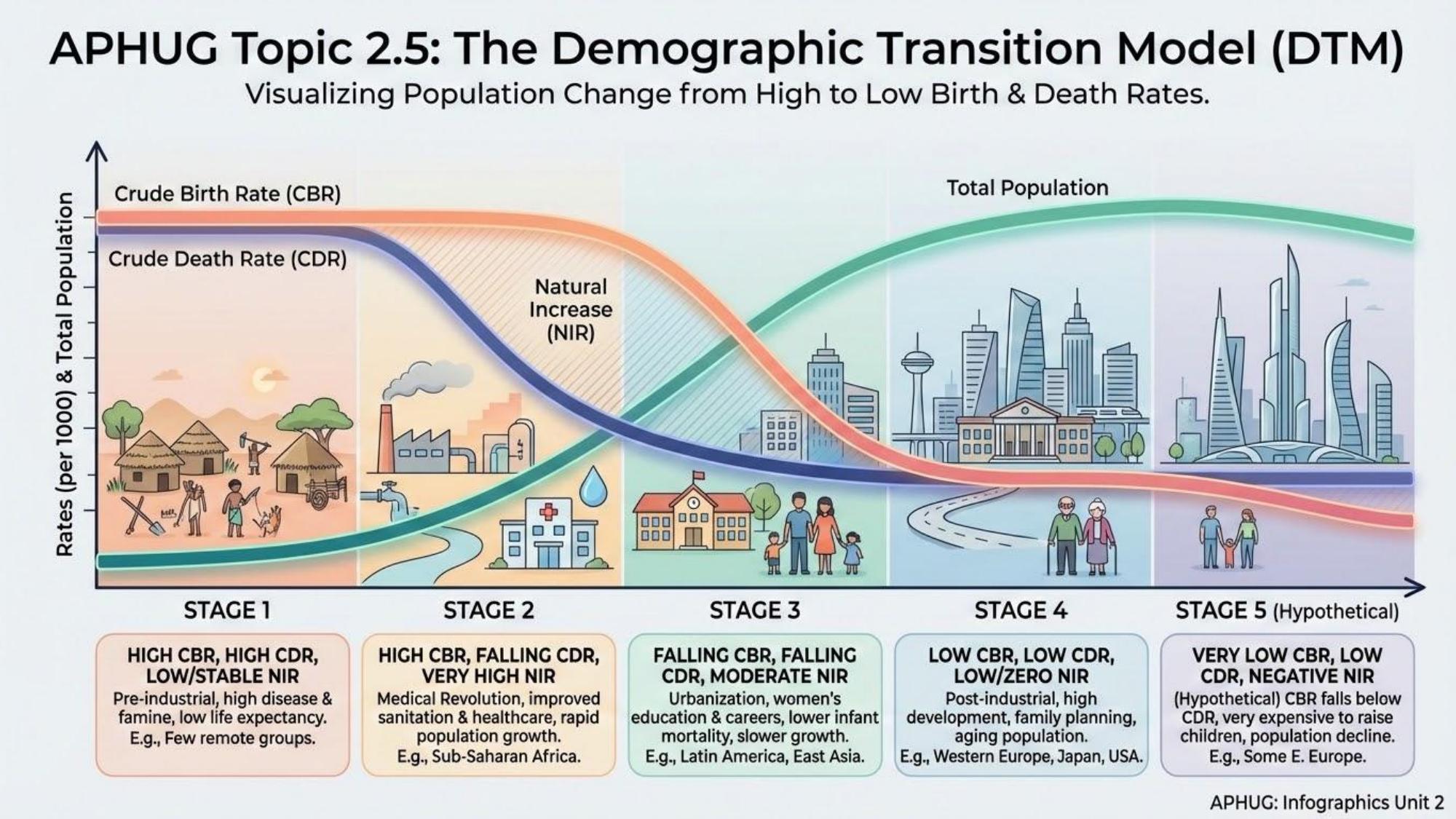
Demographic Transition Model (DTM)
Five-stage model showing how birth/death rates and population growth change with economic development.
Population Models
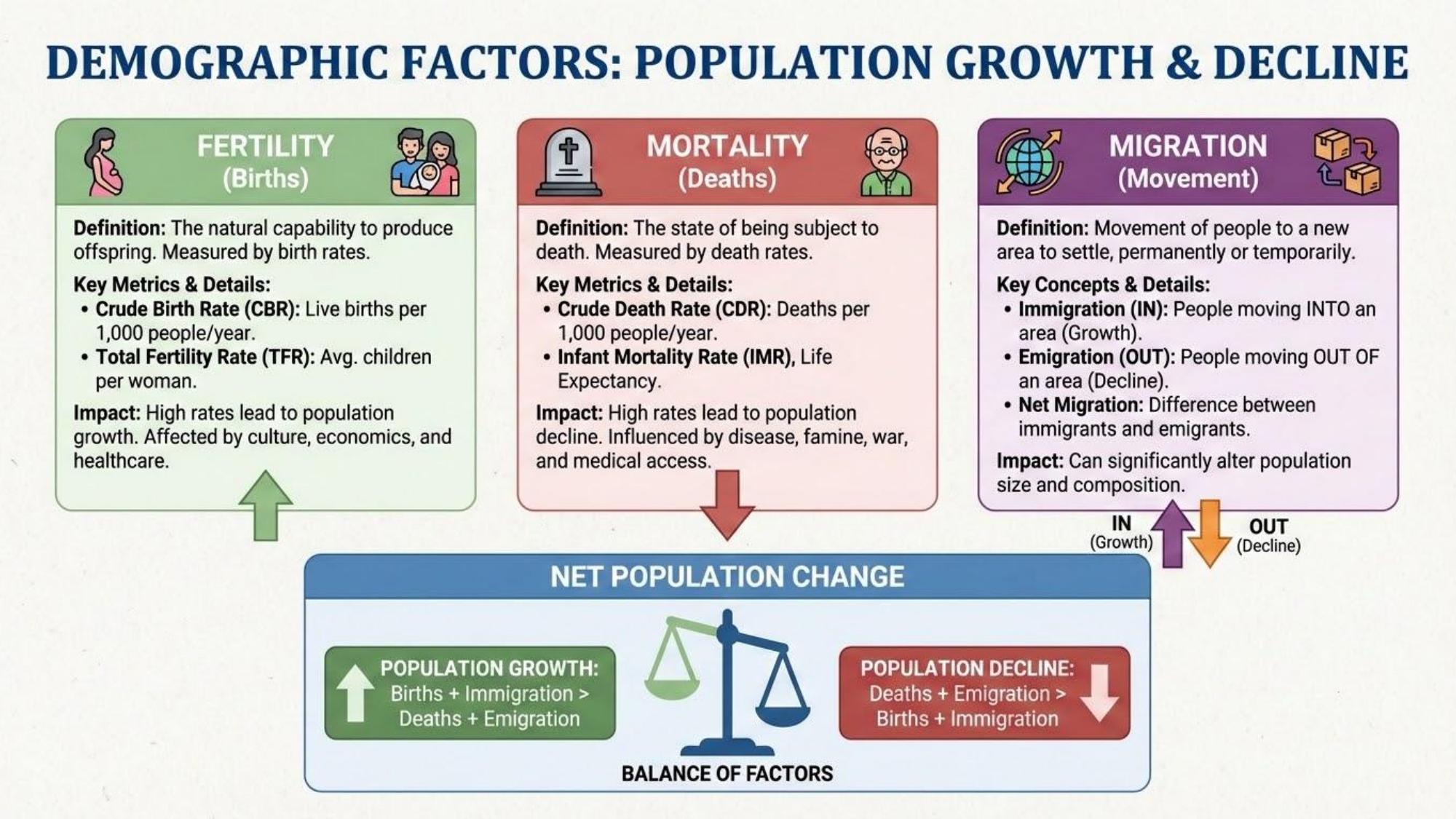
Total Fertility Rate (TFR)
Average number of children born per woman during her reproductive years; 2.1 = replacement level.
Population Measures
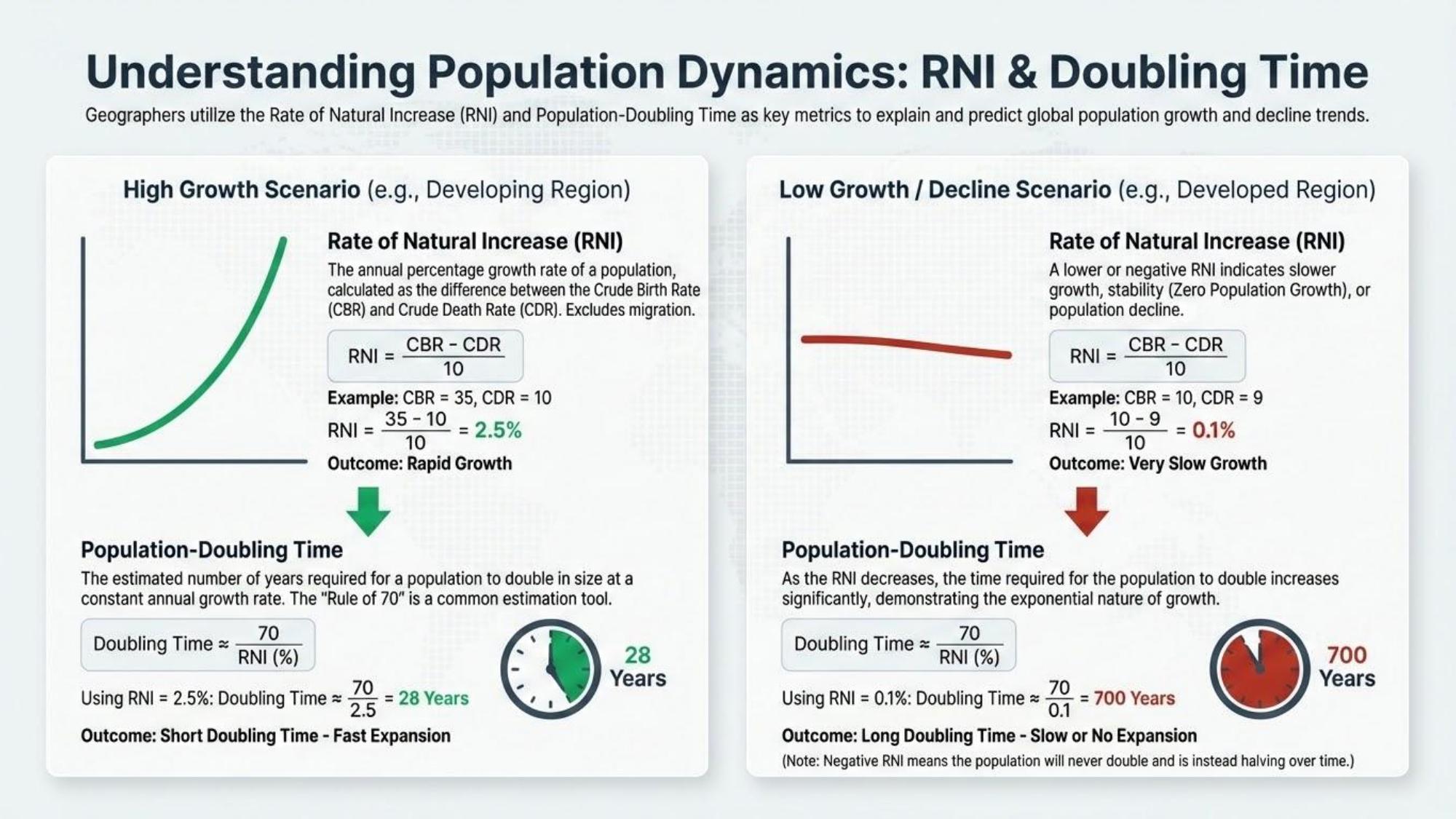
Natural Increase Rate (NIR)
Birth rate minus death rate; measures population growth excluding migration.
Population Measures
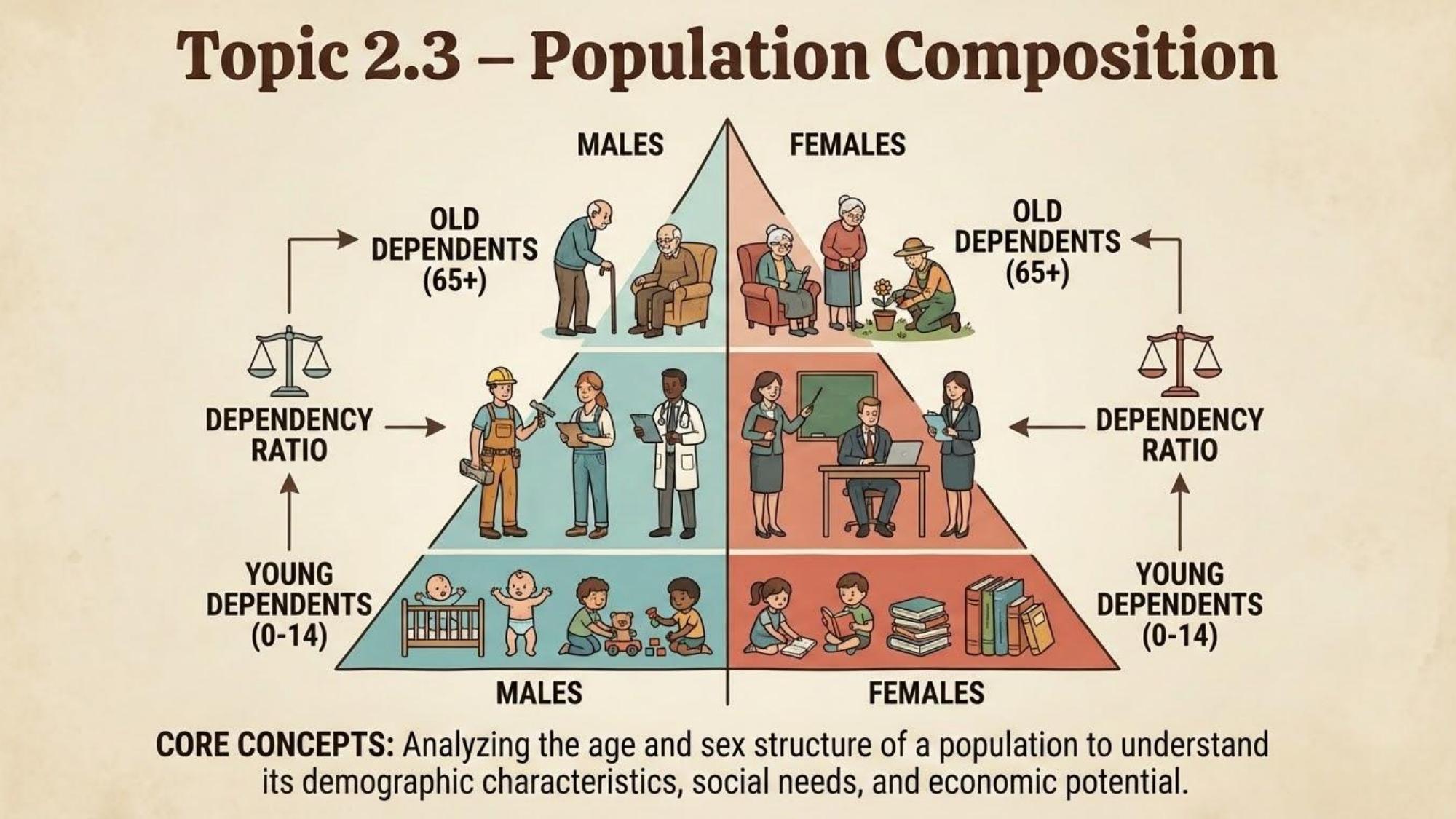
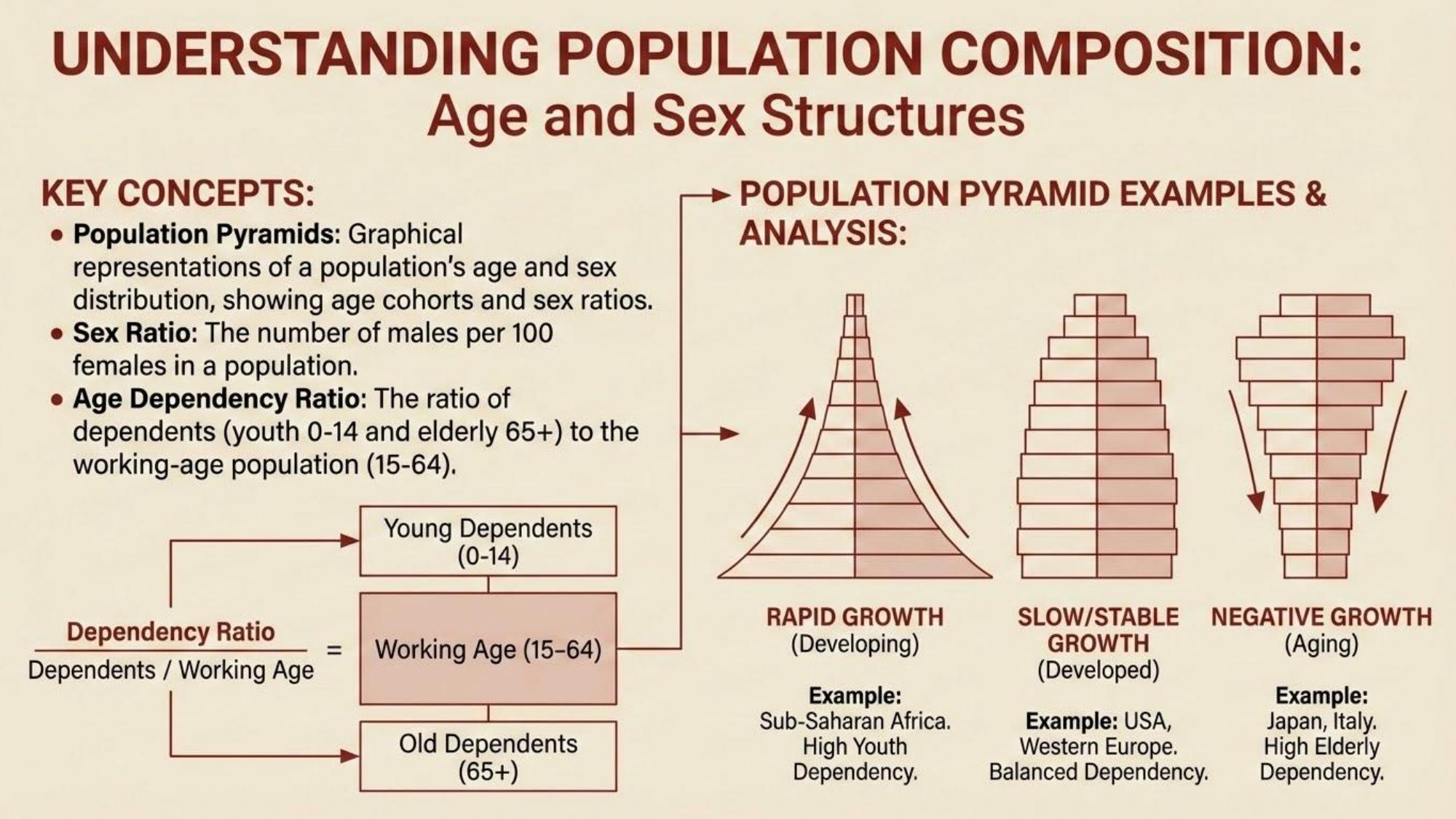
Population Pyramid
Age-sex diagram showing population distribution; shape indicates growth trends.
Population Tools
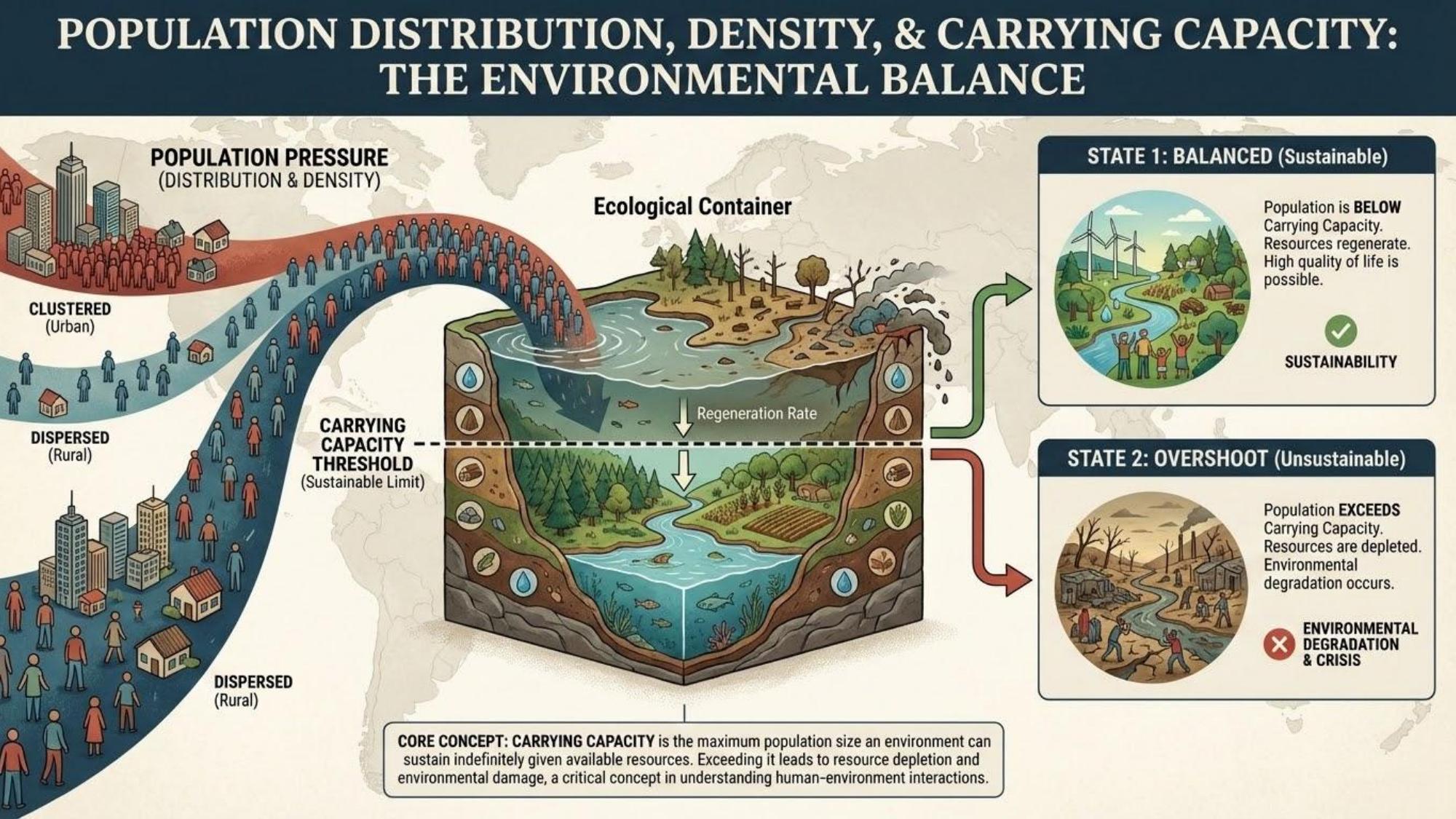
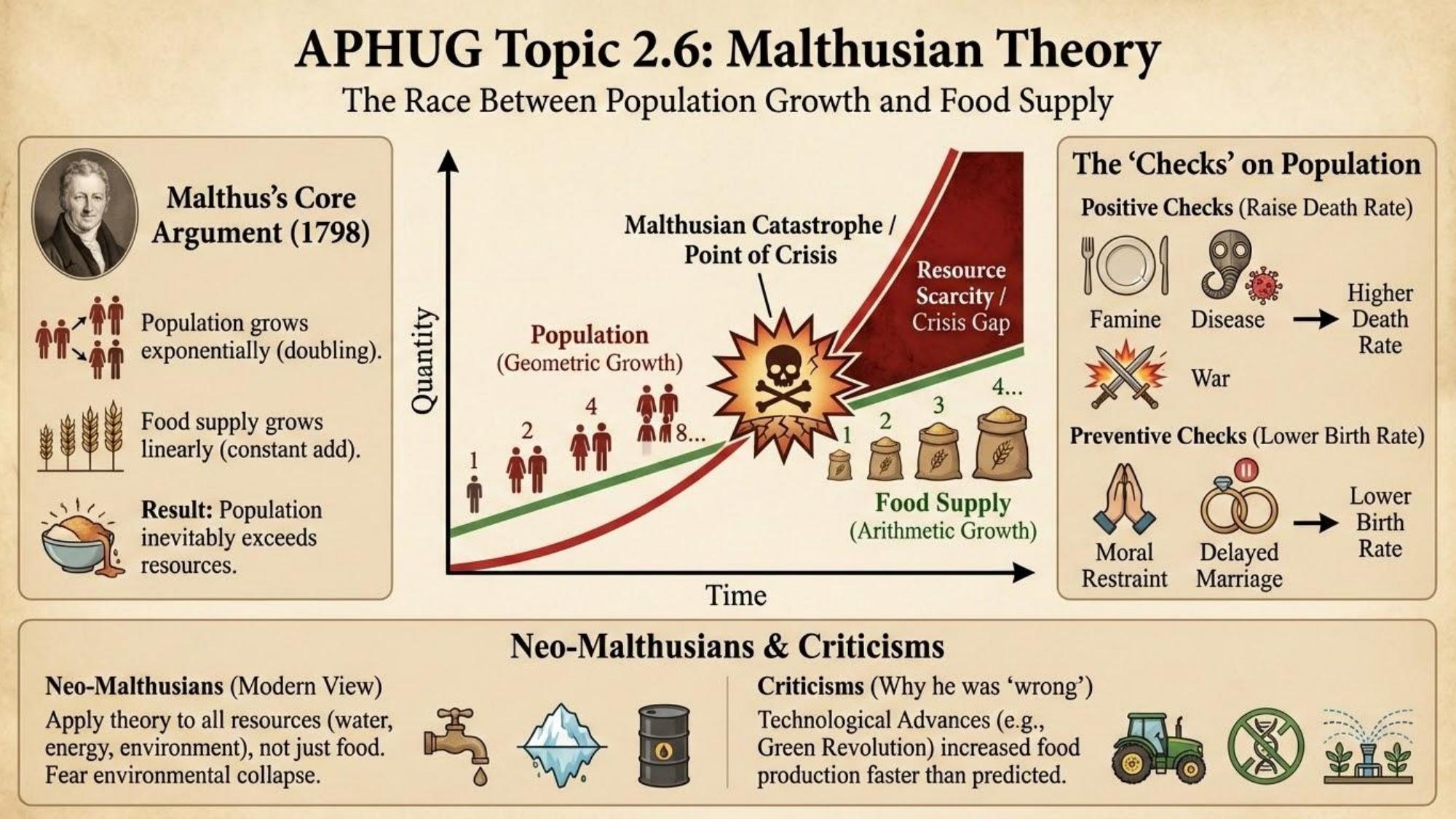
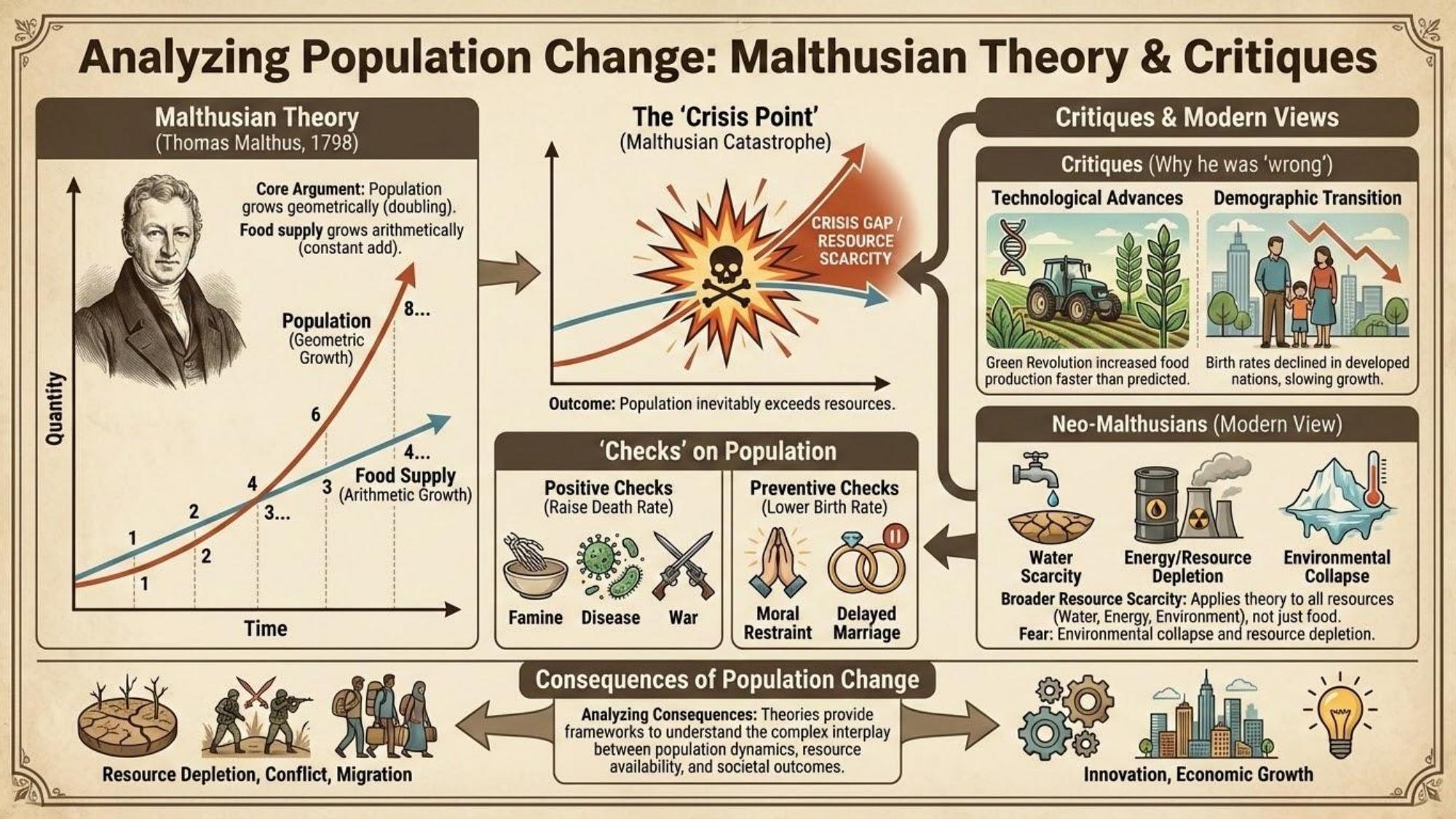
Carrying Capacity
Maximum population an environment can sustainably support.
Population Theory
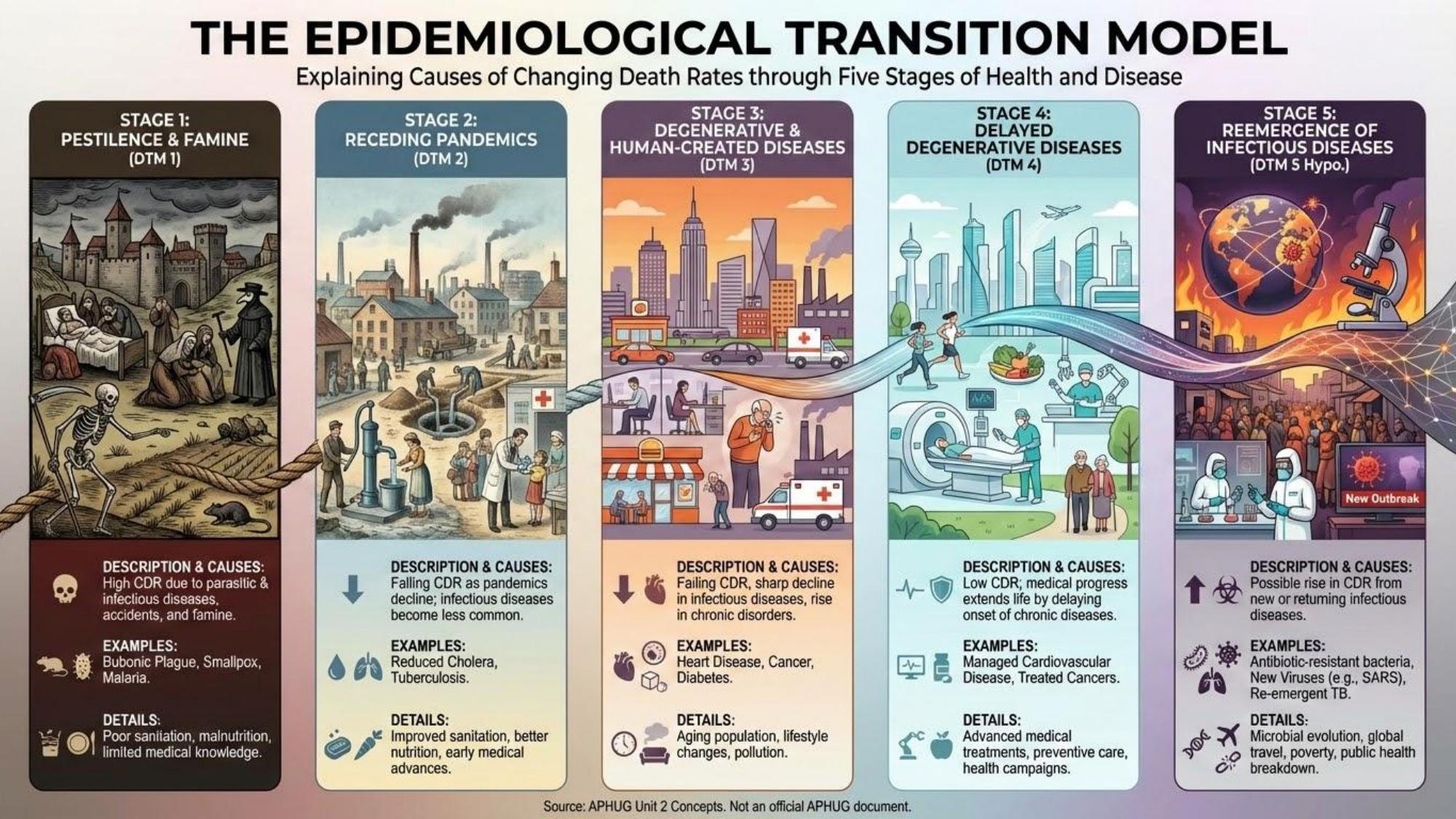
Epidemiological Transition Model
Model showing how primary causes of death shift from infectious to chronic diseases with development.
Population Models
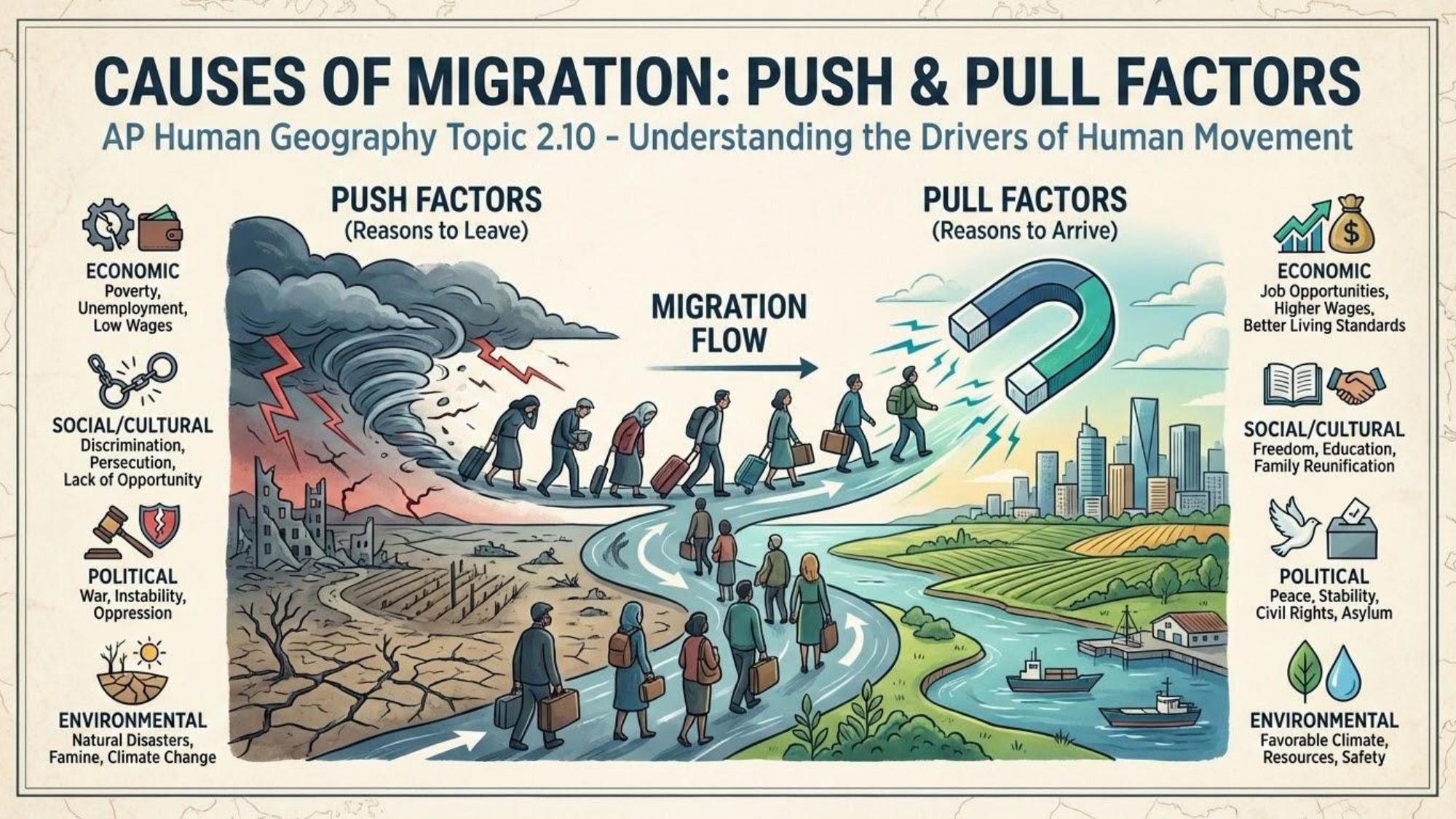
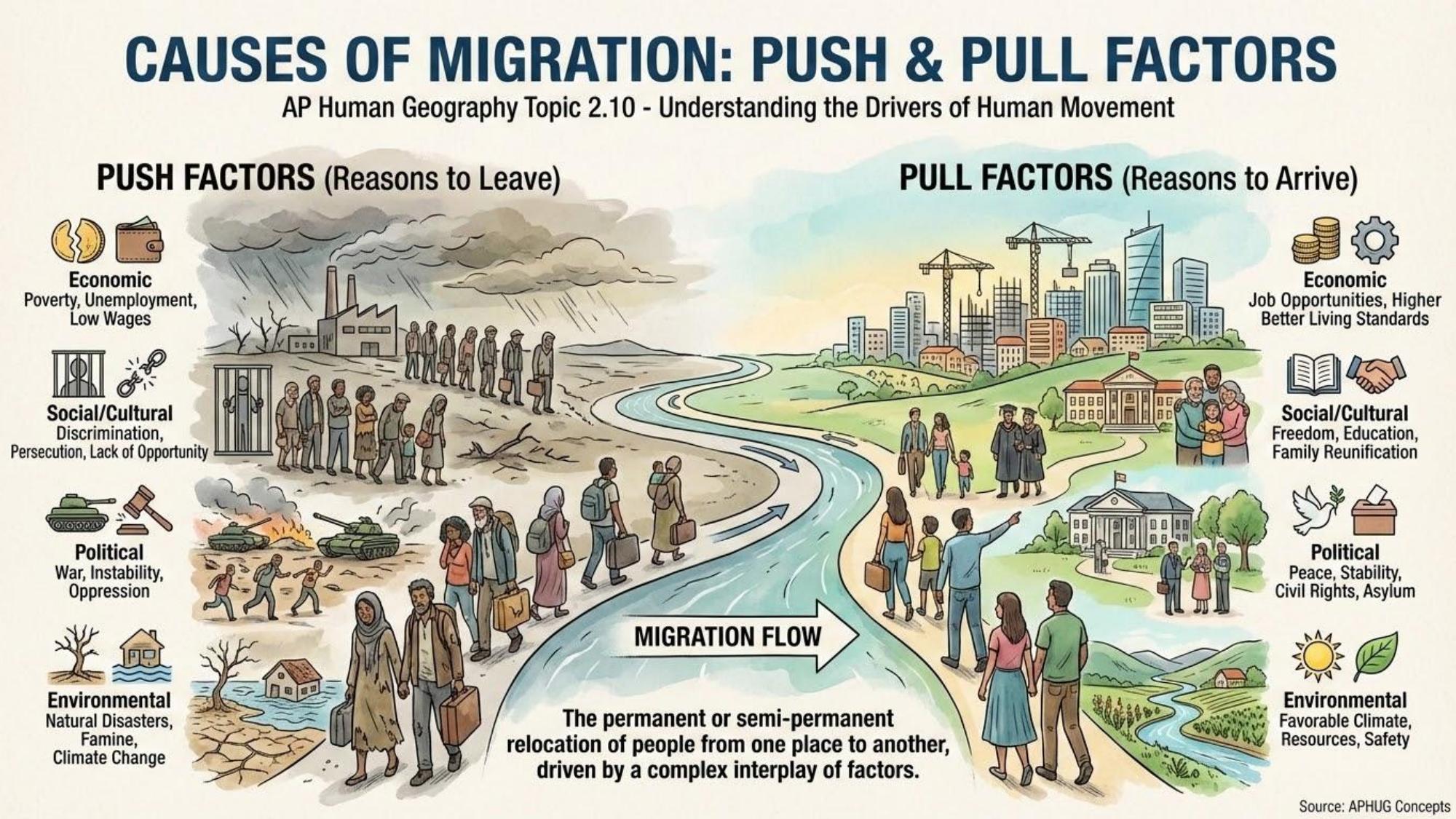
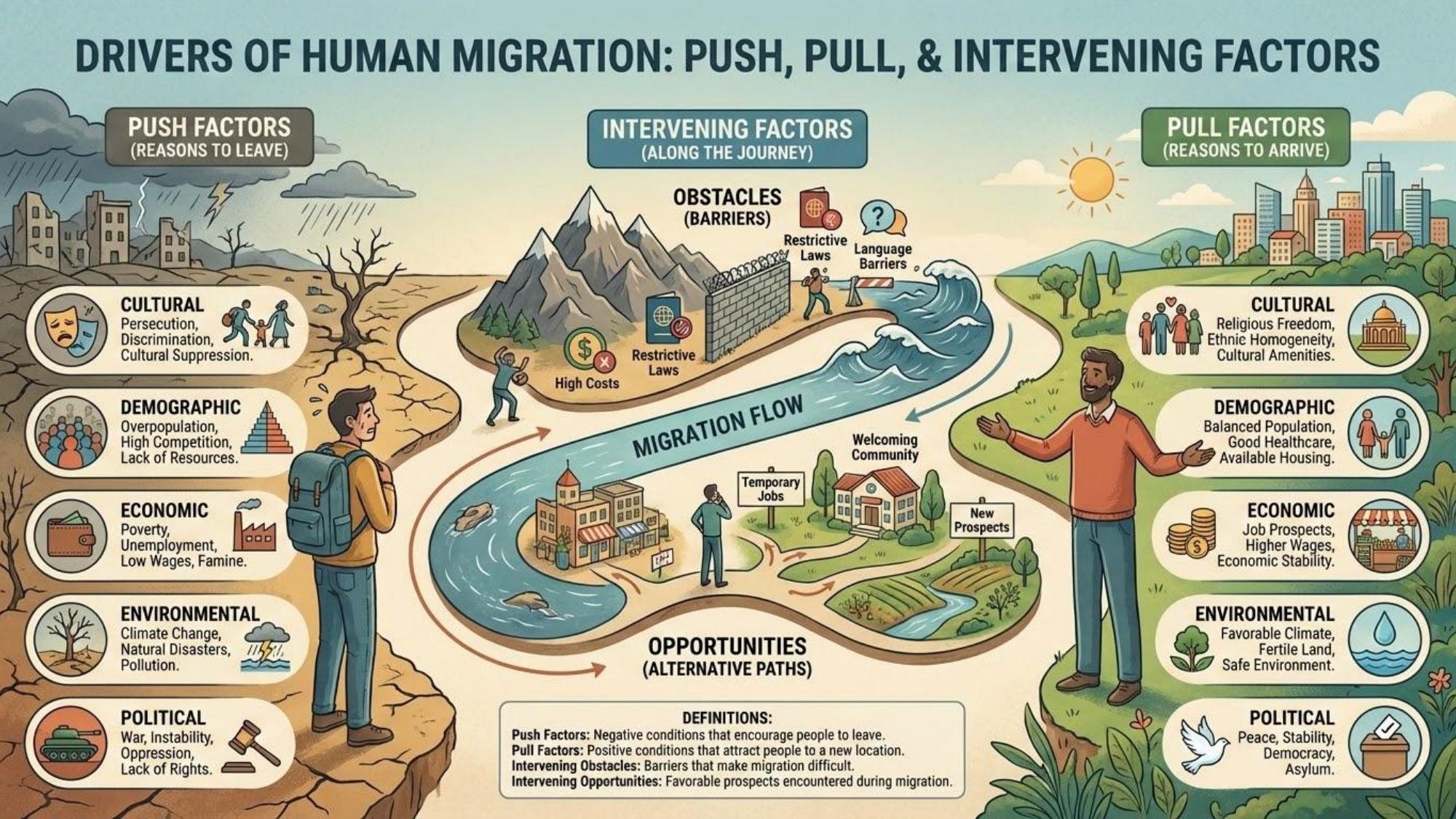
Push Factor
Condition that drives people away from a place (conflict, poverty, drought).
Migration
Pull Factor
Condition that attracts people to a destination (jobs, safety, family).
Migration
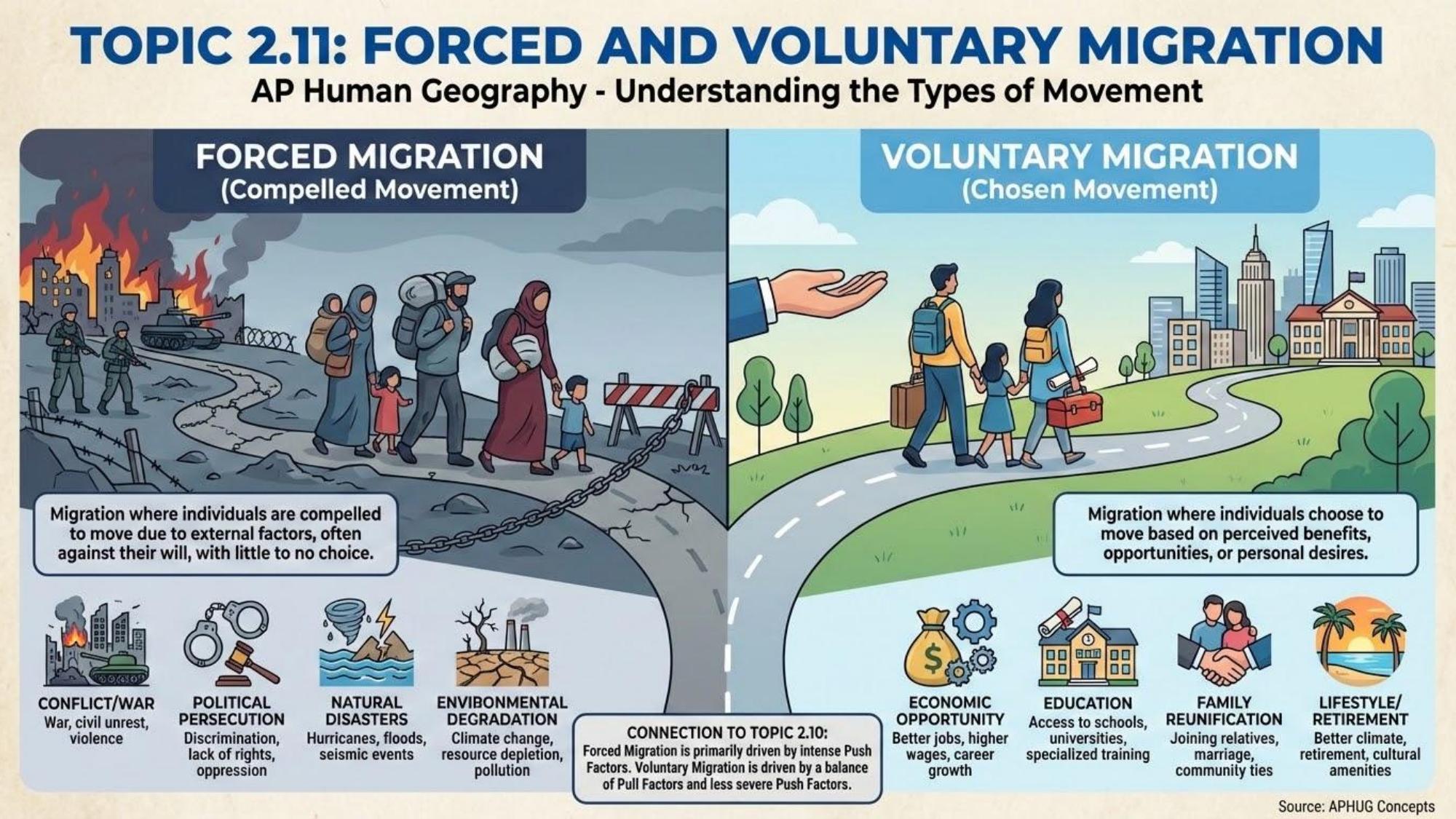
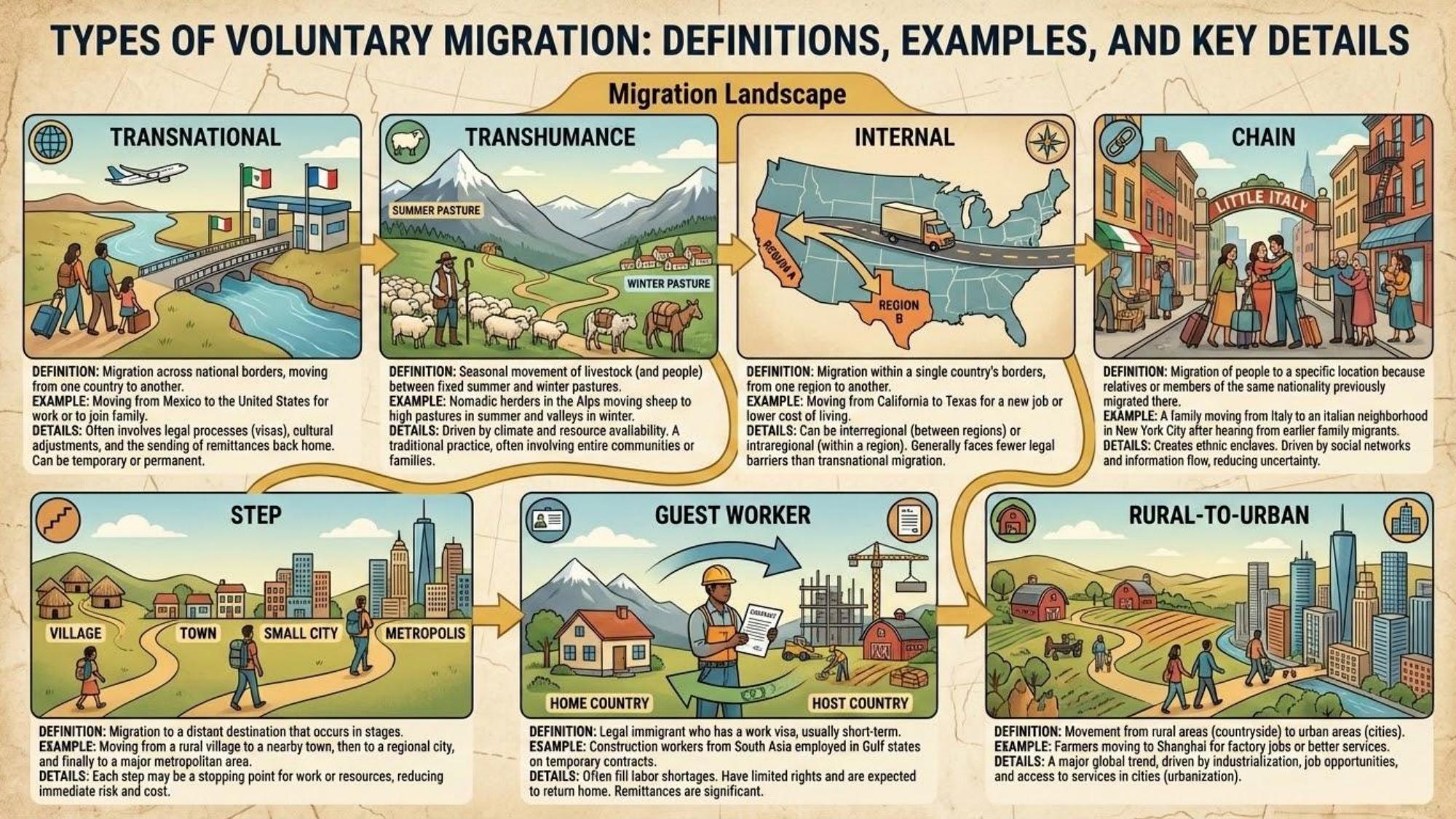
Voluntary Migration
Movement based on personal choice, usually for economic or social reasons.
Migration
Forced Migration
Movement compelled by conflict, persecution, or disaster; includes refugees and asylum seekers.
Migration
Chain Migration
Pattern where migrants follow paths established by earlier migrants from the same origin.
Migration
Intervening Obstacle
Physical, economic, or political barrier that discourages migration.
Migration
Transnationalism
Maintaining ties to home country while living abroad.
Migration
Refugee
Person forced to flee their country due to persecution, conflict, or violence.
Migration
Big Idea 1
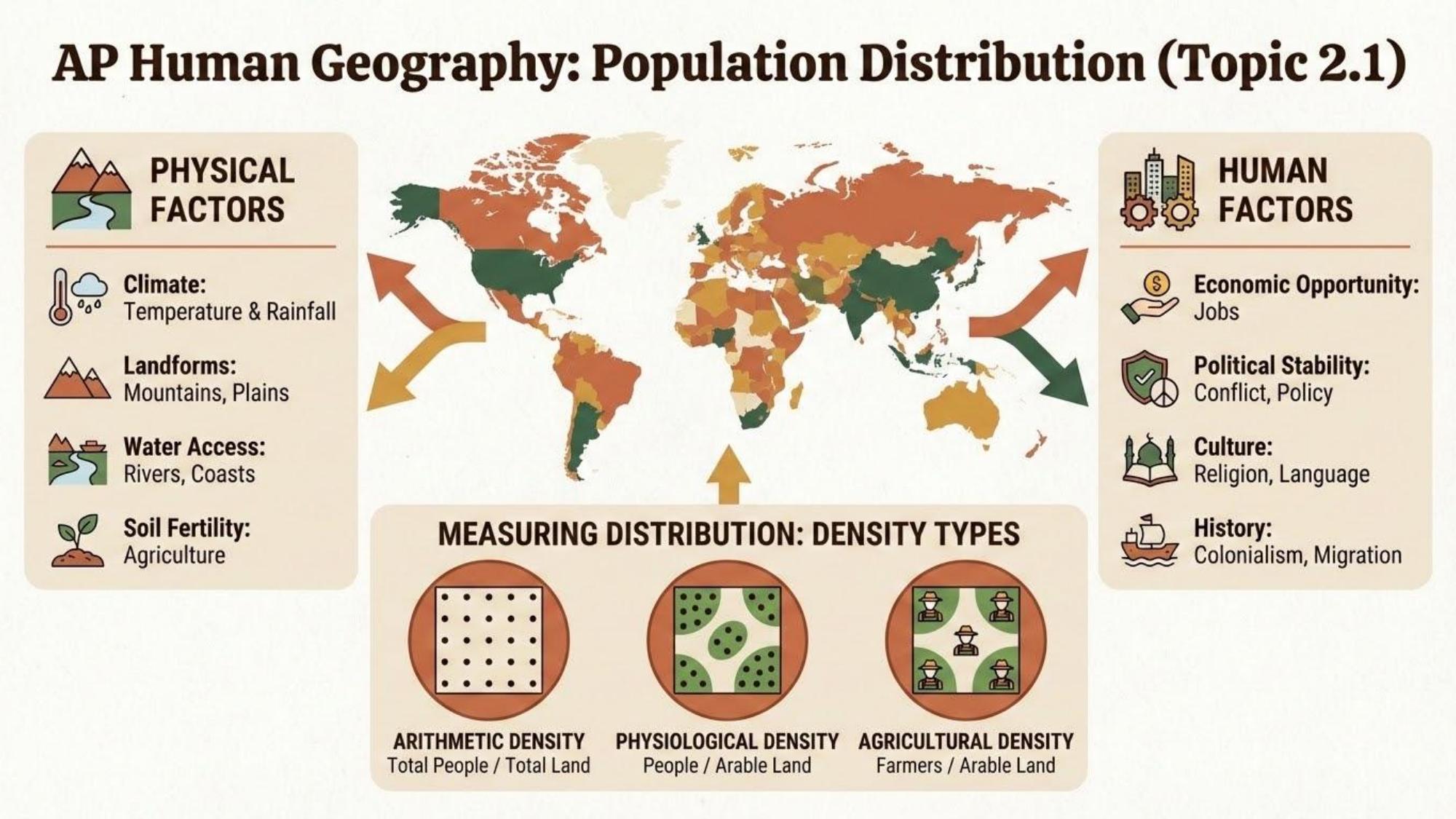
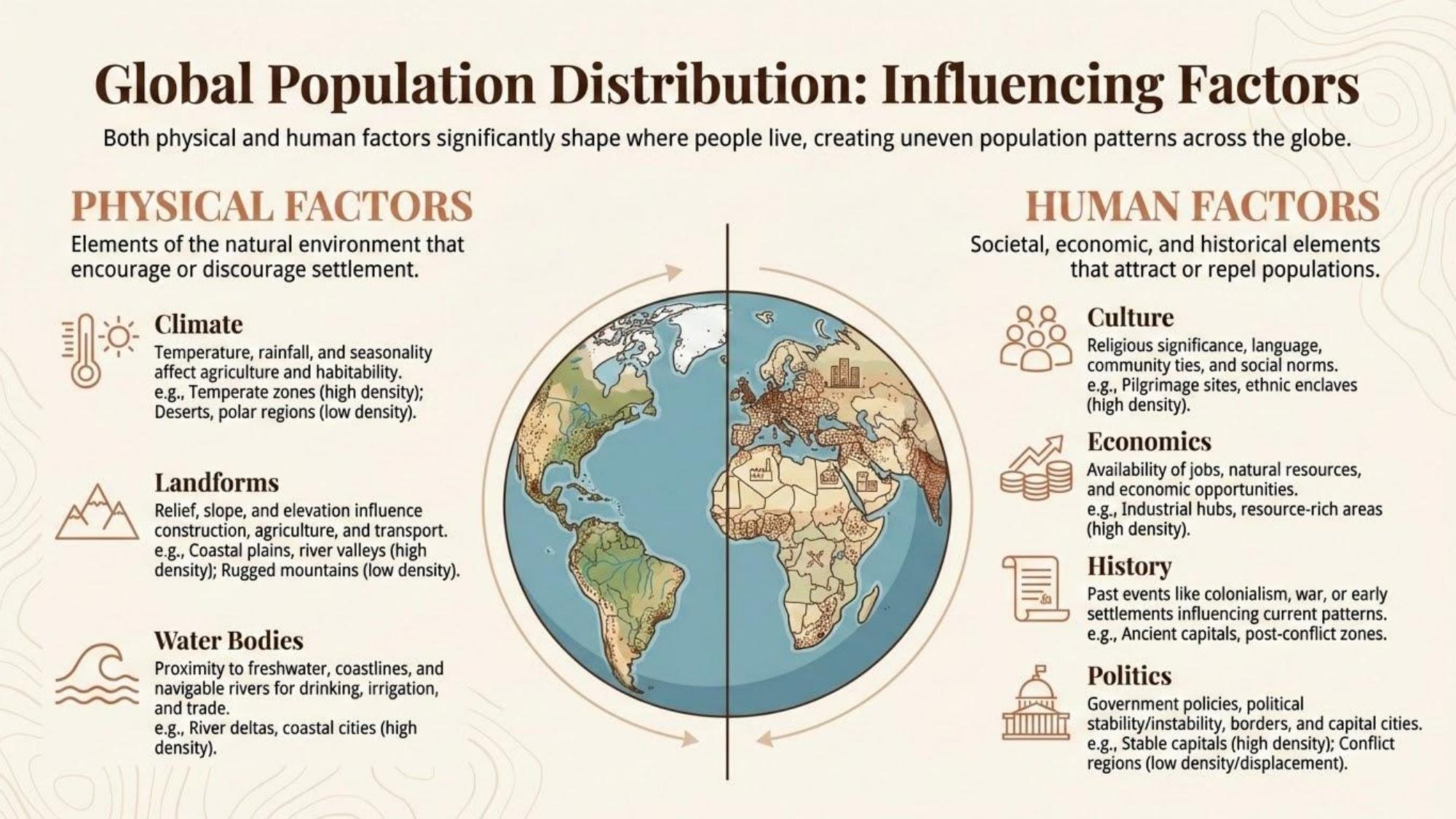
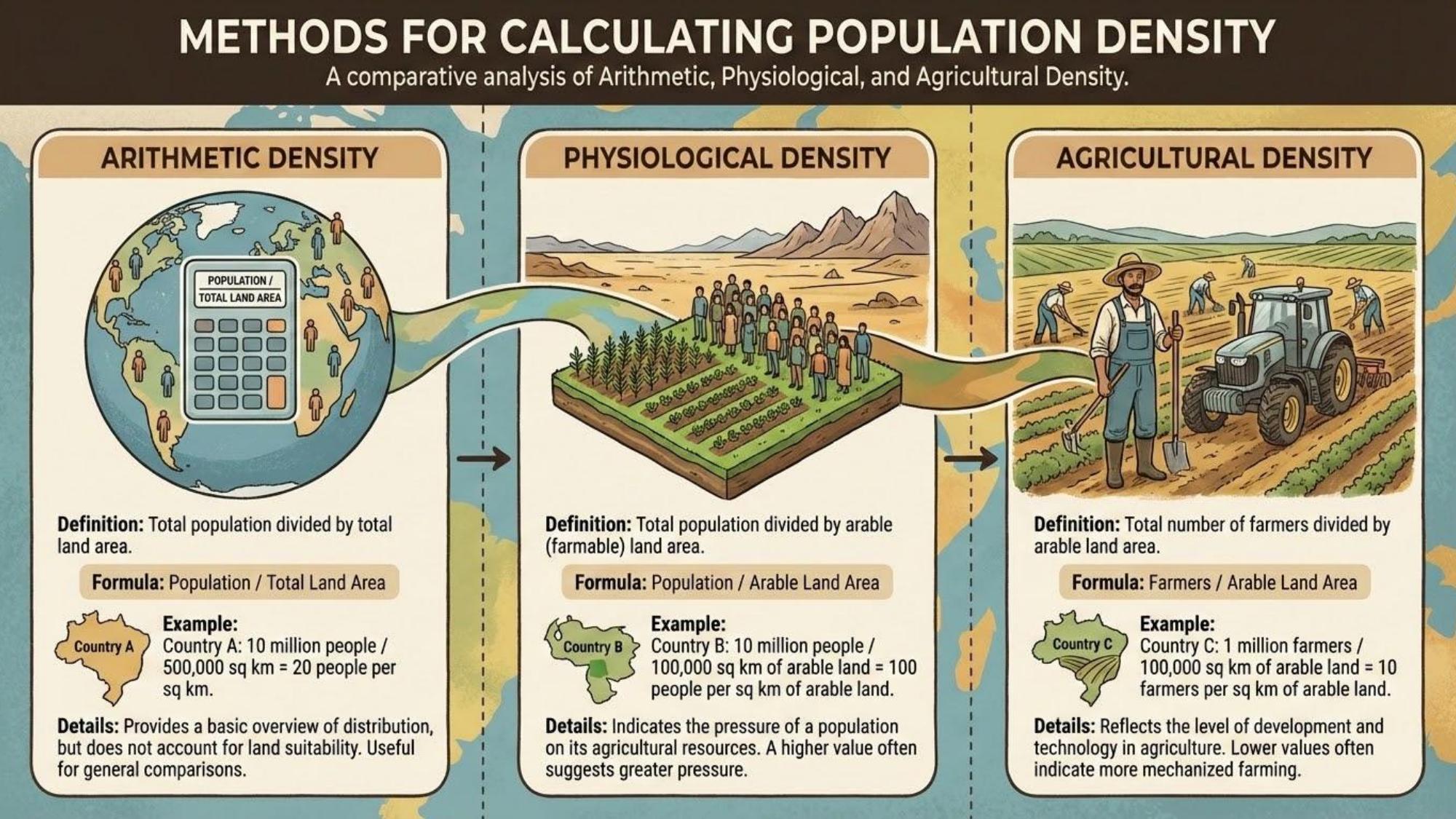
Population is unevenly distributed — and geography explains why
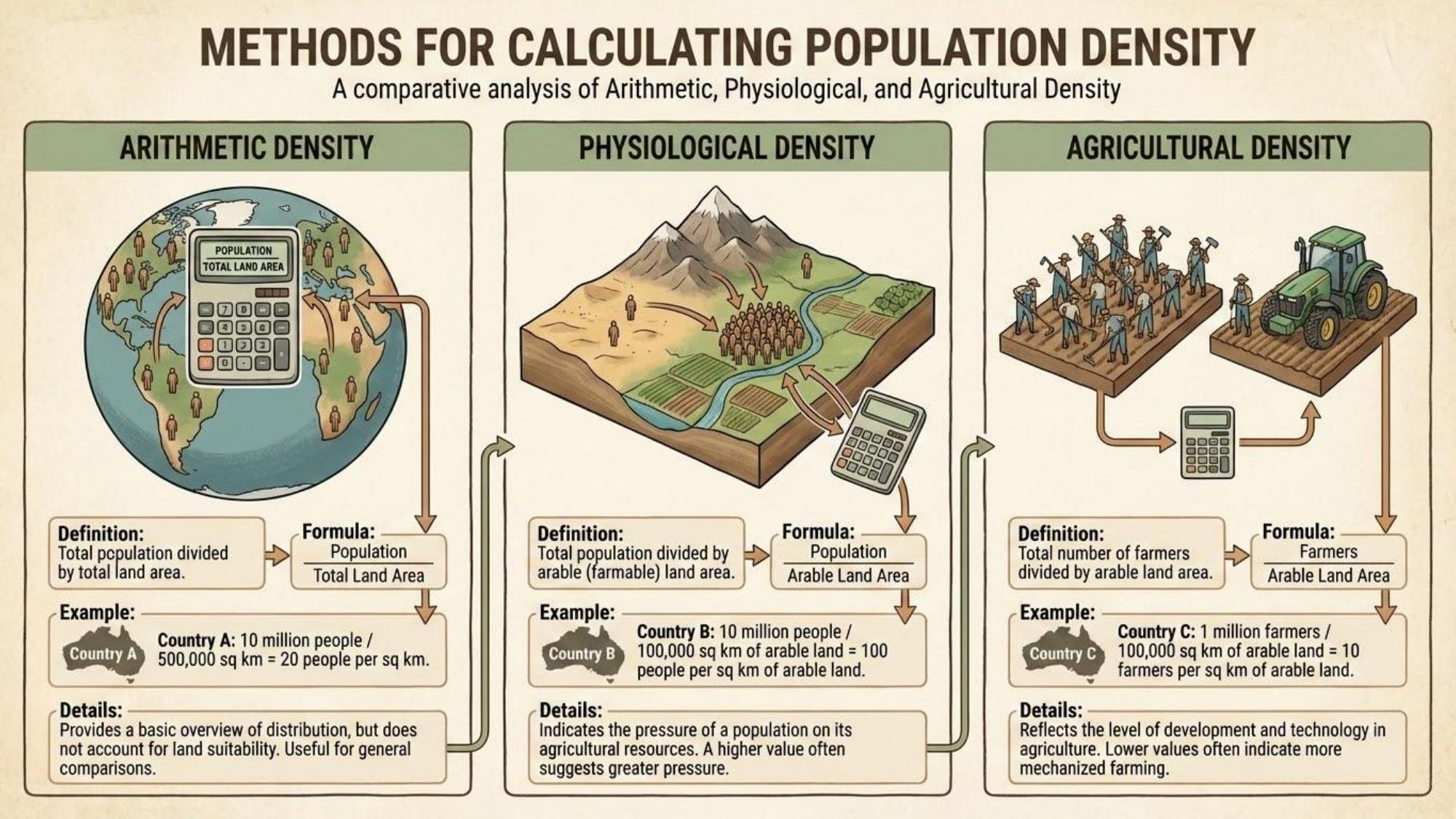
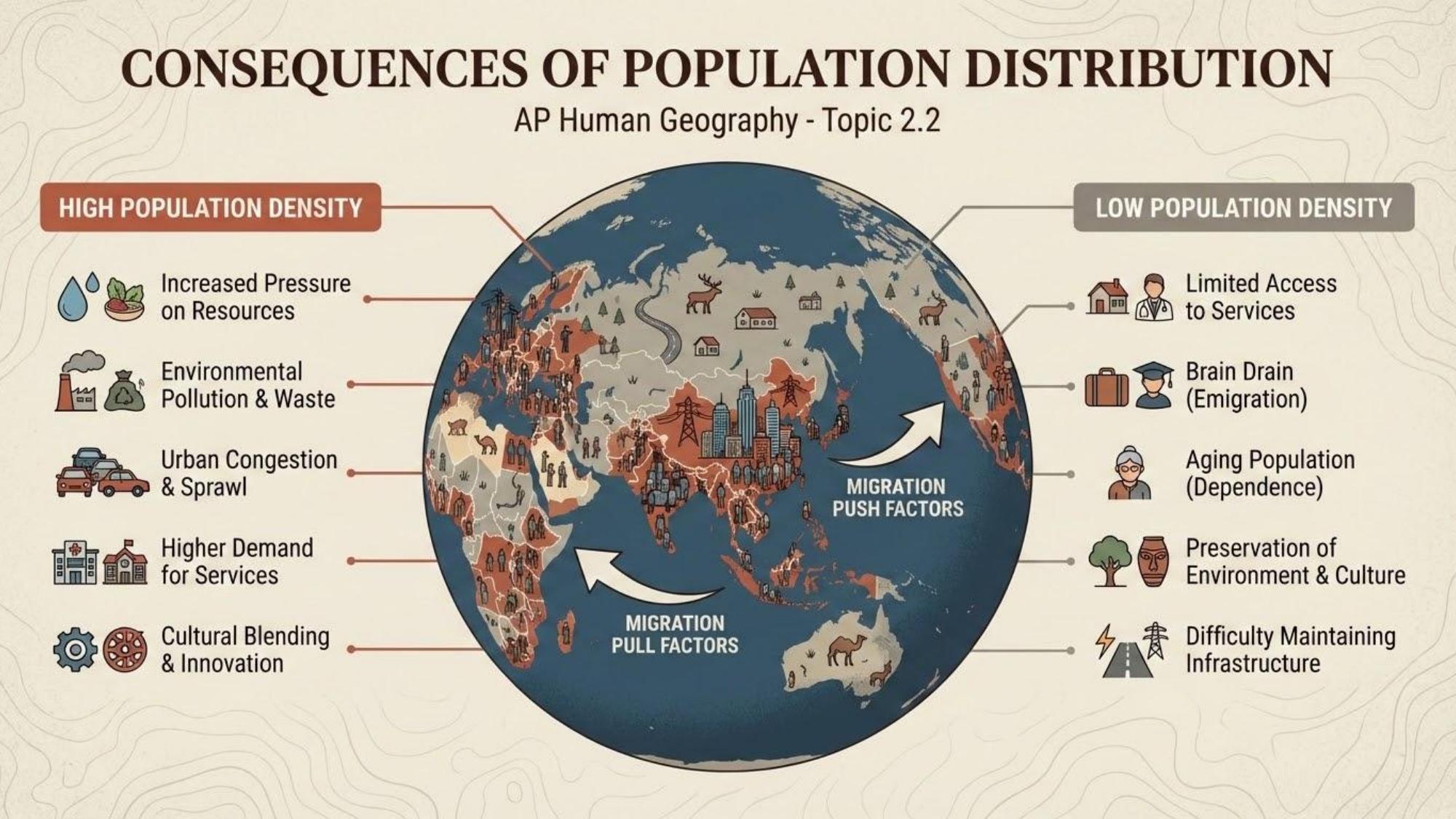
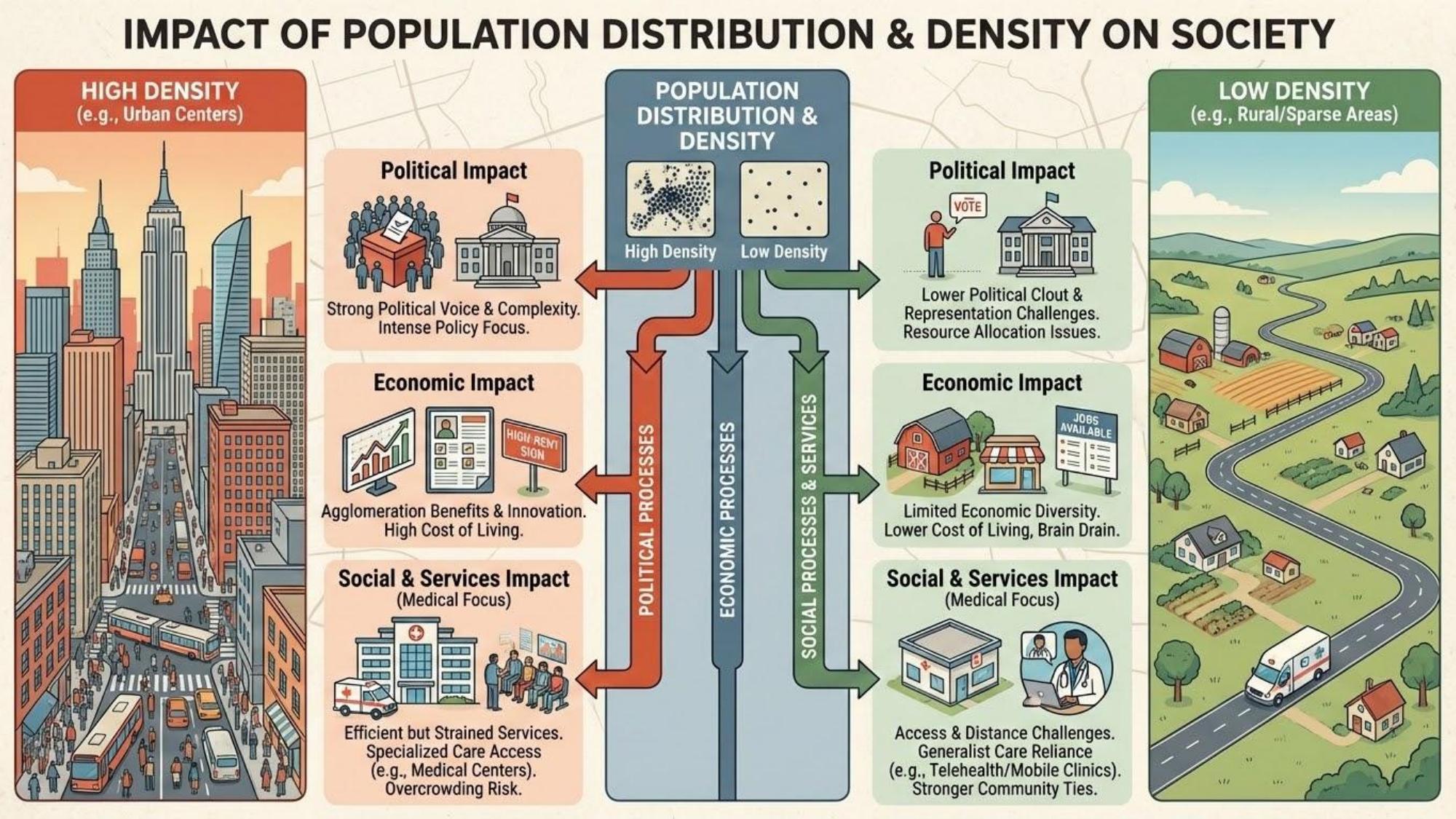
Most of the world's 8 billion people live in a few densely populated clusters: East Asia, South Asia, Europe, and eastern North America. Physical geography (climate, terrain, water), history, and economic opportunity all explain these patterns.
Distribution Density Ecumene
Big Idea 2
The Demographic Transition Model reveals development patterns
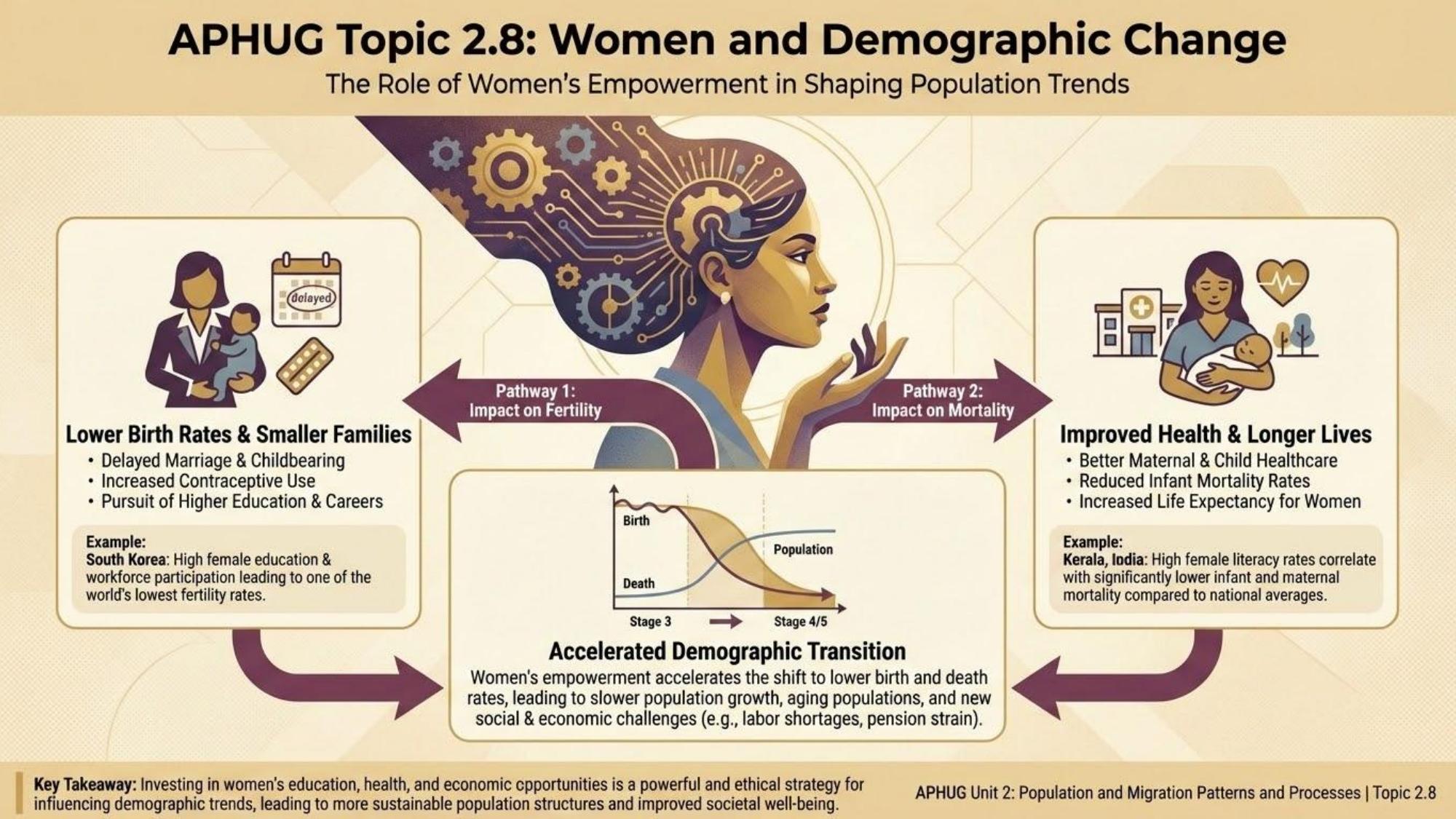
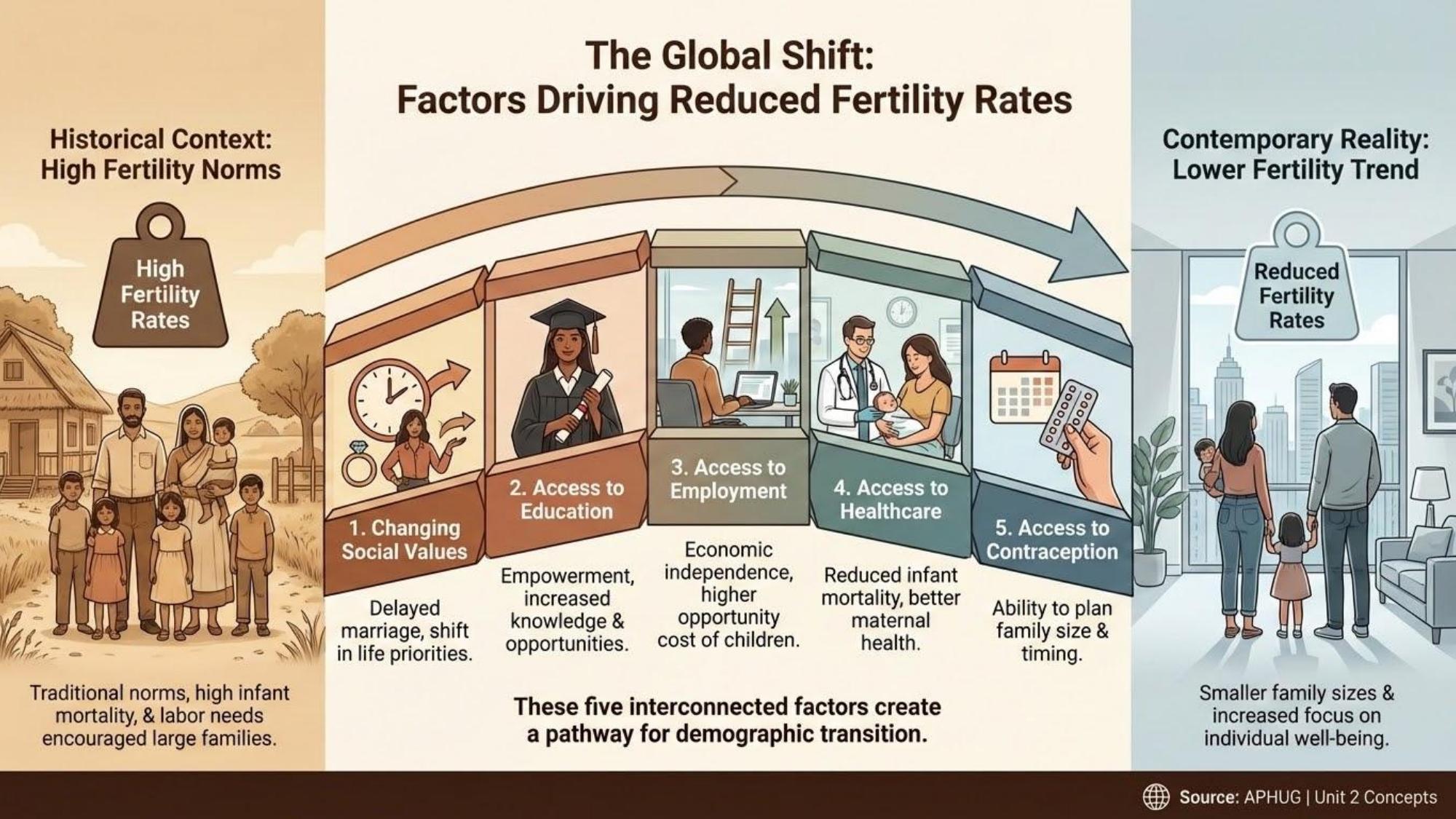
Countries move through predictable stages of population change as they develop economically — from high birth/death rates to low birth/death rates. Understanding where a country sits in the DTM explains its population challenges and policy needs.
DTM Development Policy
Big Idea 3
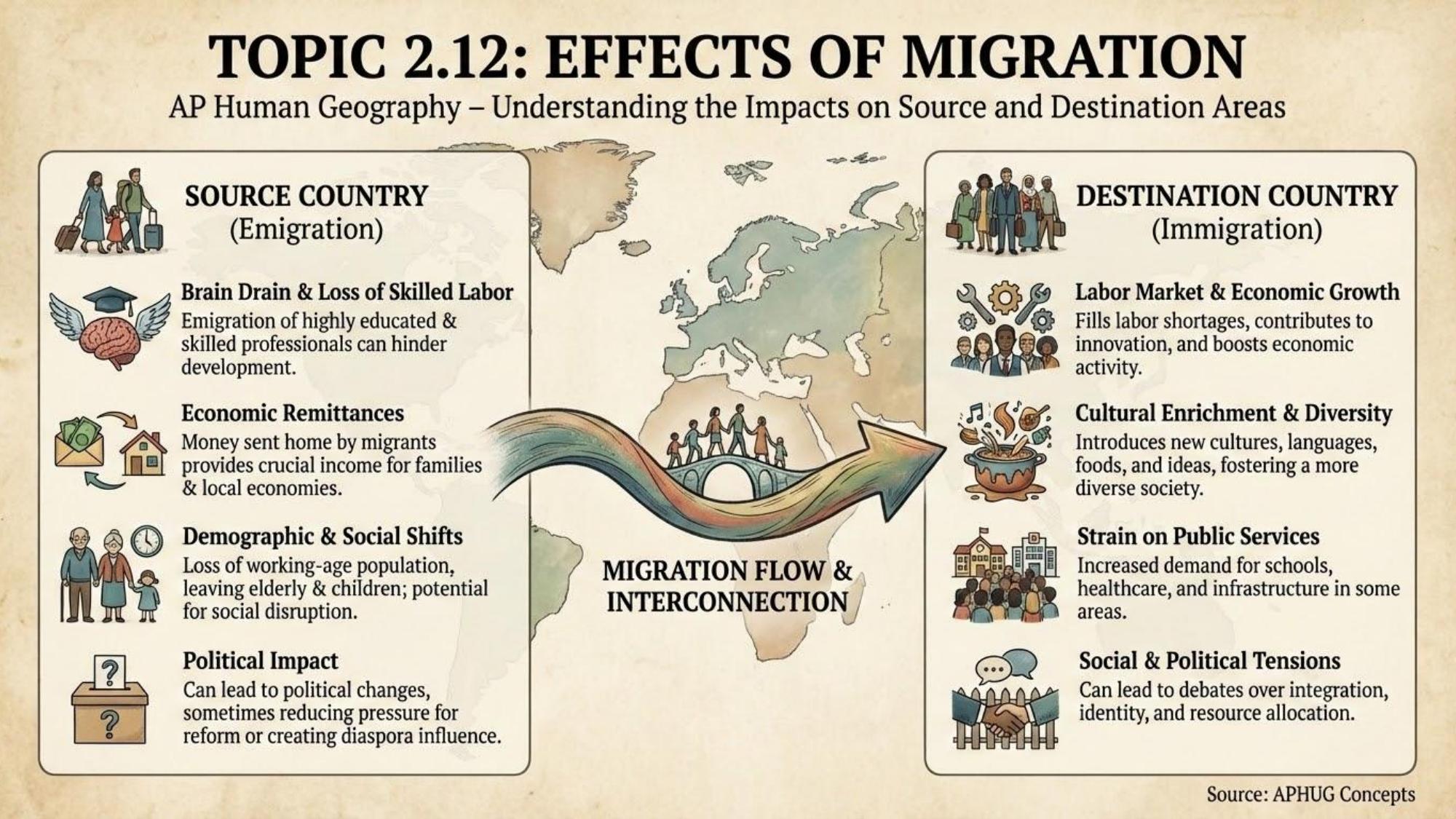
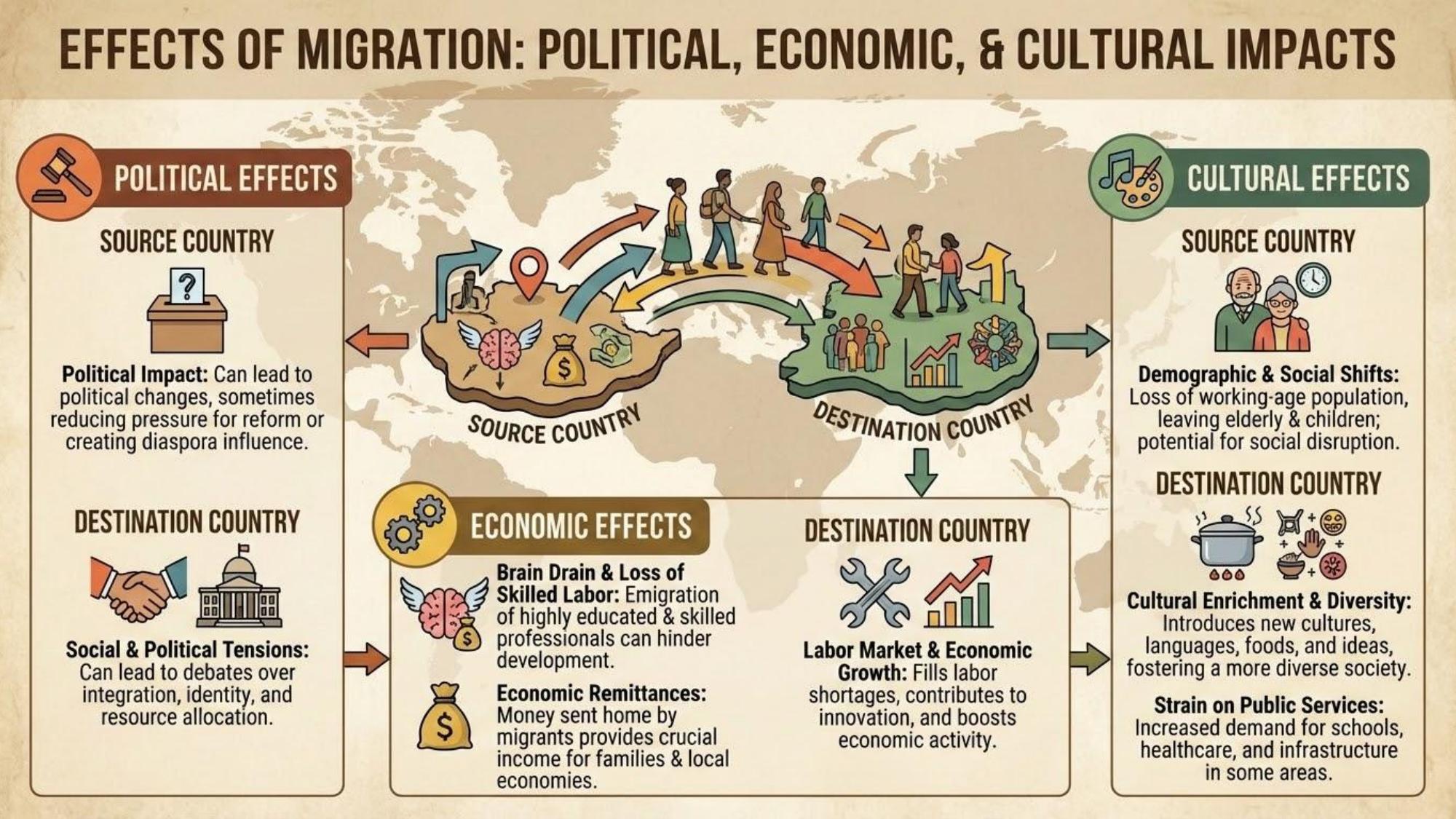
Migration reshapes populations, economies, and cultures
Migration is one of the most powerful forces in geography. It transfers labor, remittances, and cultural practices across borders. Understanding push/pull factors, migration streams, and their consequences is central to AP Human Geography.
Migration Push-Pull Consequences
Big Idea 4
Population policies reflect political values and demographic realities
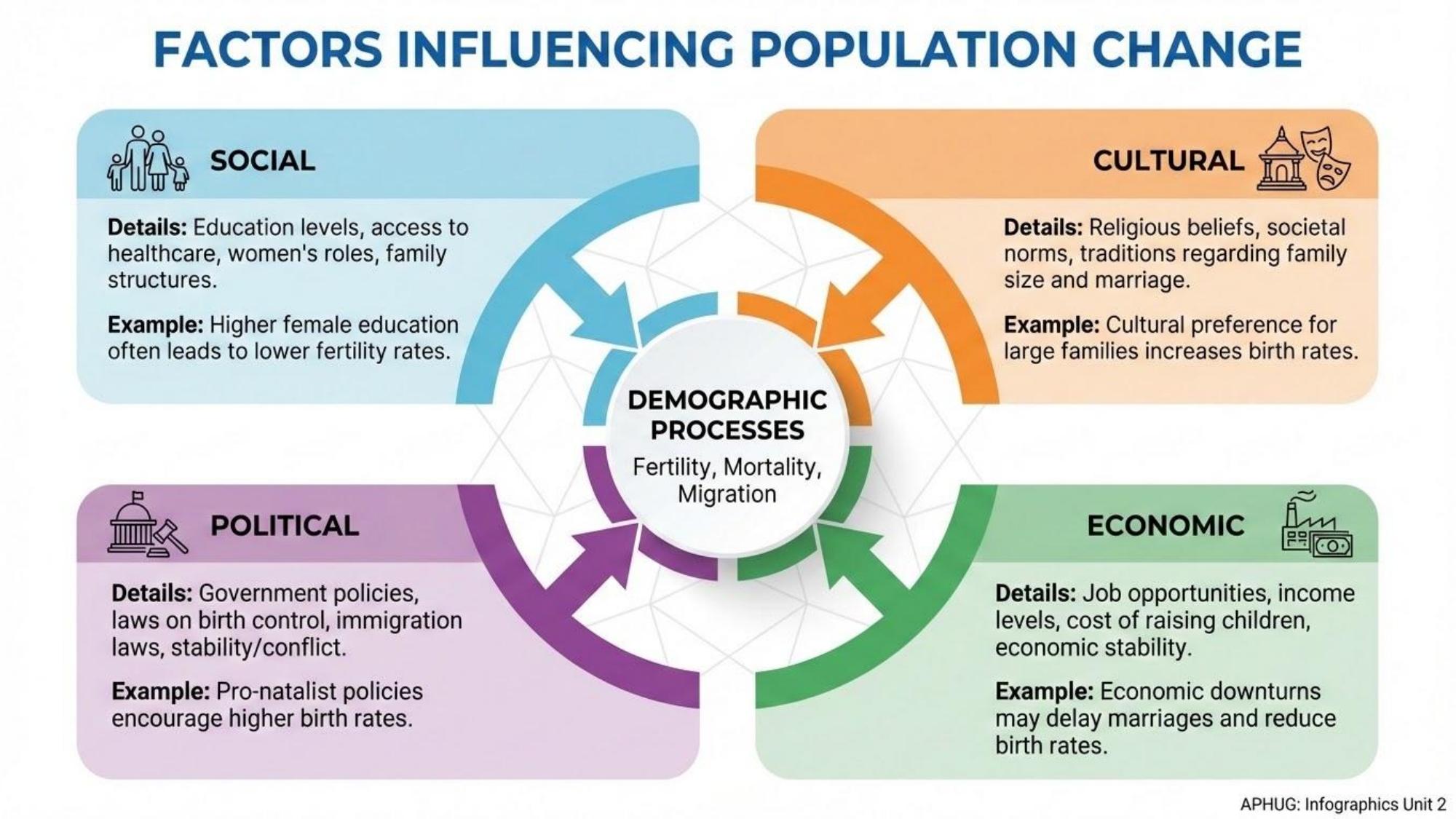
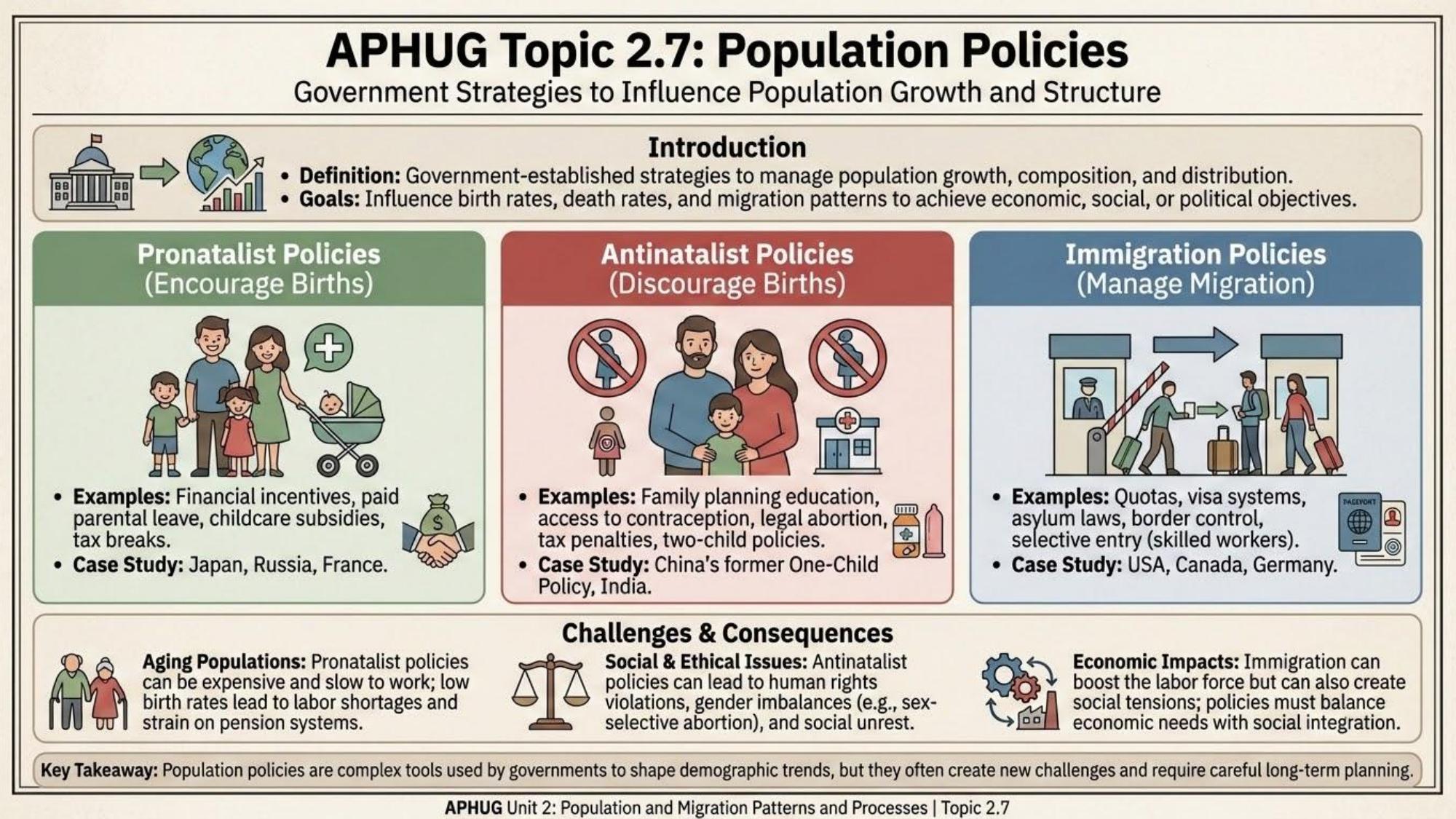
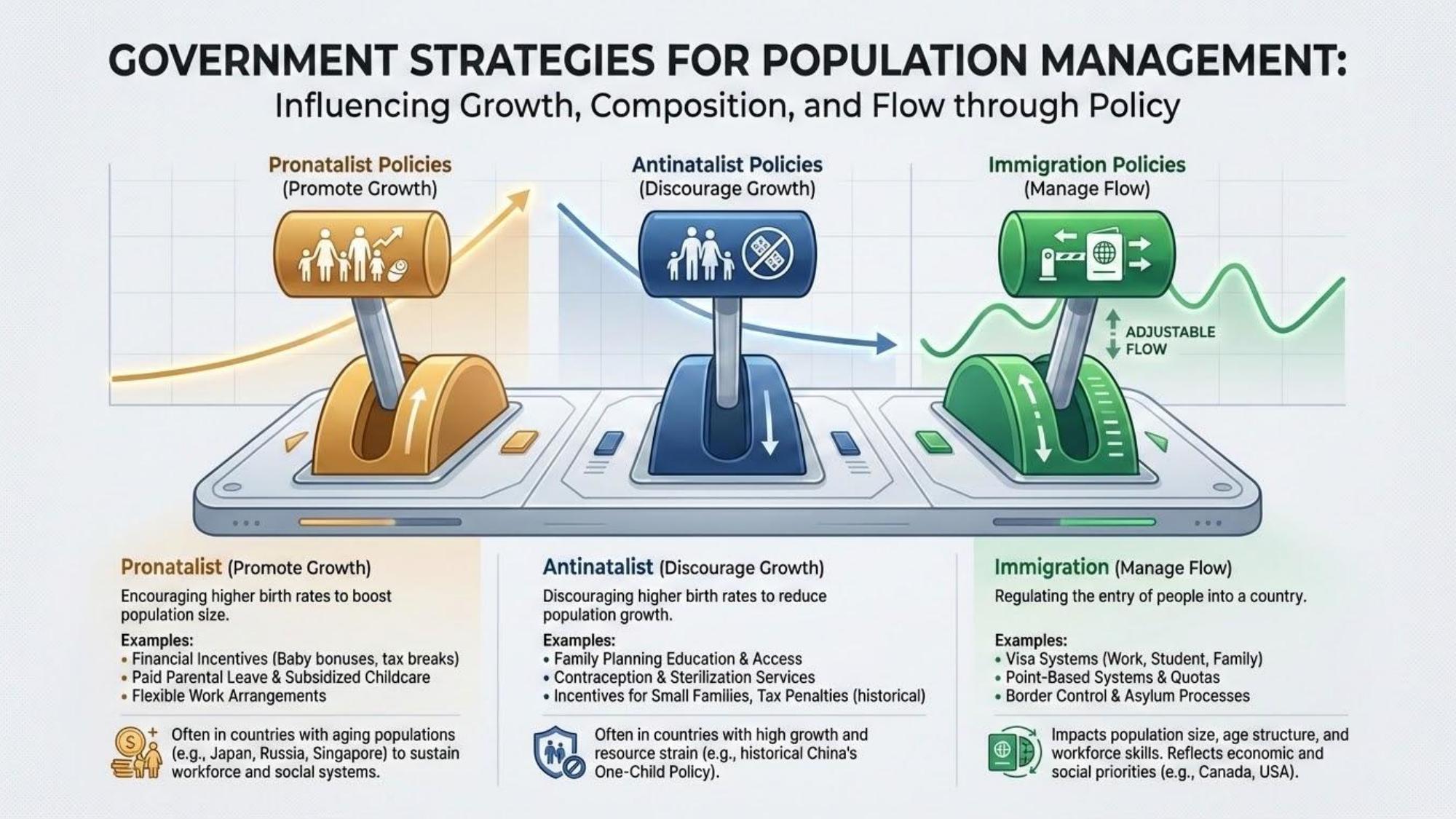
Governments respond to population trends with policies — pro-natalist (encouraging births), anti-natalist (discouraging births), or migration-focused. These policies reflect both demographic needs and political ideologies.
Policy Natalism Government
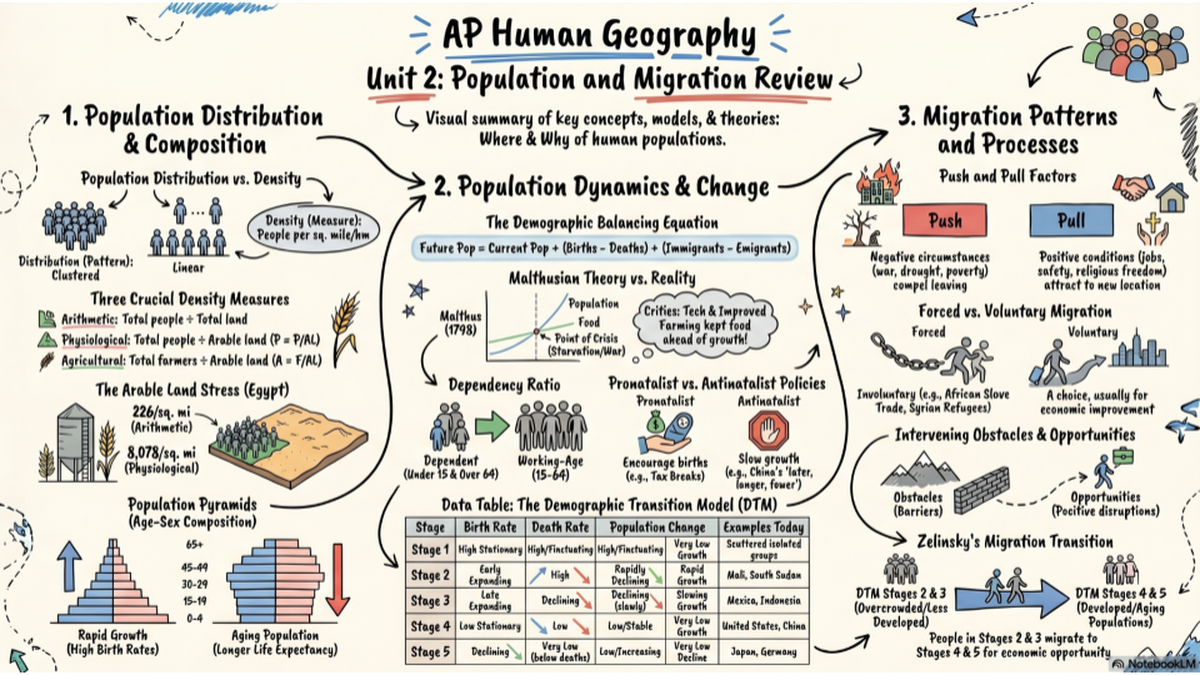
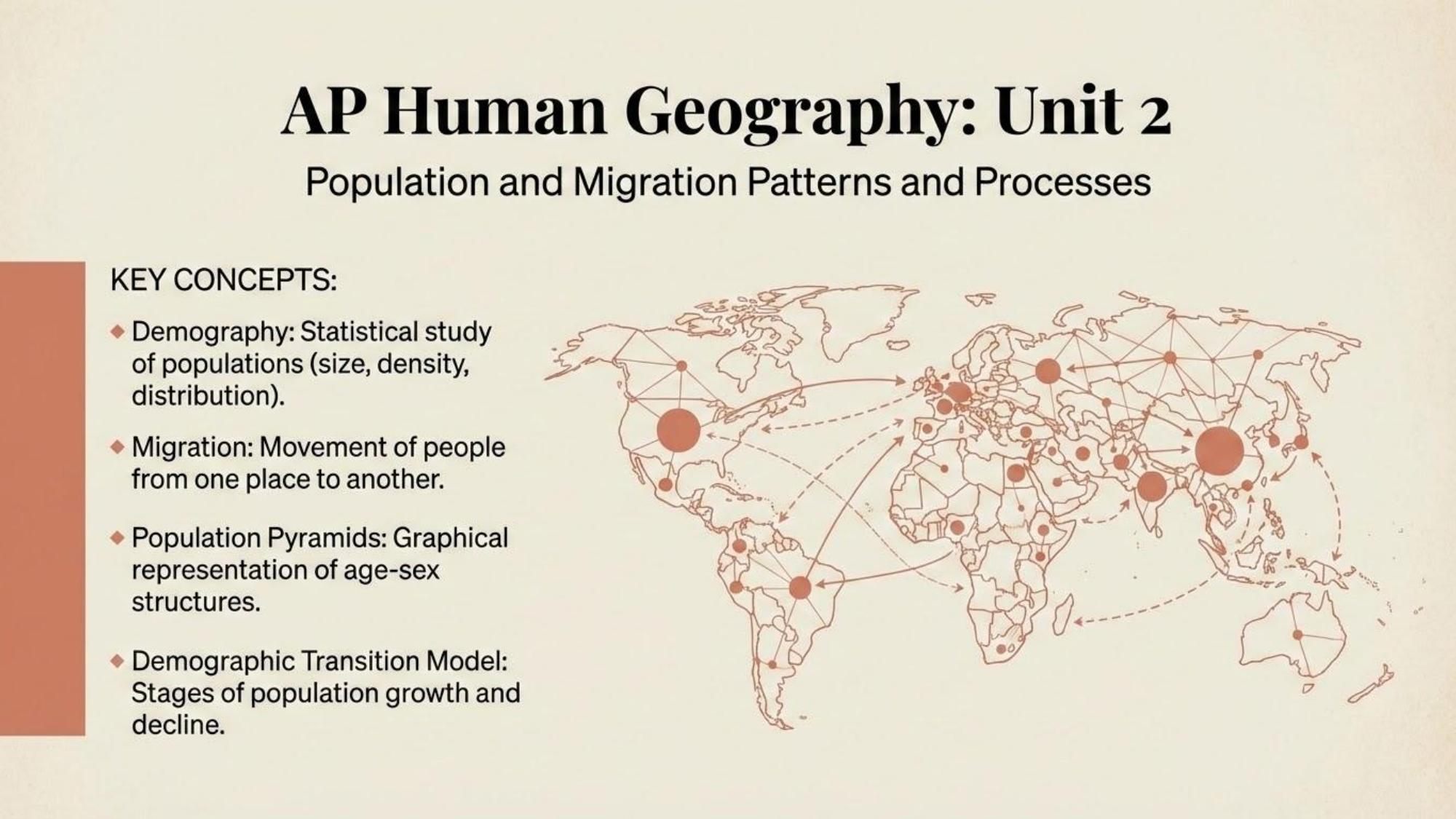
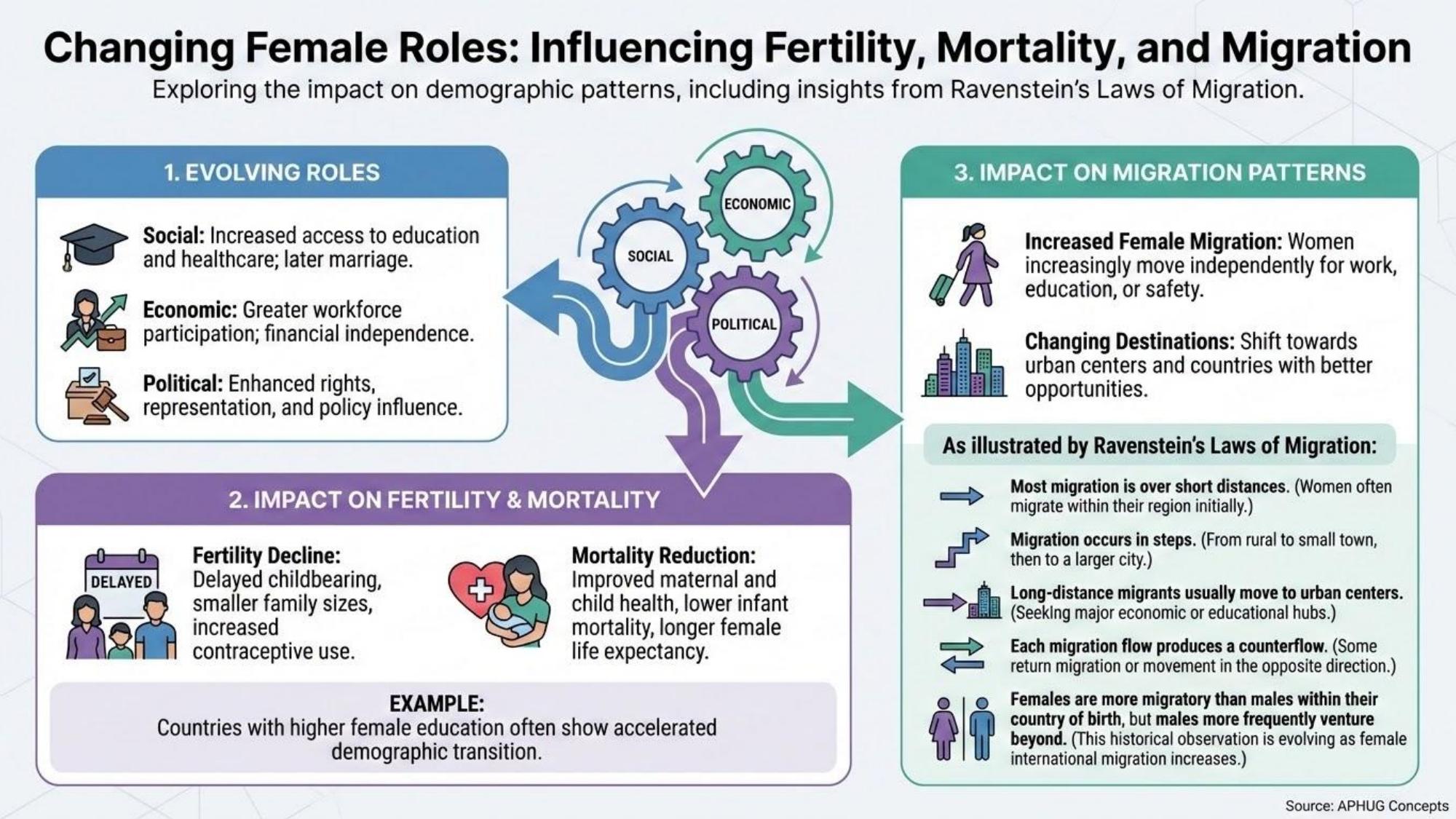
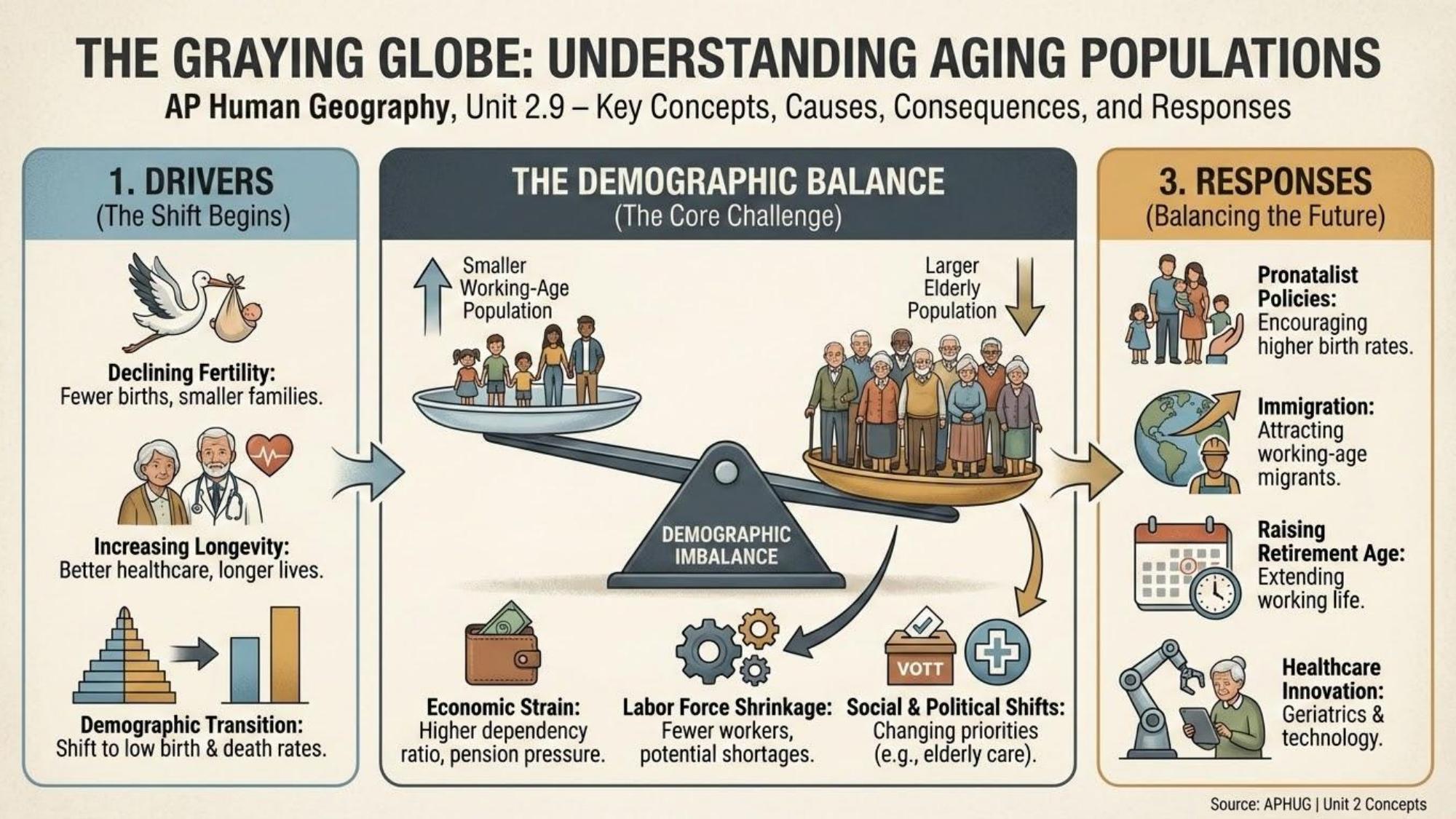
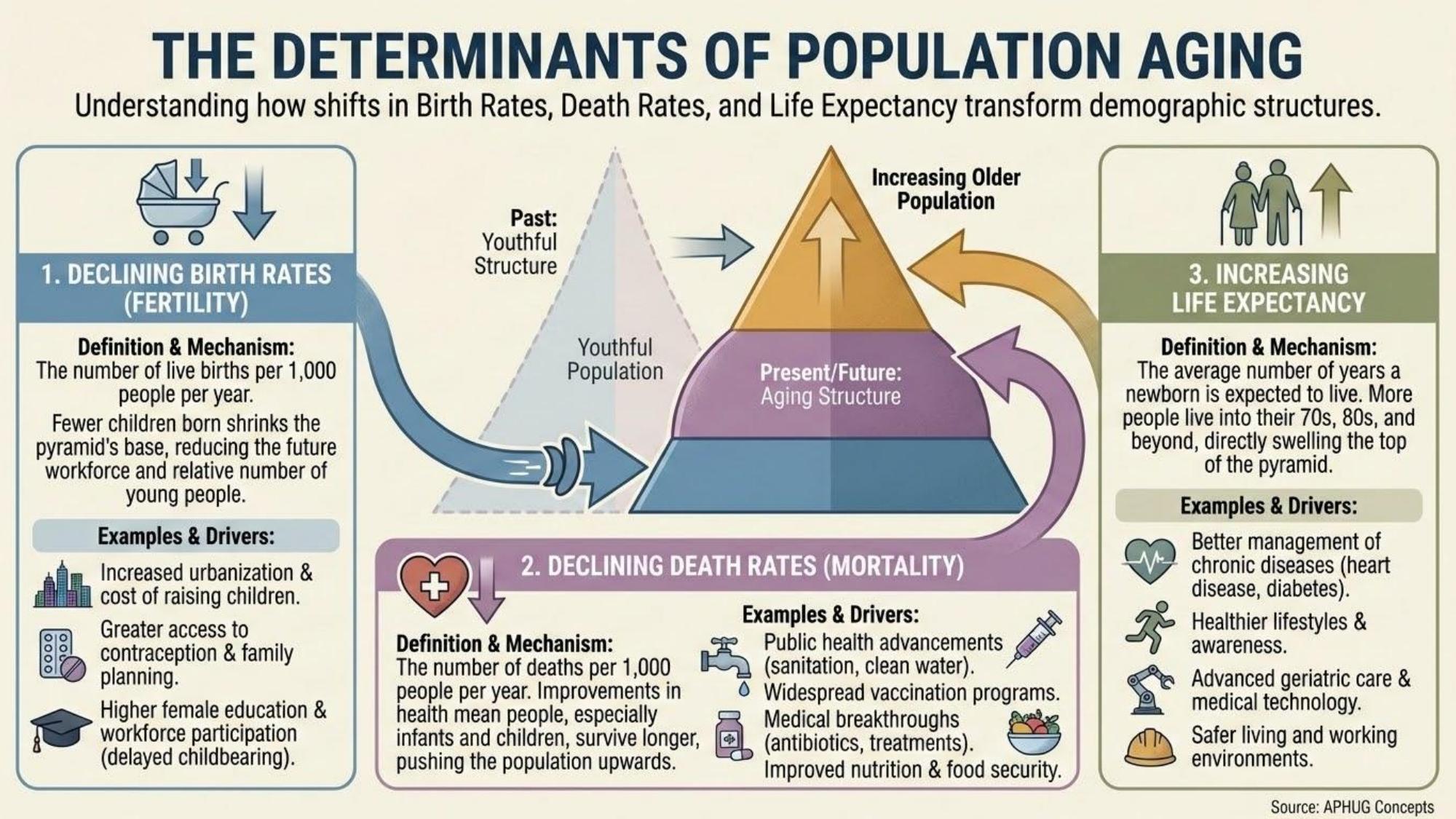
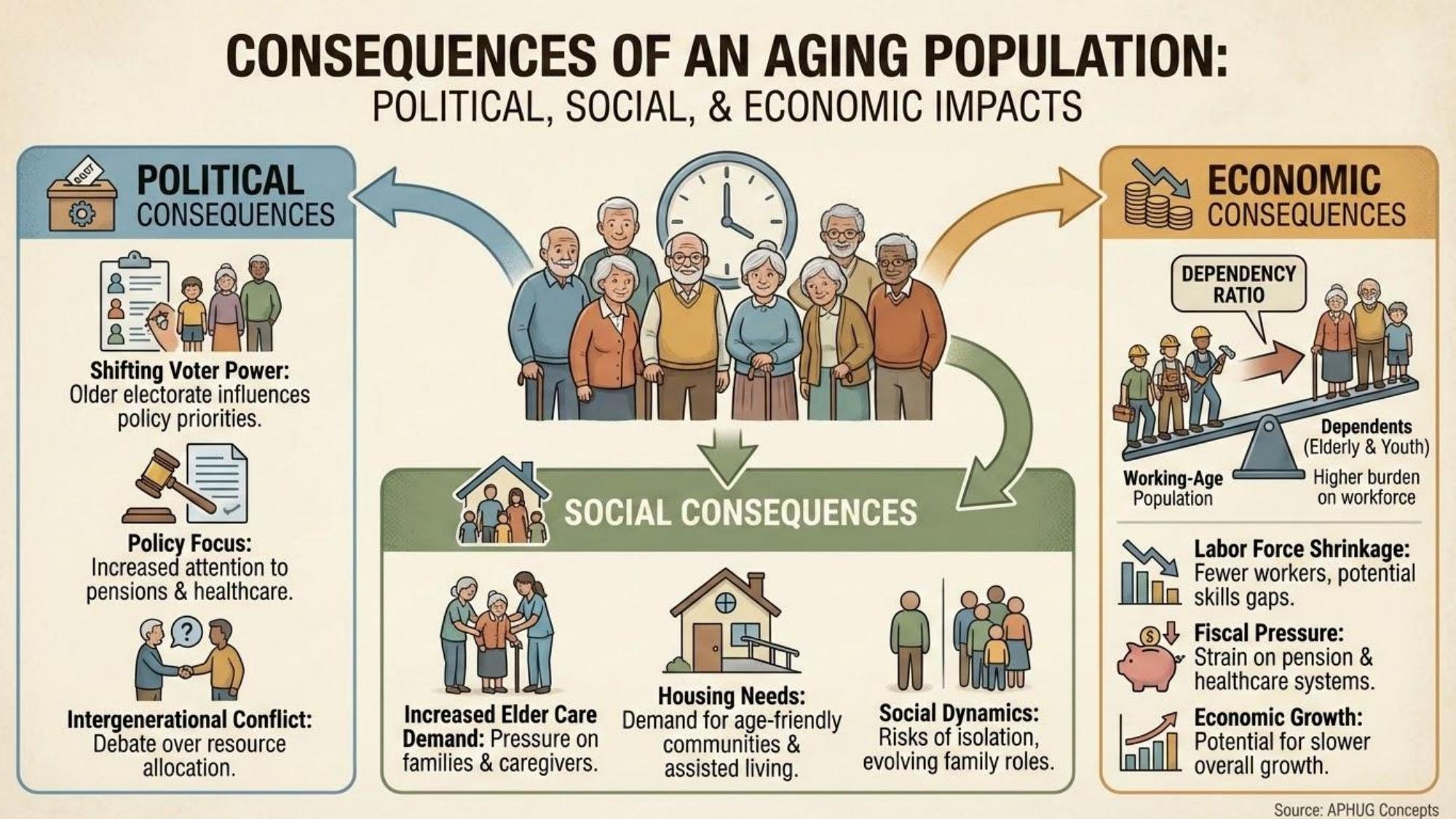
Unit 2: Population & Migration Patterns and Processes infographic
Unit visual review slide 1 Unit visual review slide 2 Unit visual review slide 3 Unit visual review slide 4 Unit visual review slide 5 Unit visual review slide 6 Unit visual review slide 7 Unit visual review slide 8 Unit visual review slide 9 Unit visual review slide 10 Unit visual review slide 11 Unit visual review slide 12 Unit visual review slide 13 Unit visual review slide 14 Unit visual review slide 15 Unit visual review slide 16 Unit visual review slide 17 Unit visual review slide 18 Unit visual review slide 19 Unit visual review slide 20 Unit visual review slide 21 Unit visual review slide 22 Unit visual review slide 23 Unit visual review slide 24 Unit visual review slide 25 Unit visual review slide 26 Unit visual review slide 27 Unit visual review slide 28 Unit visual review slide 29 Unit visual review slide 30 Unit visual review slide 31 Unit visual review slide 32 Unit visual review slide 33 Unit visual review slide 34 Unit visual review slide 35
1 / 35
3
Unit 3

Cultural Patterns & Processes

approx. 12–17% of exam
🎙

Unit 3: Cultural Patterns & Processes

Cultural landscapes, language diffusion, religion's role in shaping place, and the forces of cultural change.

🎙 Episode 3  ·  18:25
0:0018:25
Question
What is a "cultural landscape"?
Unit 3 · Cultural Patterns & Processes
tap to flip
Answer
The visible imprint of human activity on the natural landscape — including buildings, roads, and land use patterns that reflect a culture's values and history.
Card 1 of 12
Question 1 of 5 Score: 0/5
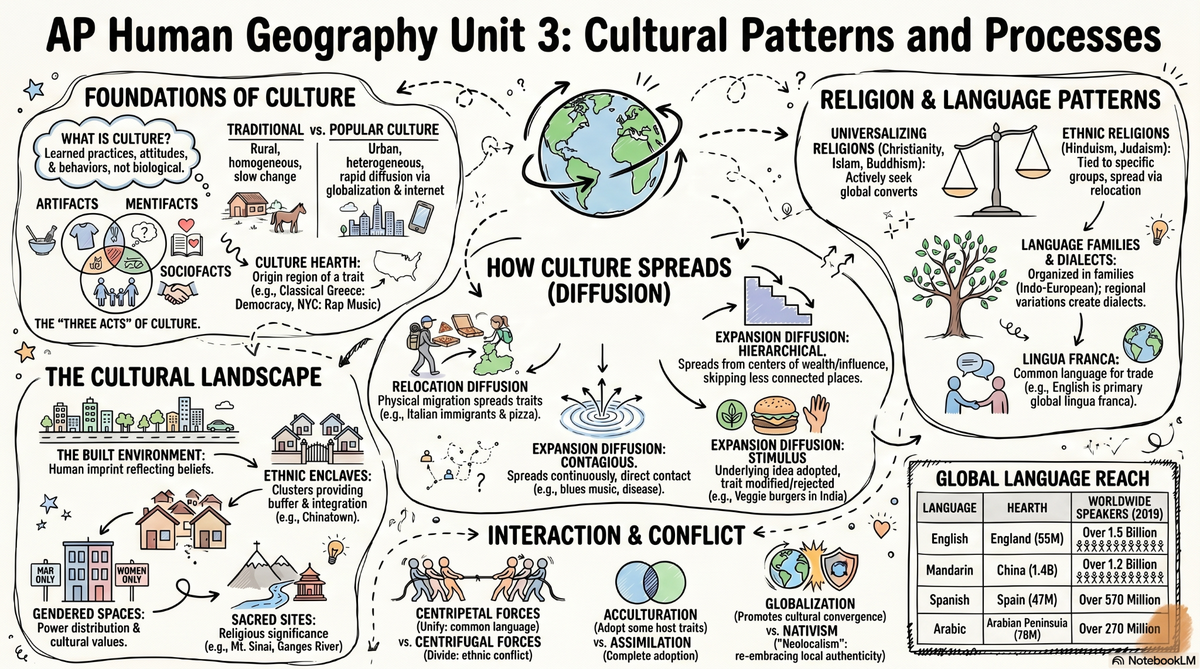
Cultural Landscape
Visible human modification of the natural landscape, reflecting cultural values and practices.
Culture & Place
Cultural Hearth
Place of origin of a major culture from which traits spread outward.
Diffusion
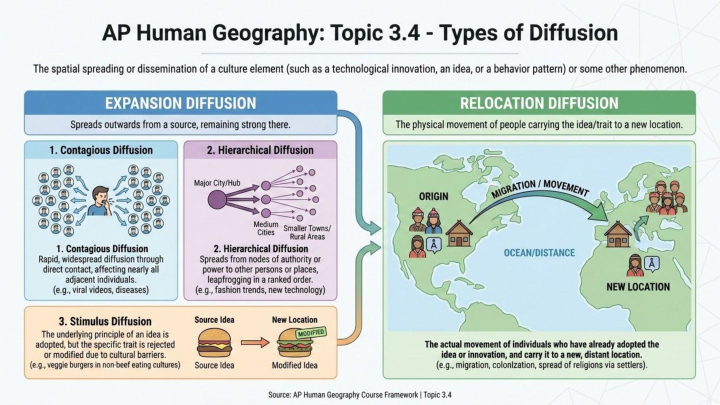
Contagious Diffusion
Rapid, widespread spread of a cultural trait from a source in all directions.
Diffusion
Hierarchical Diffusion
Spread of a cultural trait from large places or elites to smaller places or masses.
Diffusion
Stimulus Diffusion
Spread of an underlying principle even when the specific trait is rejected.
Diffusion
Relocation Diffusion
Spread of culture through the physical movement of people from one place to another.
Diffusion
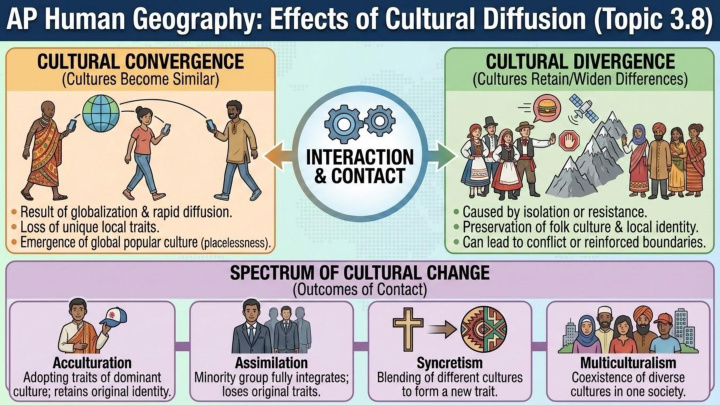
Acculturation
Adoption of elements of a dominant culture by a minority group while retaining some original traits.
Cultural Change
Assimilation
Full absorption of a minority culture into a dominant culture.
Cultural Change
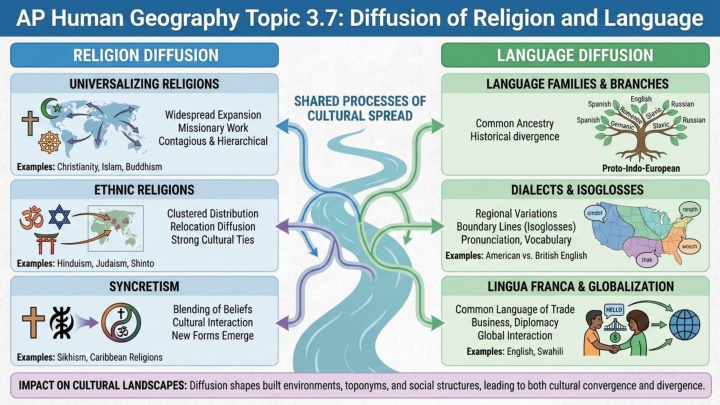
Syncretism
Blending of two or more cultural traditions into a new hybrid form.
Cultural Change
Lingua Franca
Common language used for communication among people with different native languages.
Language
Language Family
Group of languages sharing a common ancestral origin (e.g., Indo-European).
Language
Universalizing Religion
Religion that actively seeks converts worldwide (Christianity, Islam, Buddhism).
Religion
Ethnic Religion
Religion tied to a specific ethnic group or place; does not seek converts (Hinduism, Judaism).
Religion
Placelessness
Loss of unique place identity due to globalization and standardized landscapes.
Globalization
Big Idea 1
Culture is learned, shared, and constantly changing
Culture includes language, religion, customs, food, art, and architecture — all transmitted across generations and adapted over time. No culture is static; contact with other cultures, migration, and technology all drive change.
Culture Diffusion Change
Big Idea 2
Language and religion are the most powerful markers of cultural identity
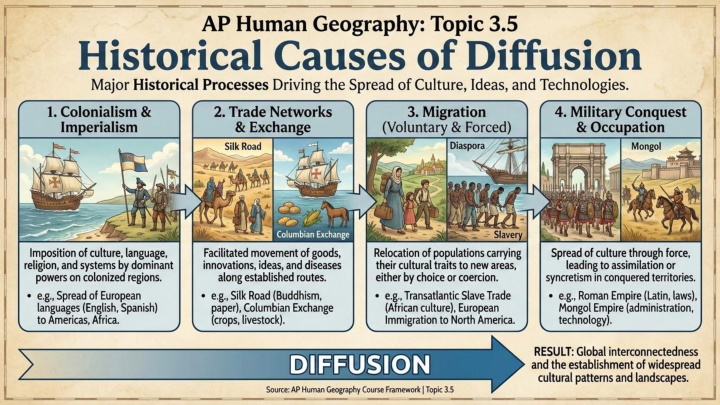
Language and religion shape how people see the world, organize societies, and relate to place. Their geographic distributions reflect historical migration, conquest, and trade — and their boundaries often coincide with political conflict zones.
Language Religion Identity
Big Idea 3
Cultural diffusion reshapes places — but so does resistance
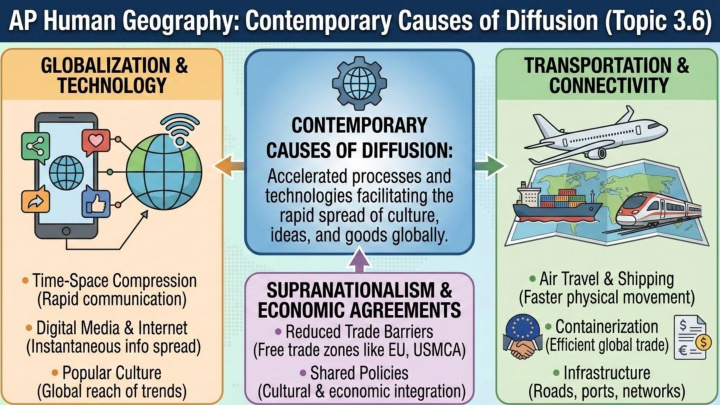
Globalization spreads cultural traits worldwide at unprecedented speed, creating both cultural homogenization and backlash. Understanding the types of diffusion (contagious, hierarchical, stimulus, relocation) and the forces that slow it helps explain cultural landscapes.
Diffusion Globalization Resistance
Big Idea 4
Cultural landscapes are geographic texts that can be read
The built environment reflects culture. Sacred spaces, architectural styles, urban street grids, and agricultural field patterns all encode cultural values and historical processes. Reading cultural landscapes is a core AP HuGe skill.
Cultural Landscape Built Environment Analysis
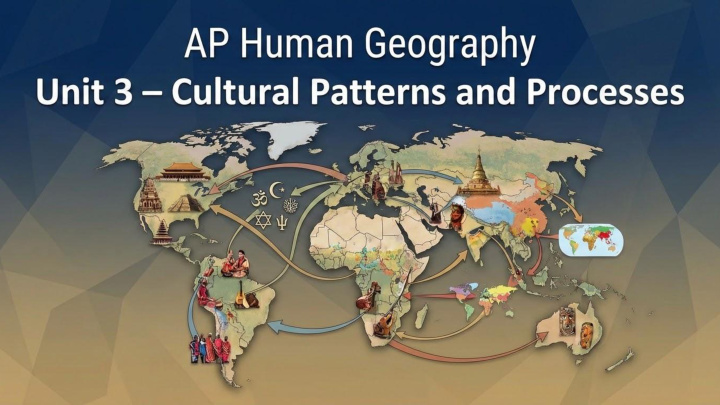
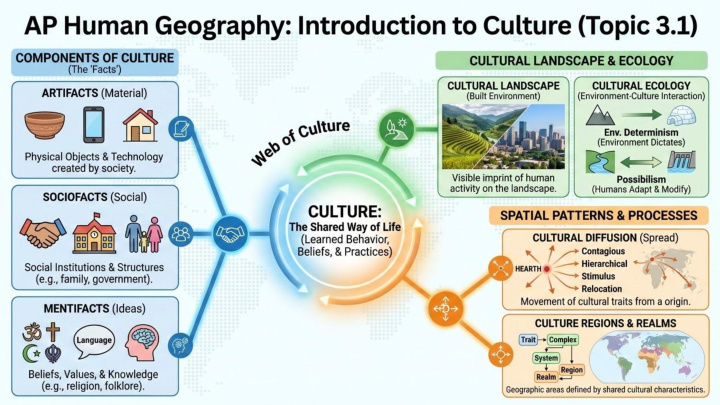
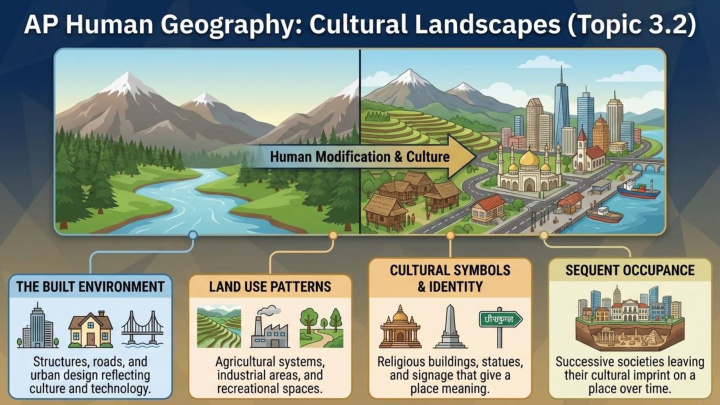
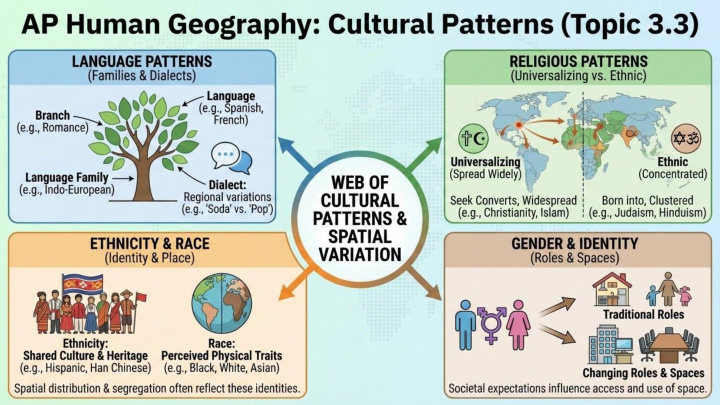
Unit 3: Cultural Patterns & Processes infographic
AP Human Geography Unit visual slide 1 AP Human Geography Unit visual slide 2 AP Human Geography Unit visual slide 3 AP Human Geography Unit visual slide 4 AP Human Geography Unit visual slide 5 AP Human Geography Unit visual slide 6 AP Human Geography Unit visual slide 7 AP Human Geography Unit visual slide 8 AP Human Geography Unit visual slide 9
1 / 9
4
Unit 4

Political Patterns & Processes

approx. 12–17% of exam
🎙

Unit 4: Political Patterns & Processes

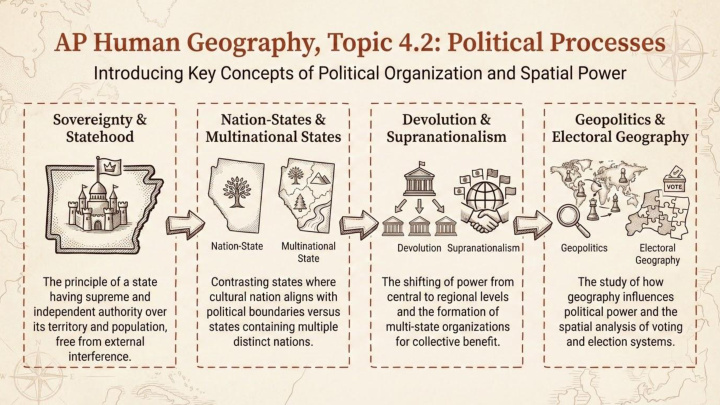
Nation-states, borders, sovereignty, supranationalism, devolution, and the geography of political power.

🎙 Episode 4  ·  18:13
0:0018:13
Question
What is the difference between a nation and a state?
Unit 4 · Political Patterns & Processes
tap to flip
Answer
A nation is a group of people sharing cultural identity (language, history, ethnicity). A state is a politically independent territory with a government. A nation-state is where the two align (e.g., Japan).
Card 1 of 12
Question 1 of 5 Score: 0/5
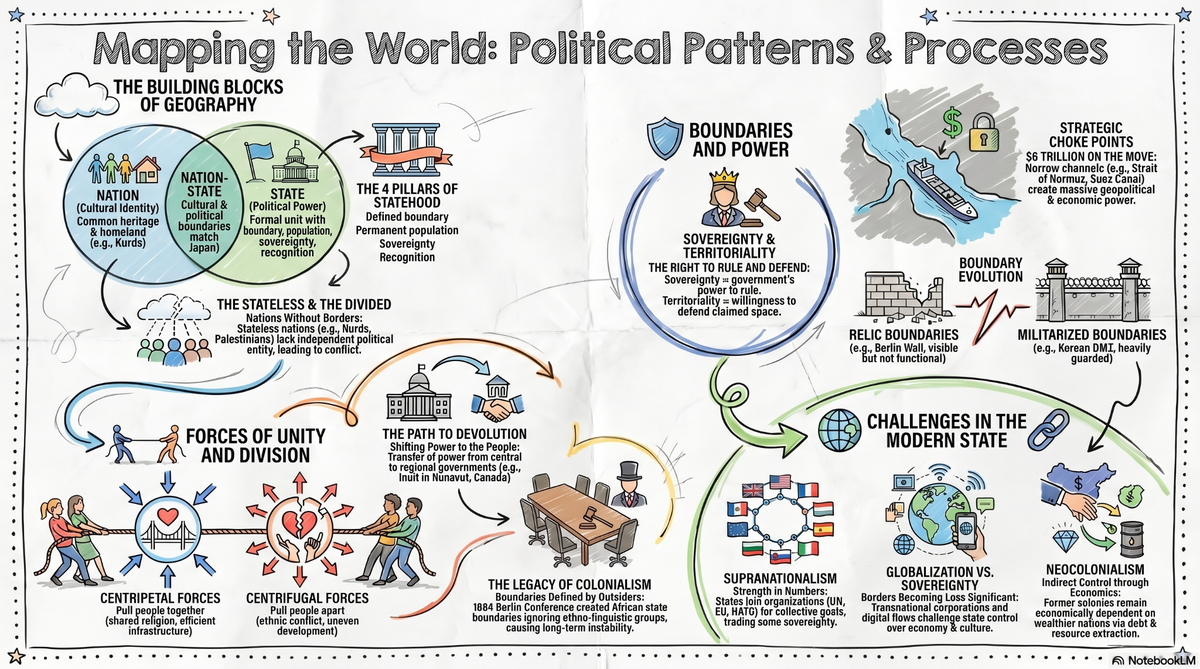
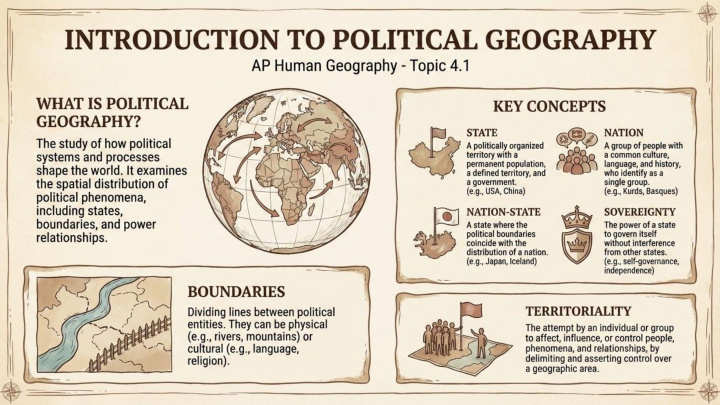
State
Politically organized territory with a permanent population, defined borders, government, and sovereignty.
Political Organization
Nation
Group of people with shared cultural identity — language, history, or ethnicity.
Political Organization
Nation-State
Ideal political unit where the cultural nation and political state coincide.
Political Organization
Sovereignty
The recognized right of a state to govern itself free from external interference.
Political Organization
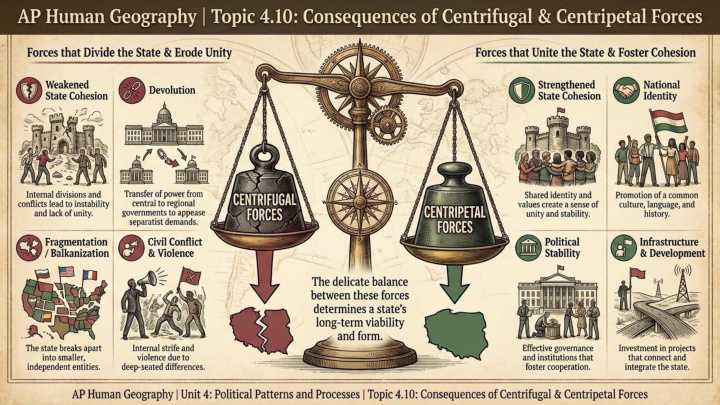
Devolution
Transfer of power from central to regional governments within a state.
Political Processes
Supranationalism
Voluntary pooling of sovereignty among states in a multinational organization.
Political Processes
Gerrymandering
Manipulation of electoral district boundaries to favor a political party or group.
Electoral Geography
Centripetal Force
Factor that unifies and strengthens a state (common language, national identity).
Political Cohesion
Centrifugal Force
Factor that divides and weakens a state (ethnic conflict, economic inequality).
Political Cohesion
Balkanization
Fragmentation of a state into smaller, hostile units — often along ethnic lines.
Political Processes
Stateless Nation
A cultural nation lacking its own independent state (e.g., Kurds, Palestinians).
Political Organization
Exclave / Enclave
Exclave: territory separated from main state. Enclave: territory surrounded by another state.
Borders & Territory
Heartland Theory
Mackinder's geopolitical theory that control of Eurasian interior equals world power.
Geopolitical Theories
Territorial Morphology
The shape of a state — compact, elongated, prorupted, perforated, or fragmented.
State Characteristics
Big Idea 1
The nation-state is the dominant form of political organization — but it's fragile
The idea that every nation deserves its own state is powerful but rarely achieved perfectly. Stateless nations, multinational states, and contested borders are far more common than true nation-states. This tension drives much of global conflict.
Nation-State Sovereignty Conflict
Big Idea 2
Borders are political constructs with real geographic consequences
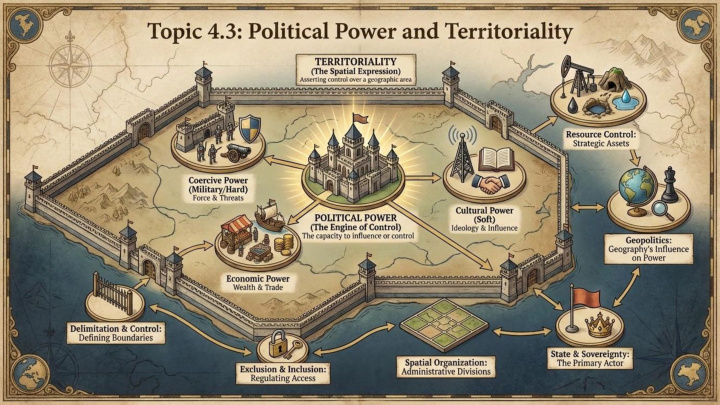
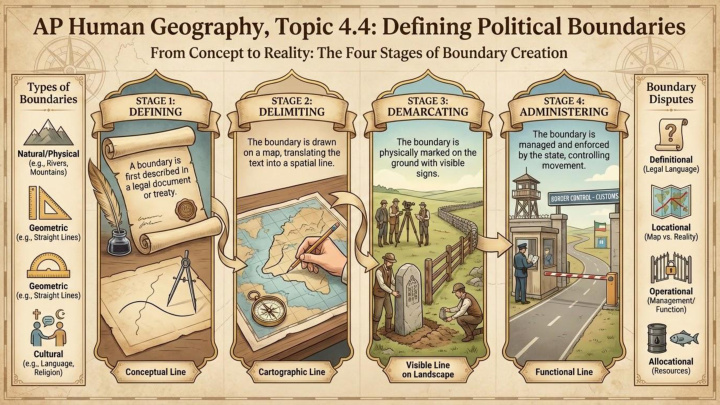
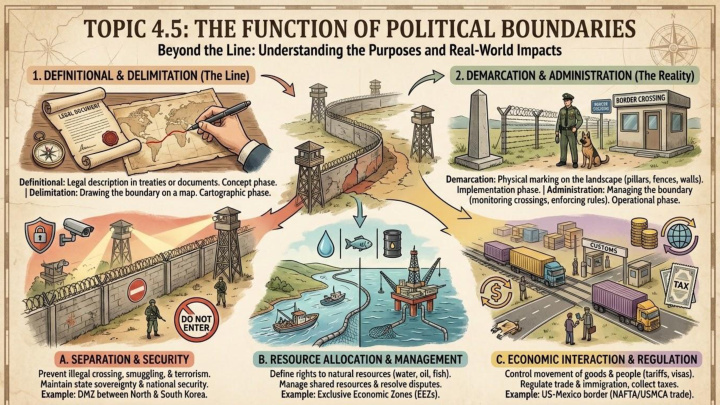
Borders define who belongs, who pays taxes, who votes, and who can cross. They can be natural (rivers, mountains) or geometric (straight lines), but all borders are political decisions with geographic impacts on trade, migration, and culture.
Borders Territory Power
Big Idea 3
States face simultaneous pressures to unite and divide
Centripetal forces (national identity, common language) compete with centrifugal forces (ethnic diversity, regional inequality) in every state. Devolution, separatism, and supranationalism are all responses to this tension.
Centripetal Centrifugal Devolution
Big Idea 4
Geopolitical theories reflect geographic thinking about power
Heartland theory, rimland theory, and other geopolitical frameworks attempt to explain global power through geography. Though often oversimplified, they reveal how location shapes strategic thinking — from Cold War policy to current US-China competition.
Geopolitics Power Strategy
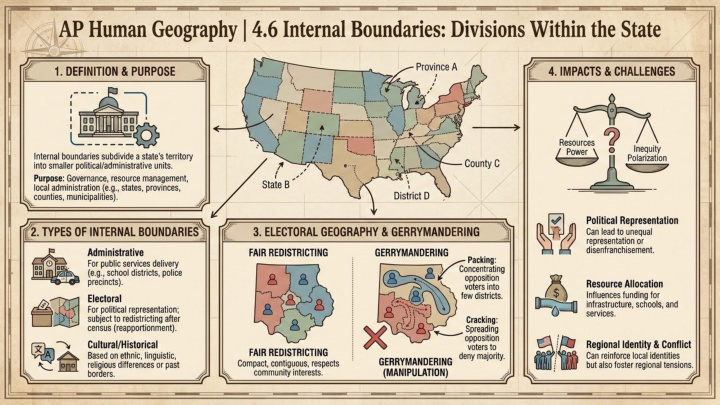
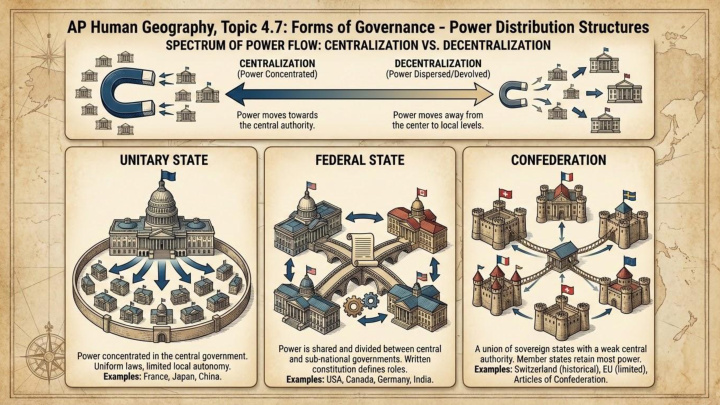
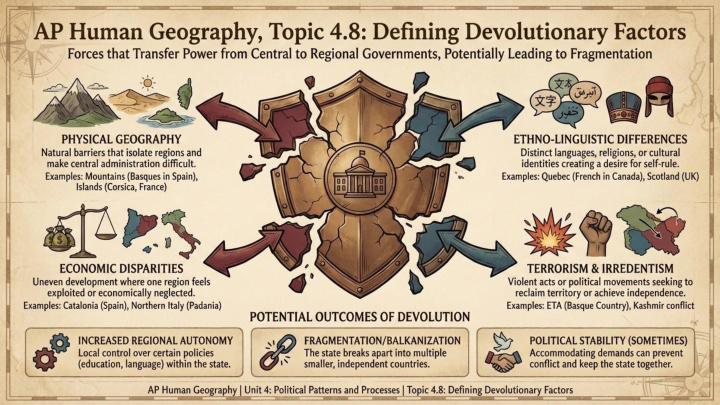
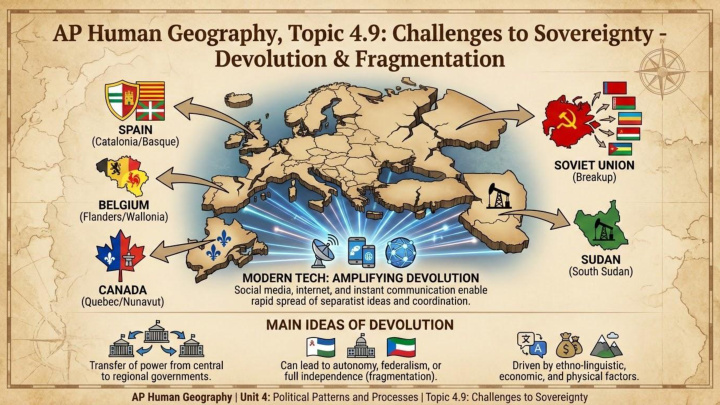
Unit 4: Political Patterns & Processes infographic
AP Human Geography Unit visual slide 1 AP Human Geography Unit visual slide 2 AP Human Geography Unit visual slide 3 AP Human Geography Unit visual slide 4 AP Human Geography Unit visual slide 5 AP Human Geography Unit visual slide 6 AP Human Geography Unit visual slide 7 AP Human Geography Unit visual slide 8 AP Human Geography Unit visual slide 9 AP Human Geography Unit visual slide 10 AP Human Geography Unit visual slide 11
1 / 11
5
Unit 5

Agriculture & Rural Land Use Patterns and Processes

approx. 12–17% of exam
🎙

Unit 5: Agriculture & Rural Land Use Patterns and Processes

Agricultural origins, land use models, the Green Revolution, food security, and the geography of farming systems.

🎙 Episode 5  ·  27:07
0:0027:07
Question
What is the difference between subsistence and commercial agriculture?
Unit 5 · Agriculture & Rural Land Use P
tap to flip
Answer
Subsistence agriculture produces food primarily for the farmer's own family. Commercial agriculture produces food for sale in markets, often on large scales.
Card 1 of 12
Question 1 of 5 Score: 0/5
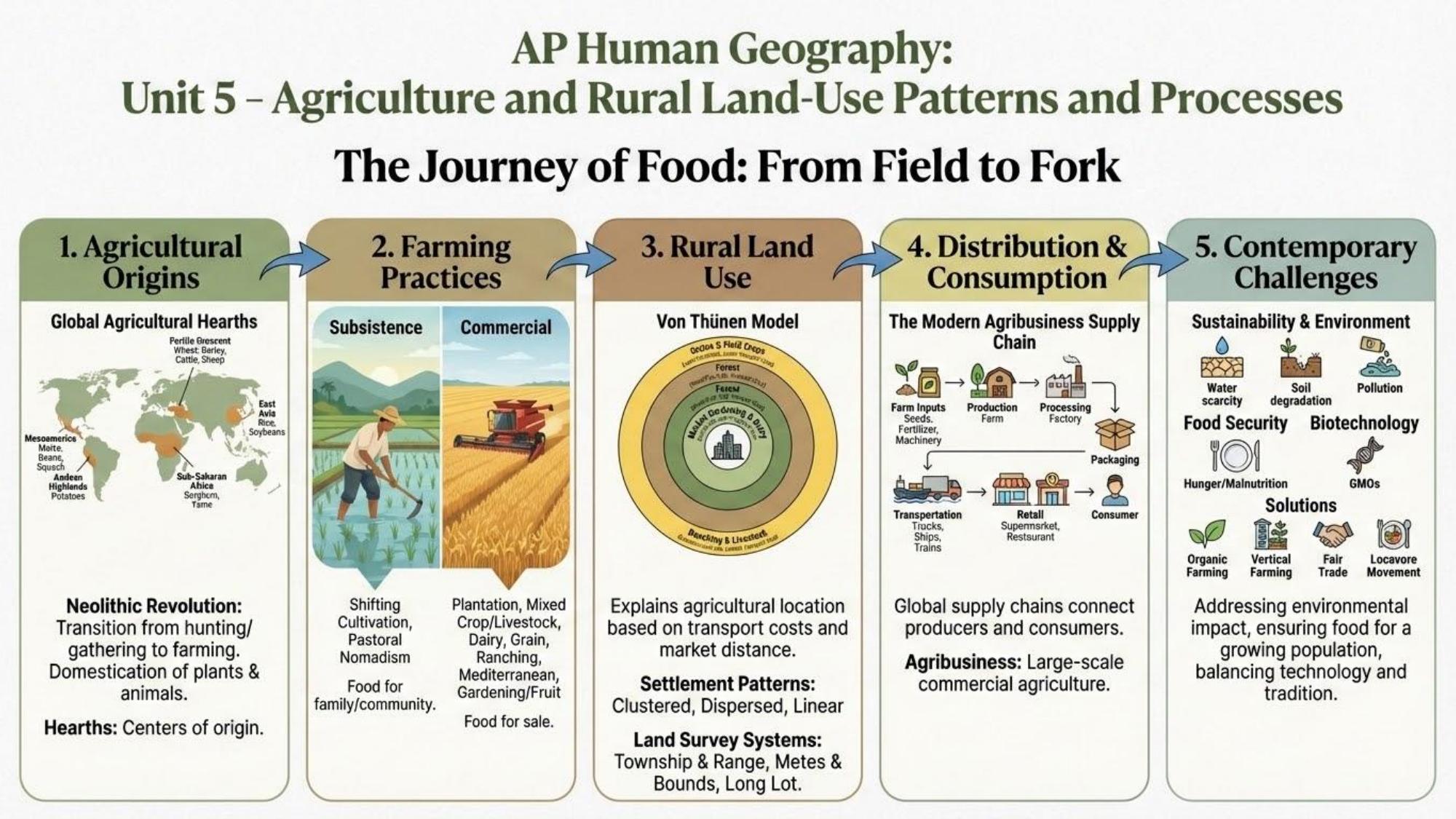
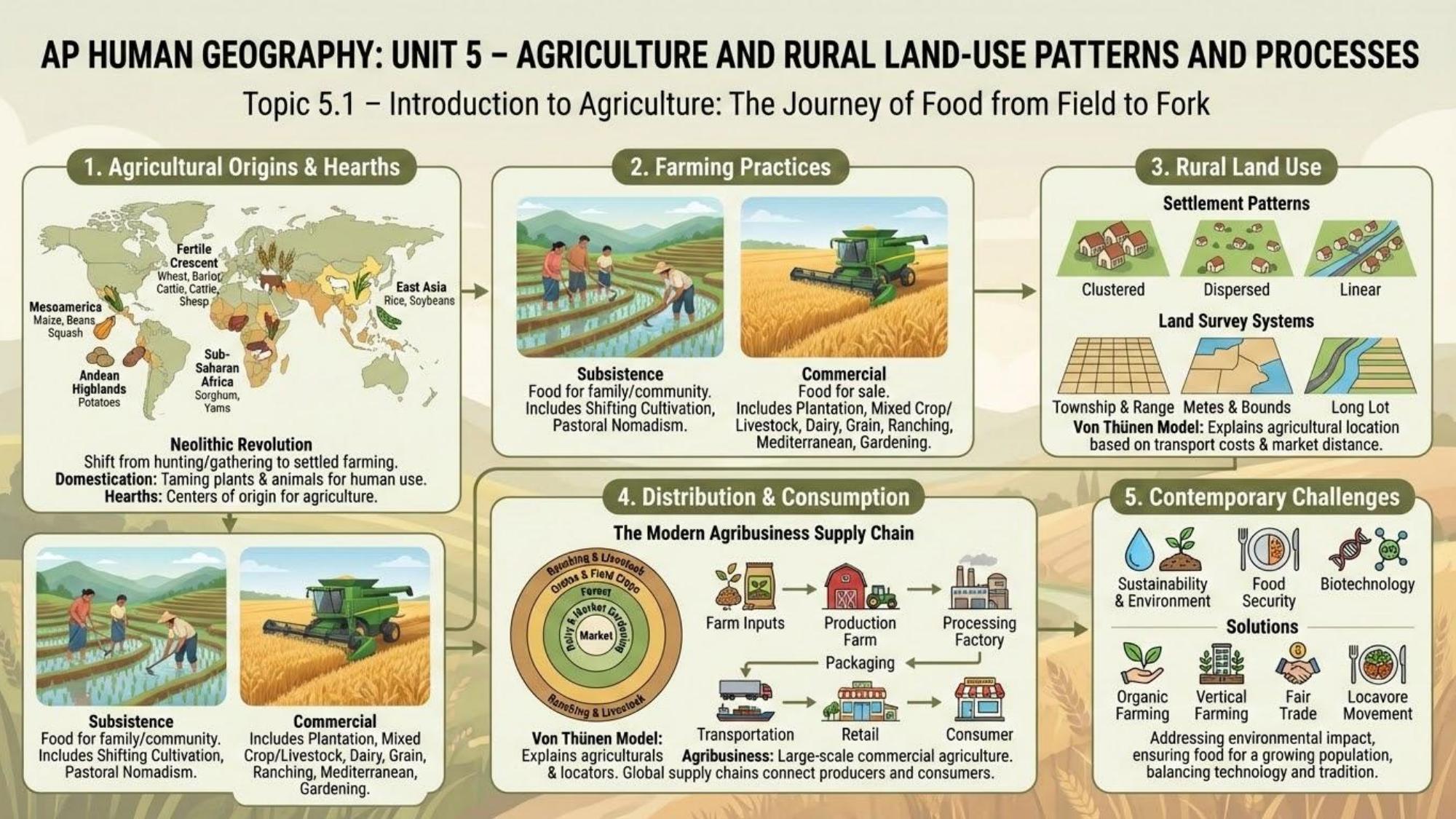
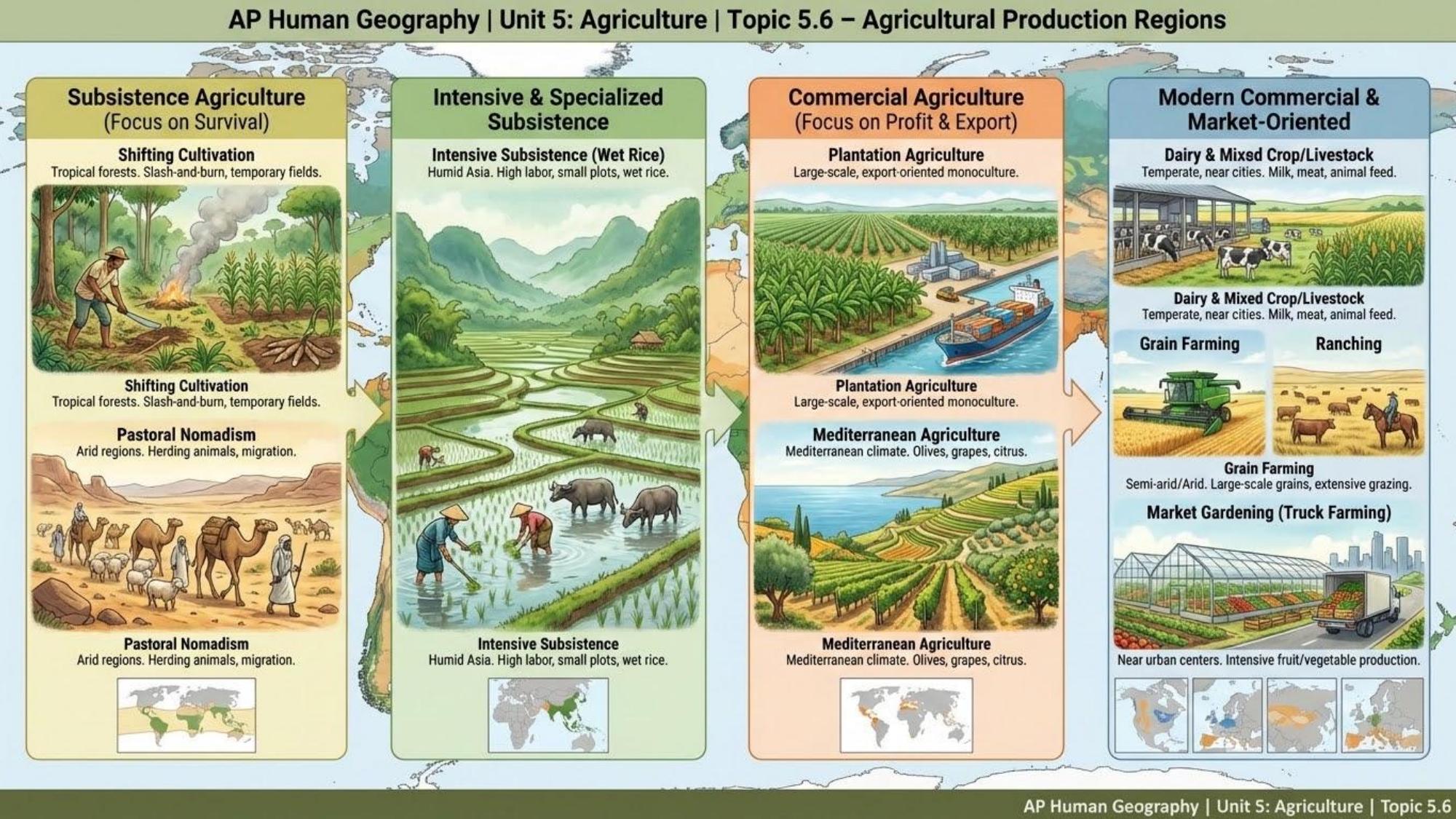
Subsistence Agriculture
Farming that produces food primarily for the farmer's household, not for market sale.
Agricultural Types
Commercial Agriculture
Farming oriented toward market sale, often large-scale and mechanized.
Agricultural Types
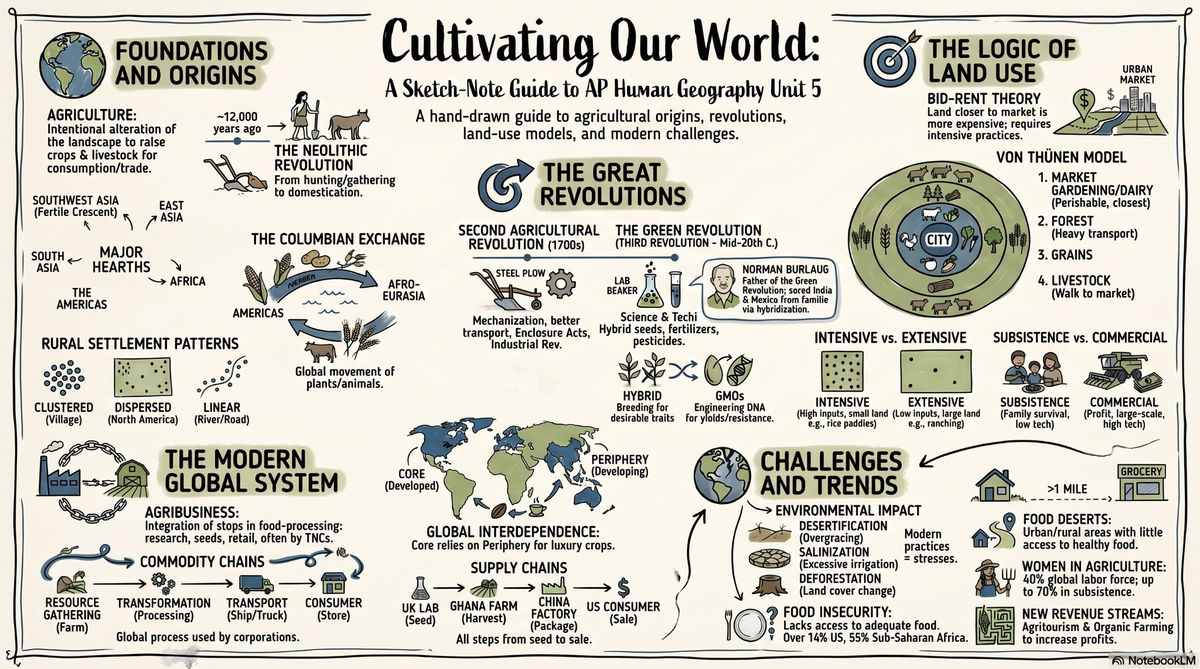
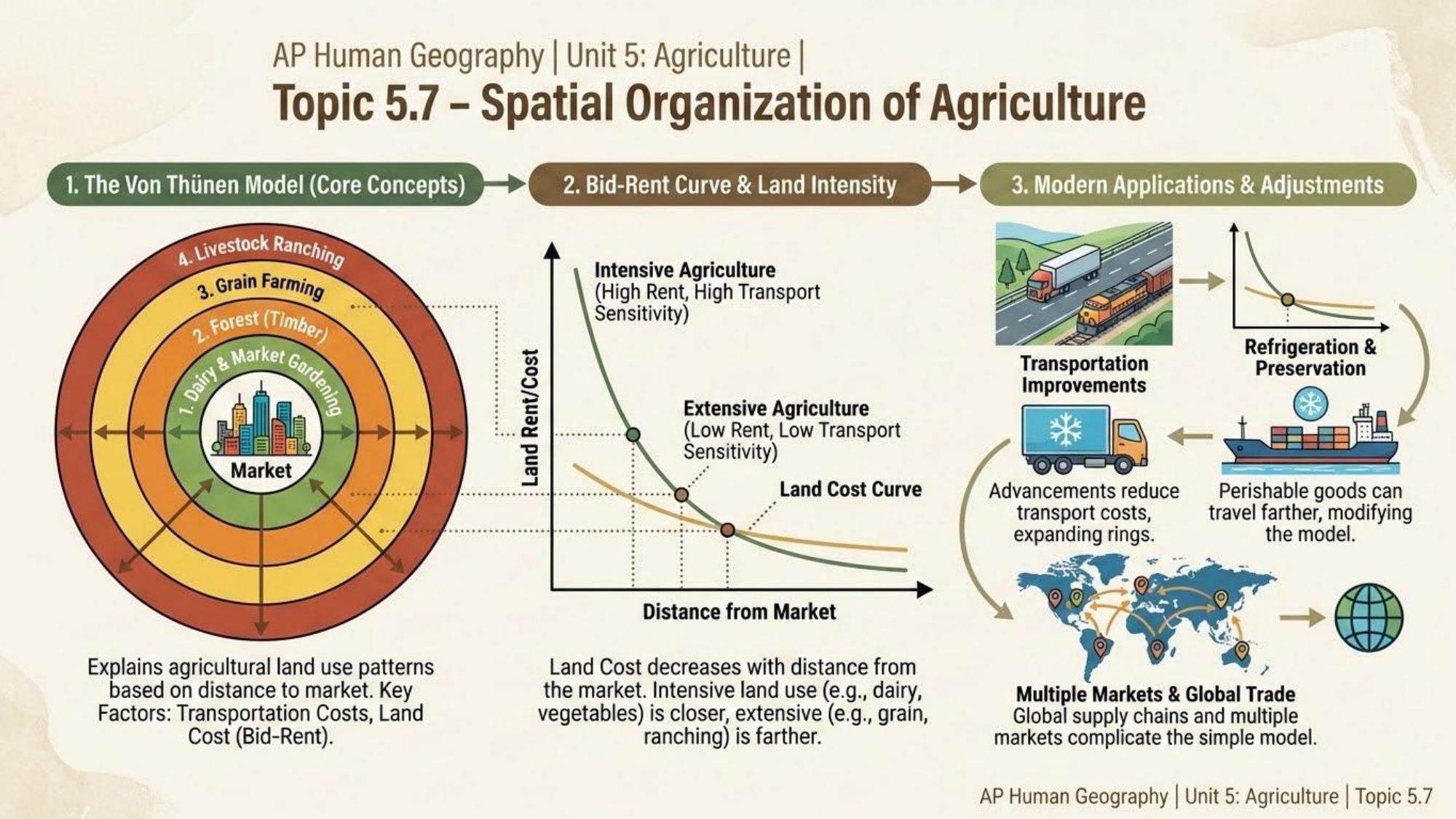
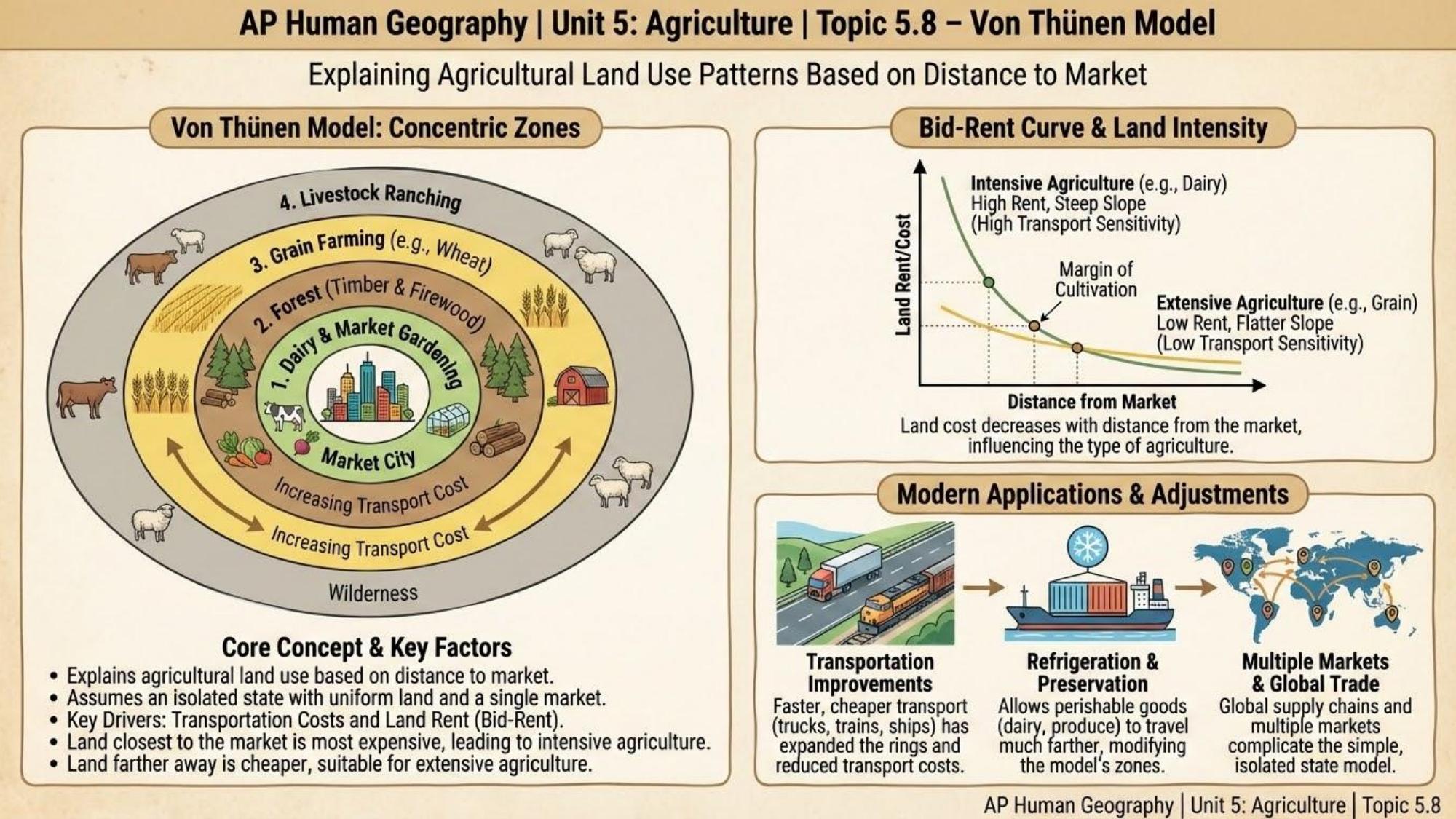
Von Thünen's Model
Concentric ring model showing agricultural land use arranged by distance from market based on transport costs.
Agricultural Models
Neolithic (First Agricultural) Revolution
The transition ~10,000 BCE from hunter-gatherer lifestyles to settled agriculture and animal domestication.
Agricultural History
Green Revolution
Mid-20th century agricultural transformation using high-yield varieties, fertilizers, and irrigation to boost food production.
Agricultural History
Intensive Agriculture
Farming using high inputs of labor, capital, or technology per unit of land.
Agricultural Systems
Extensive Agriculture
Farming using relatively low inputs per unit of land; often in areas with abundant land.
Agricultural Systems
Shifting Cultivation
Subsistence farming where plots are cleared, farmed briefly, then abandoned as soil depletes.
Agricultural Systems
Plantation Agriculture
Large-scale commercial monoculture of a cash crop using hired labor, historically linked to colonialism.
Agricultural Systems
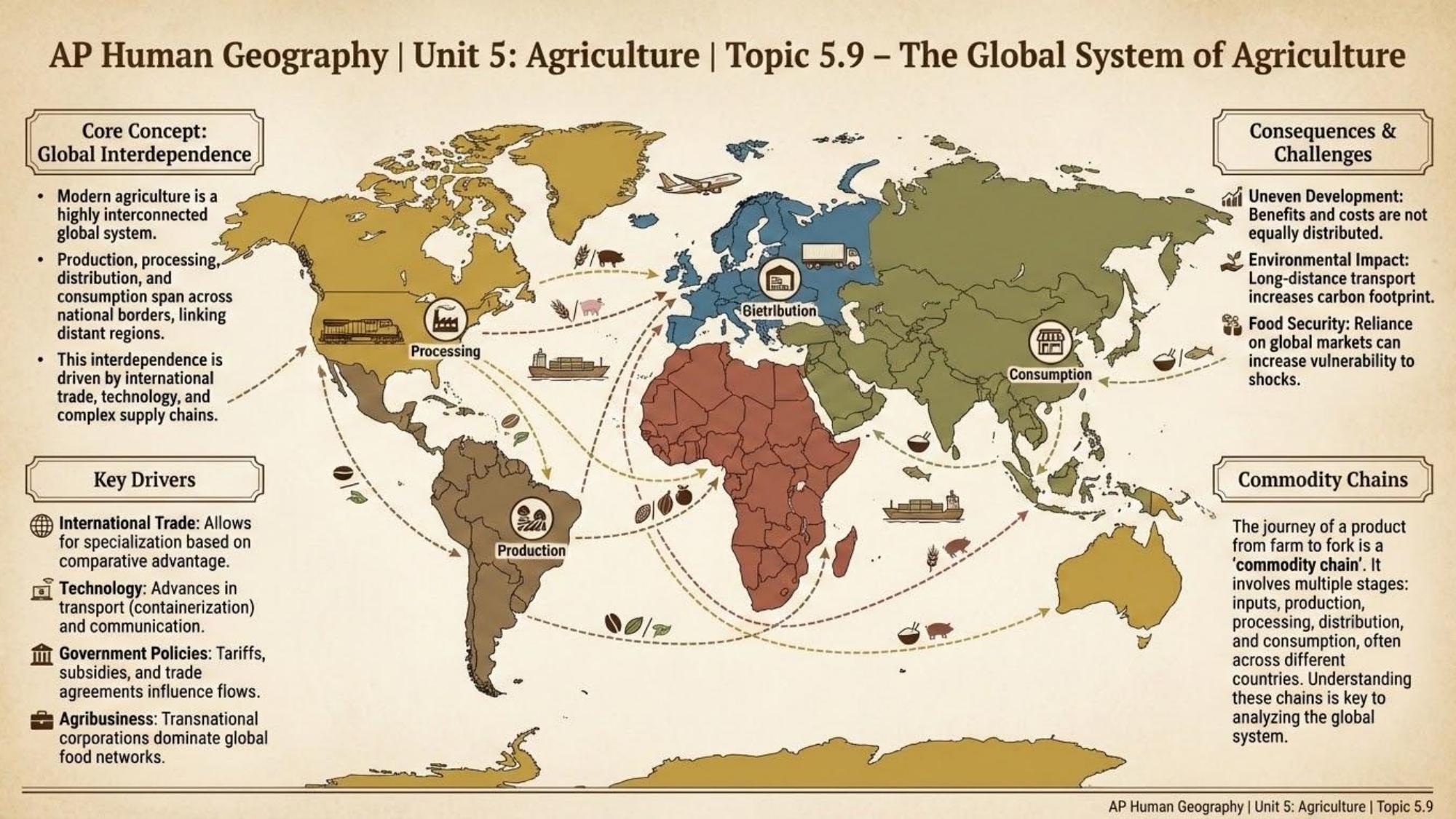
Agribusiness
Large-scale corporate agriculture controlling multiple stages from production to distribution.
Agricultural Economy
Food Desert
Area lacking access to affordable, nutritious food, often in low-income urban communities.
Food Security
GMO (Genetically Modified Organism)
Crop with DNA altered to improve yield, pest resistance, or drought tolerance.
Agricultural Technology
Monoculture
Farming practice of growing a single crop over a large area — maximizes efficiency but risks disease and soil depletion.
Agricultural Practices
Food Sovereignty
The right of peoples to define their own food and agricultural policies independently of global markets.
Food Systems
Big Idea 1
Agriculture transformed human civilization — and continues to evolve
The Neolithic Revolution was one of the most consequential events in human history — enabling cities, states, and civilization. The Green Revolution and current biorevolution are equally transformative, reshaping food systems, environments, and power structures globally.
Agricultural Revolutions Development Change
Big Idea 2
Location shapes farming — von Thünen explains why
Von Thünen's model remains relevant today: farming types change with distance from markets based on transportation costs and land rent. Dairy farms cluster near cities; grain and livestock farms are farther out. Modern transportation has modified but not eliminated this pattern.
Von Thünen Location Land Rent
Big Idea 3
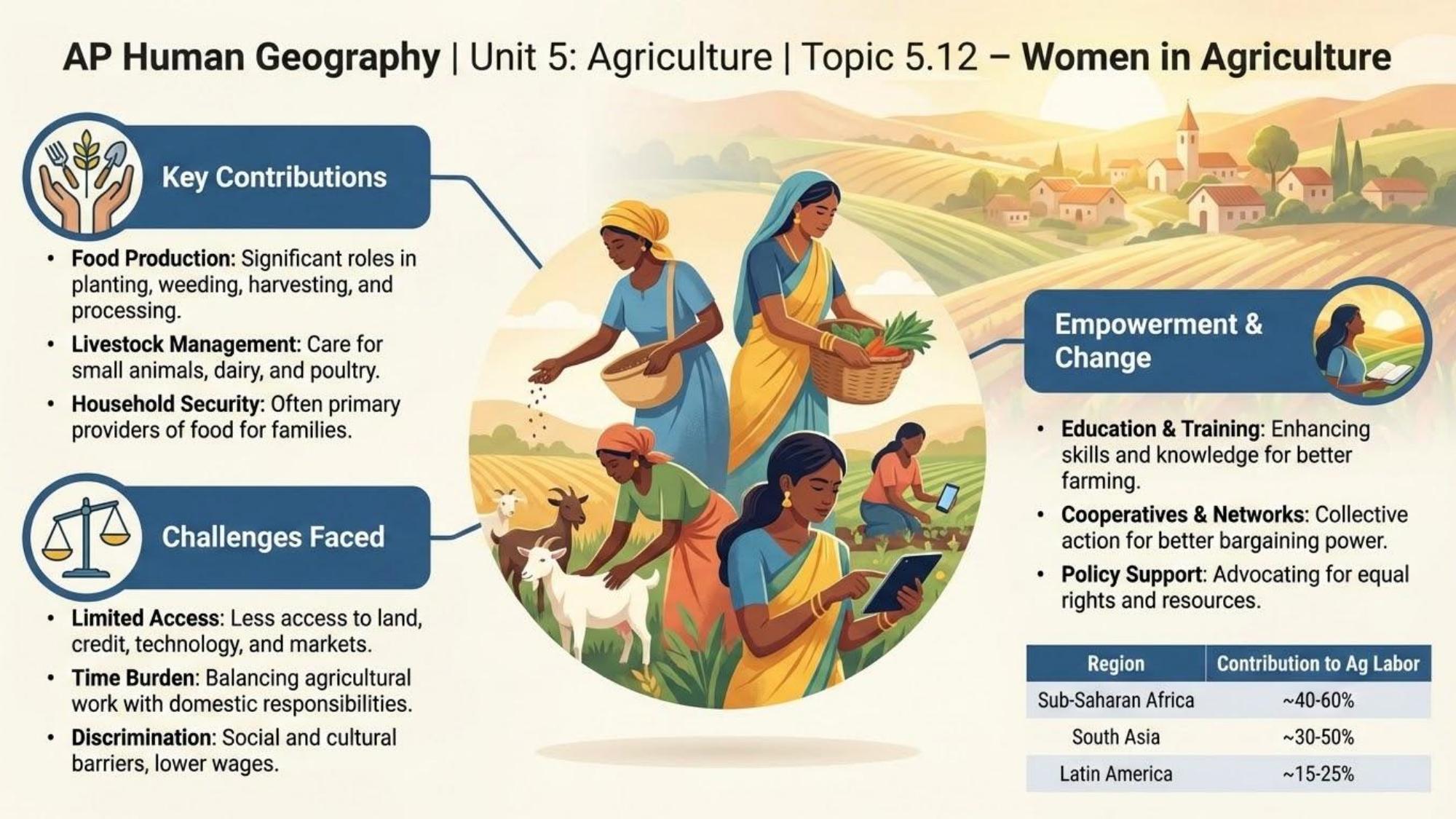
Agricultural systems reflect development levels and global inequality
Subsistence farming dominates in developing nations; commercial/industrial agriculture dominates in developed ones. The Green Revolution increased yields but also increased dependence on corporate inputs and widened inequality. Food security remains one of geography's most pressing challenges.
Development Food Security Inequality
Big Idea 4
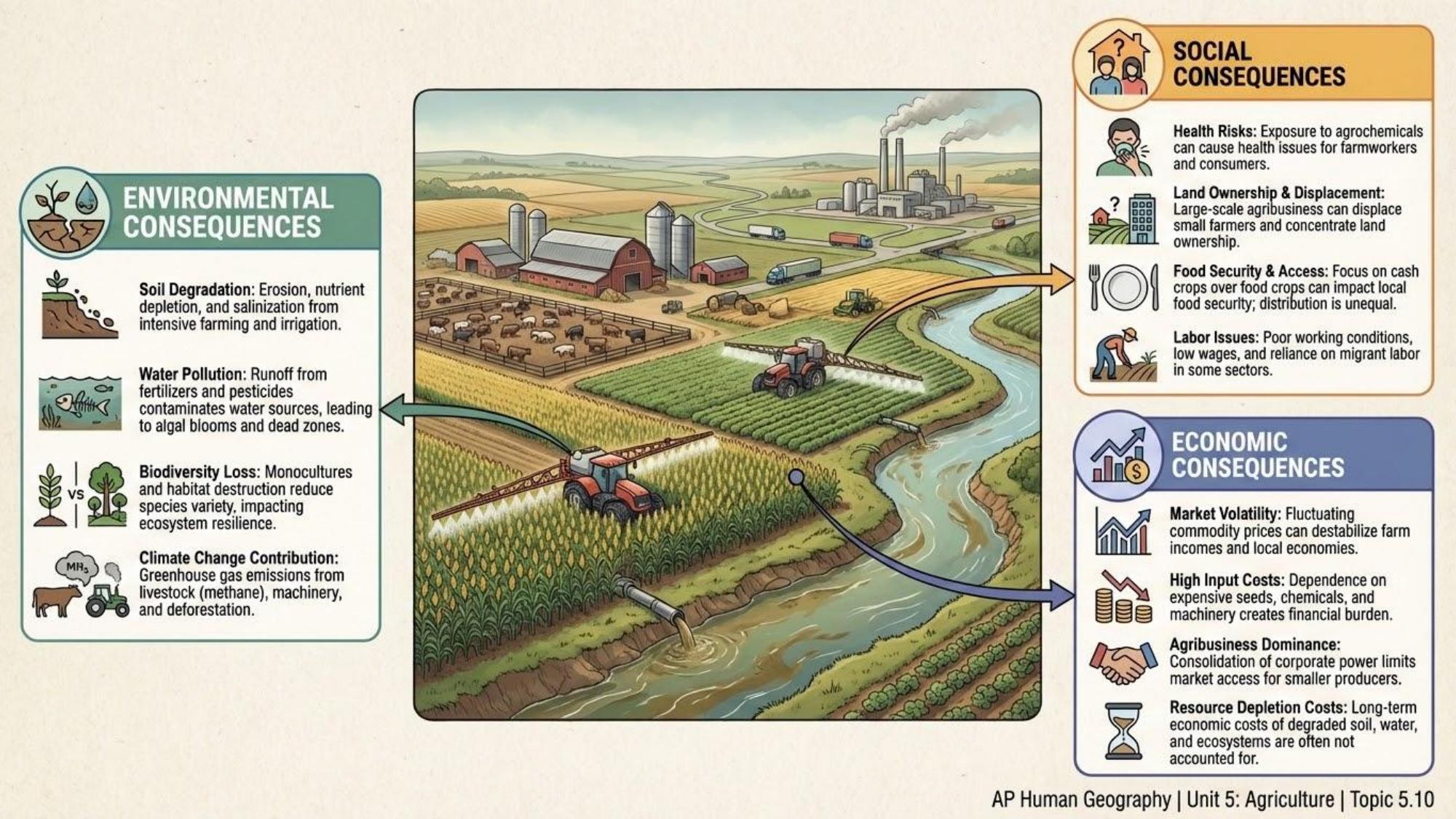
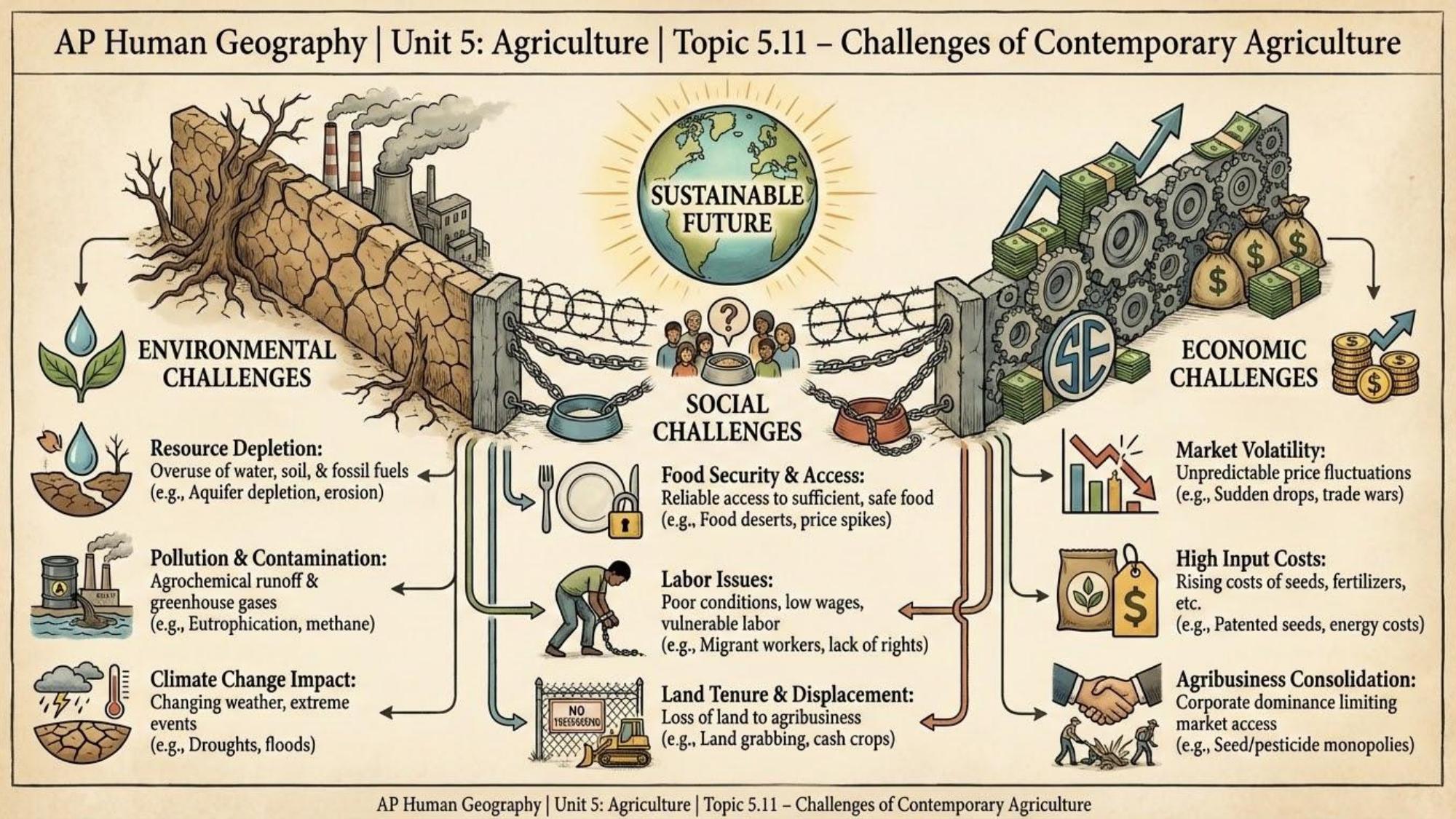
Modern agriculture has massive environmental consequences
Industrial agriculture uses 70% of the world's freshwater, is the leading driver of deforestation, contributes significantly to greenhouse gas emissions, and threatens biodiversity through monocultures and pesticides. Understanding these impacts is central to sustainability debates.
Environment Sustainability Land Use
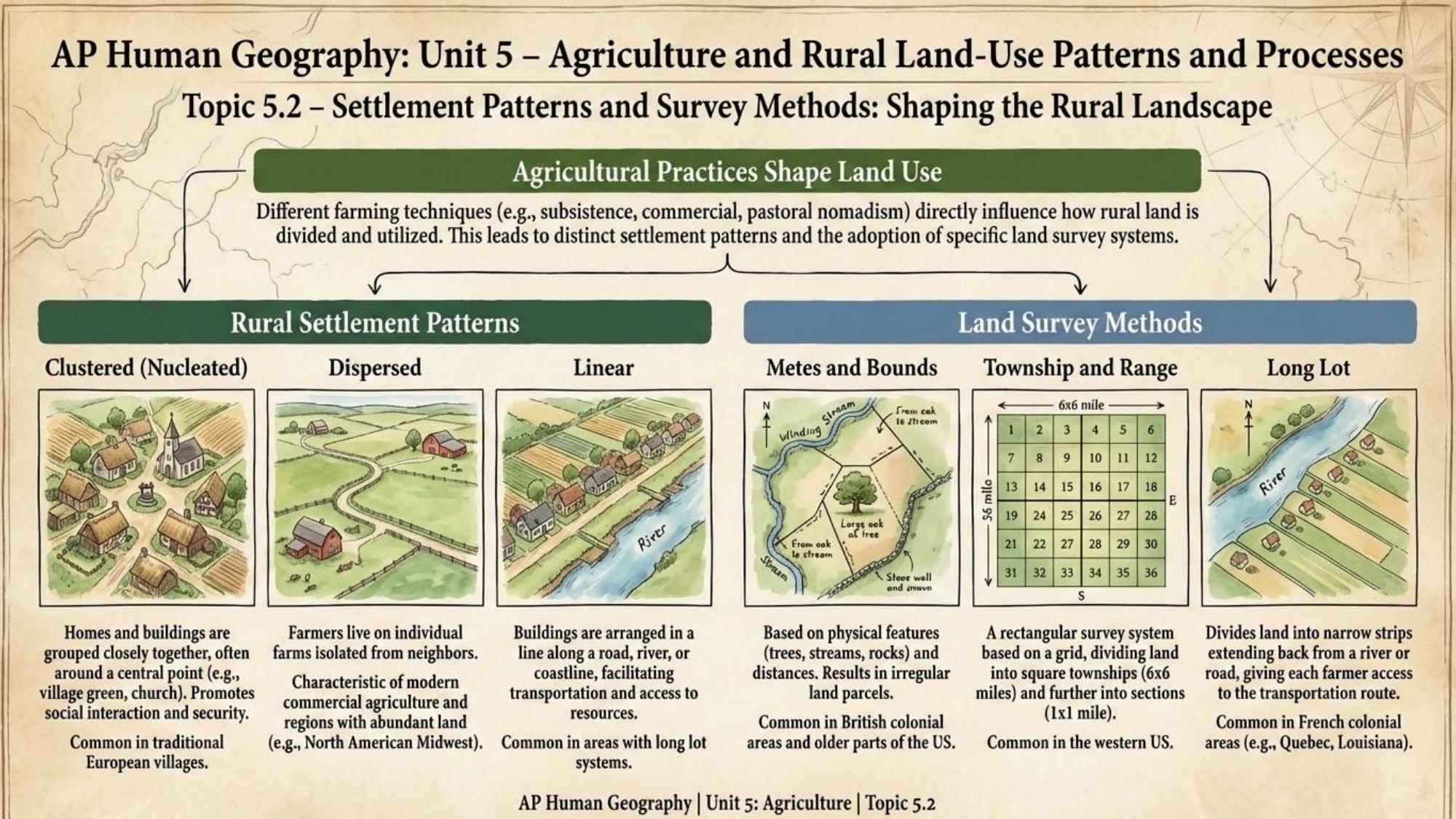
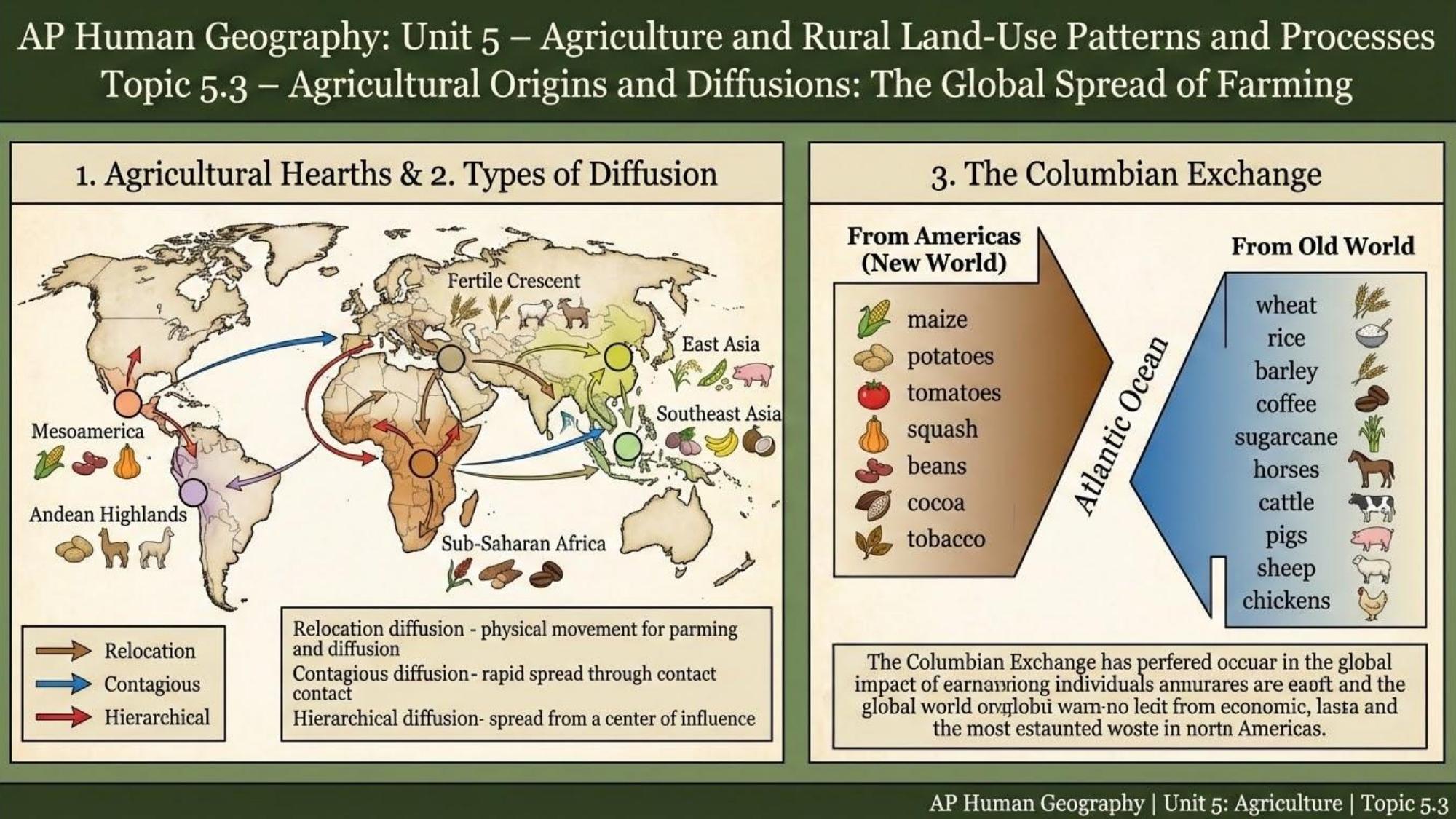
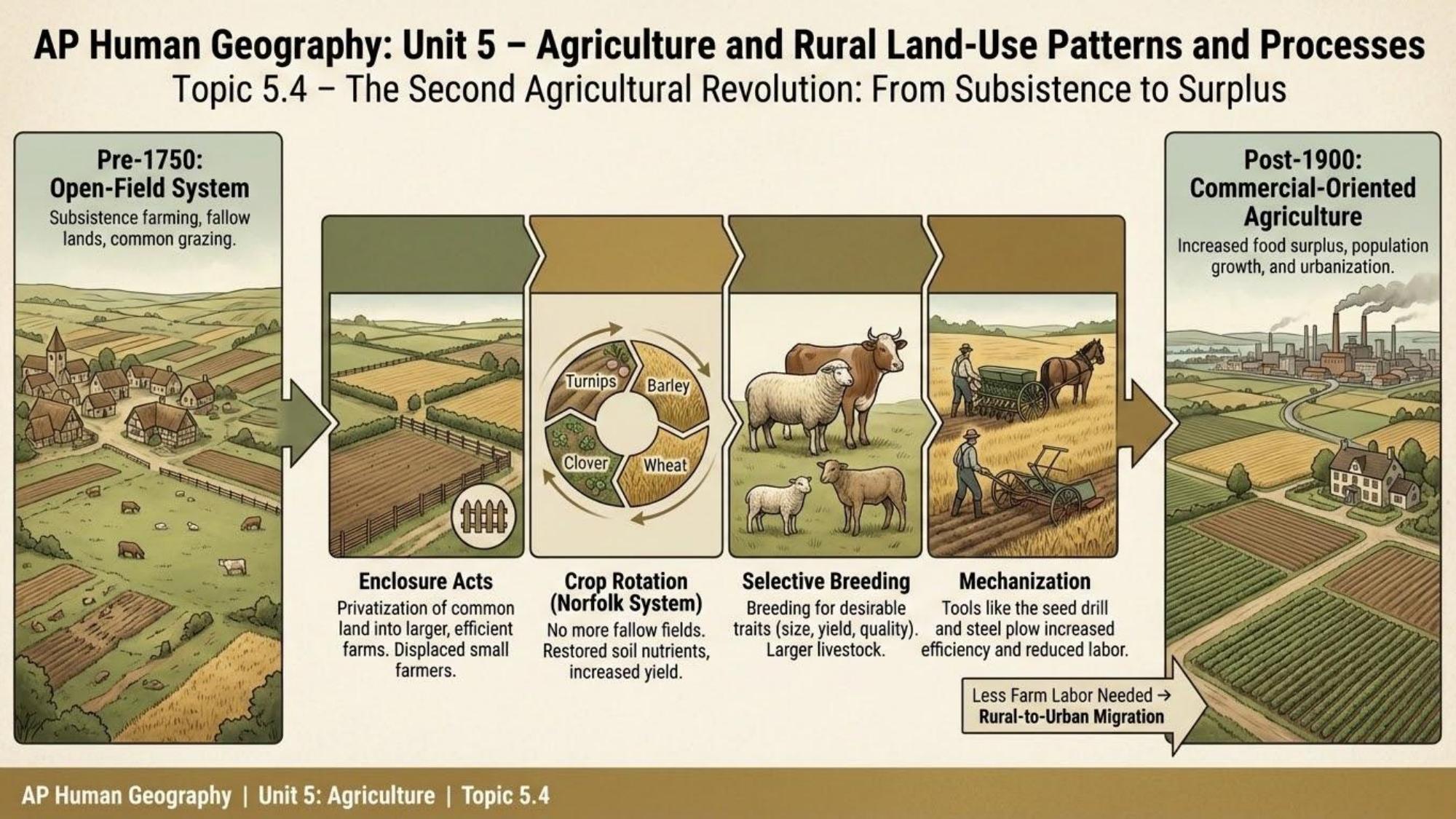
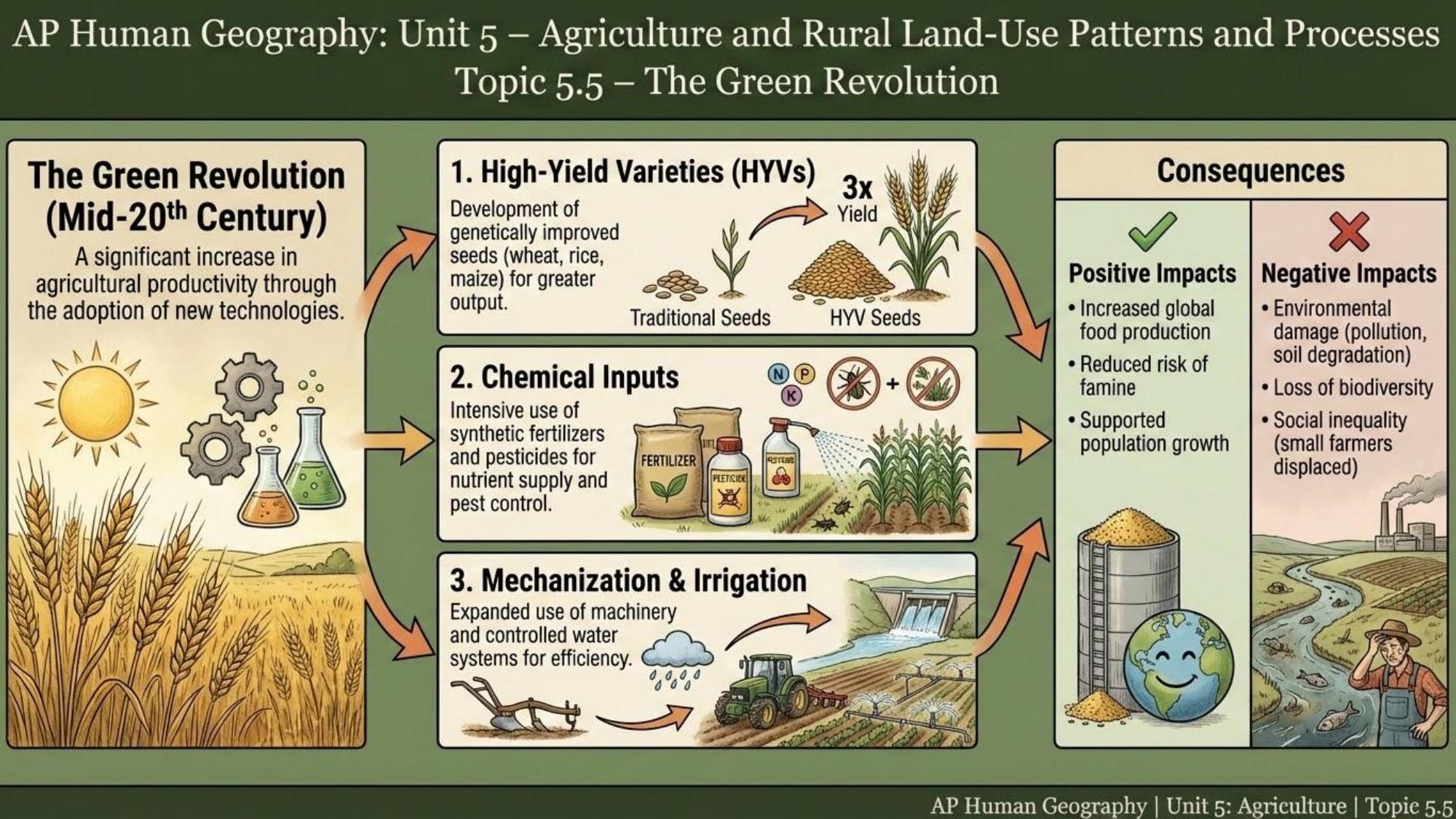
Unit 5: Agriculture & Rural Land Use Patterns and Processes infographic
Unit visual review slide 1 Unit visual review slide 2 Unit visual review slide 3 Unit visual review slide 4 Unit visual review slide 5 Unit visual review slide 6 Unit visual review slide 7 Unit visual review slide 8 Unit visual review slide 9 Unit visual review slide 10 Unit visual review slide 11 Unit visual review slide 12 Unit visual review slide 13
1 / 13
6
Unit 6

Cities & Urban Land Use Patterns and Processes

approx. 12–17% of exam
🎙

Unit 6: Cities & Urban Land Use Patterns and Processes

Urbanization, urban land use models, global cities, urban planning, and the challenges of rapid urban growth.

🎙 Episode 6  ·  24:45
0:0024:45
Question
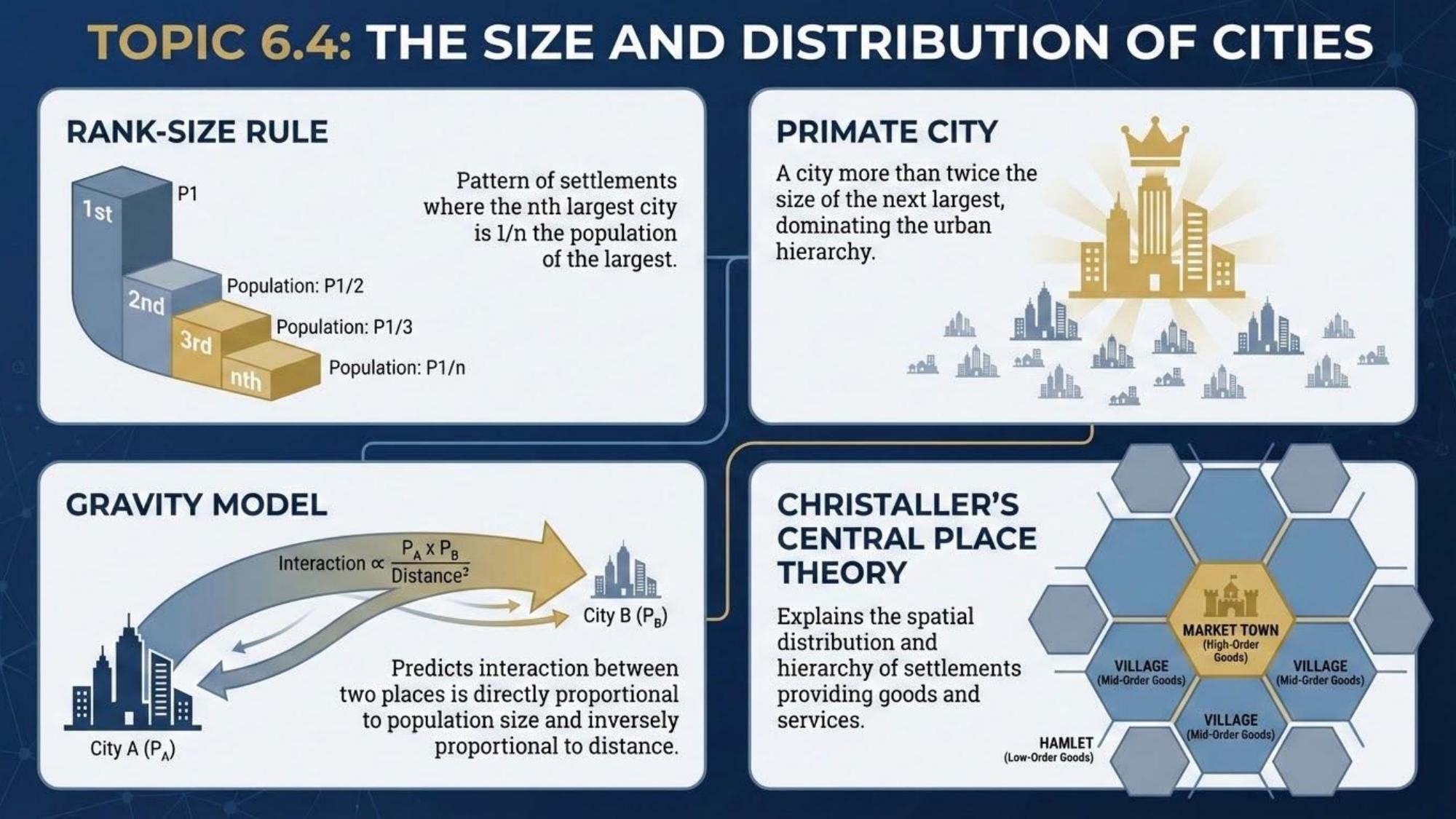
What is the "rank-size rule"?
Unit 6 · Cities & Urban Land Use Patter
tap to flip
Answer
The principle that in a country, the second-largest city is half the size of the largest, the third is one-third, etc. Countries that follow this rule have a balanced urban system.
Card 1 of 12
Question 1 of 5 Score: 0/5
Central Business District (CBD)
The commercial and business core of a city — highest land values, most accessible, tallest buildings.
Urban Structure
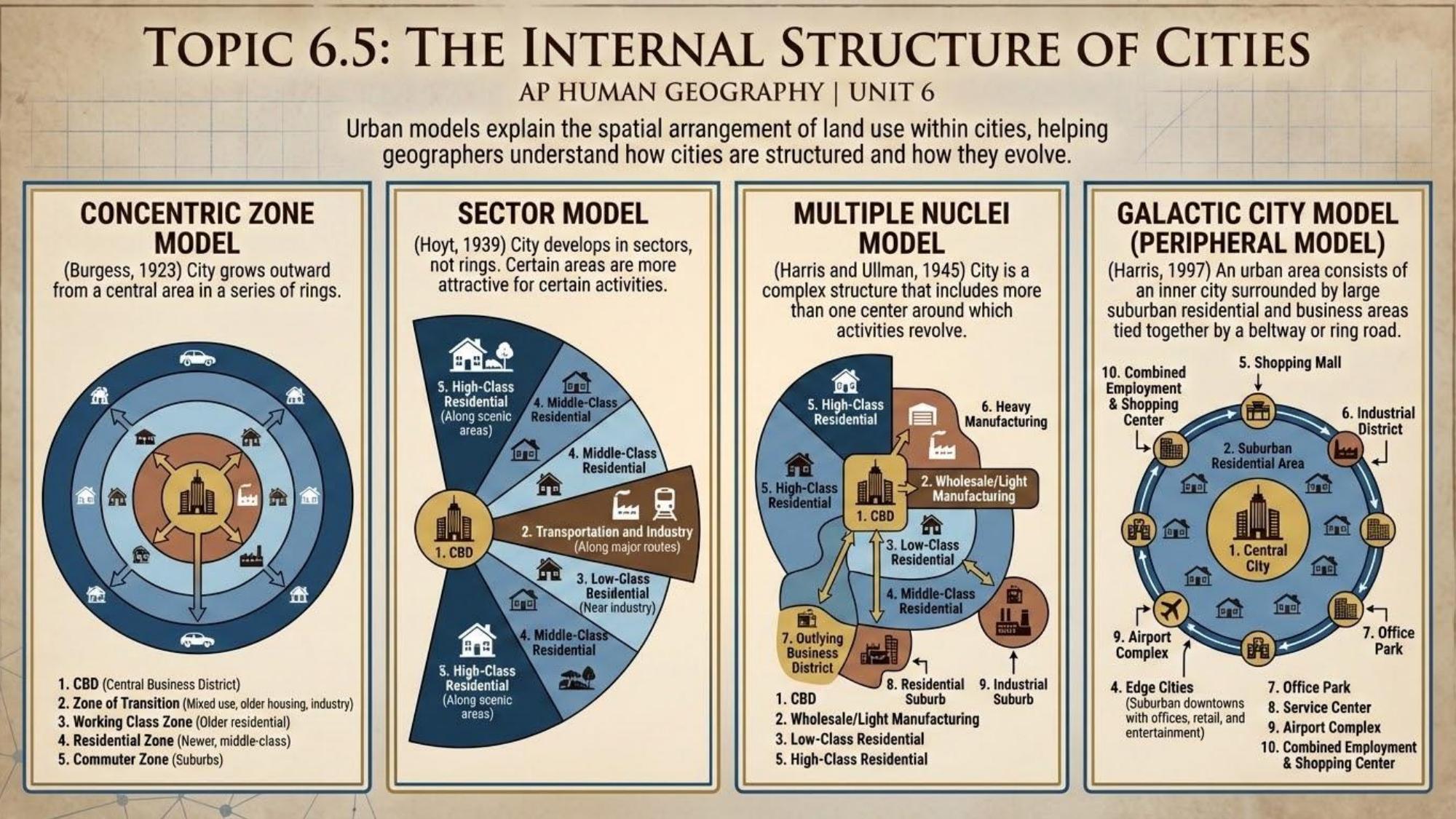
Burgess Concentric Zone Model
Urban land use model with concentric rings radiating from the CBD.
Urban Models
Hoyt Sector Model
Urban land use model with wedge-shaped sectors extending from the CBD along transport routes.
Urban Models
Multiple Nuclei Model
Urban model showing cities developing around multiple centers or nodes.
Urban Models
Primate City
City disproportionately larger than all others in a country's urban system.
Urban Hierarchy
Rank-Size Rule
Pattern where the nth-largest city is 1/n the size of the largest city.
Urban Hierarchy
Central Place Theory
Christaller's model explaining the size and spacing of settlements based on market areas.
Urban Theory
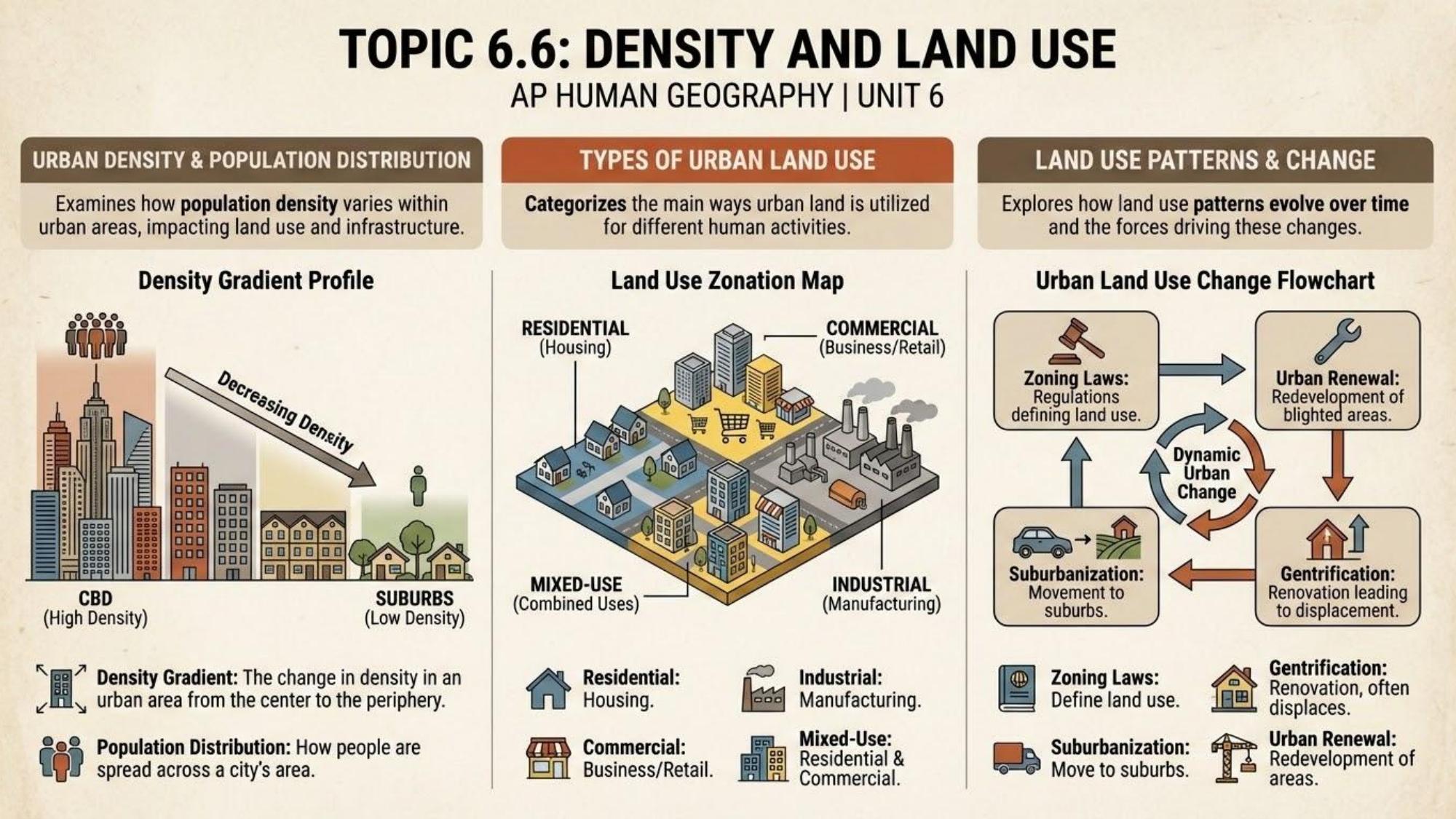
Gentrification
Reinvestment in inner-city neighborhoods by higher-income residents, often displacing lower-income ones.
Urban Change
Urban Sprawl
Low-density, car-dependent urban expansion into surrounding rural land.
Urban Growth
Suburbanization
Growth of residential areas outside city centers, enabled by transportation improvements.
Urban Growth
Squatter Settlement
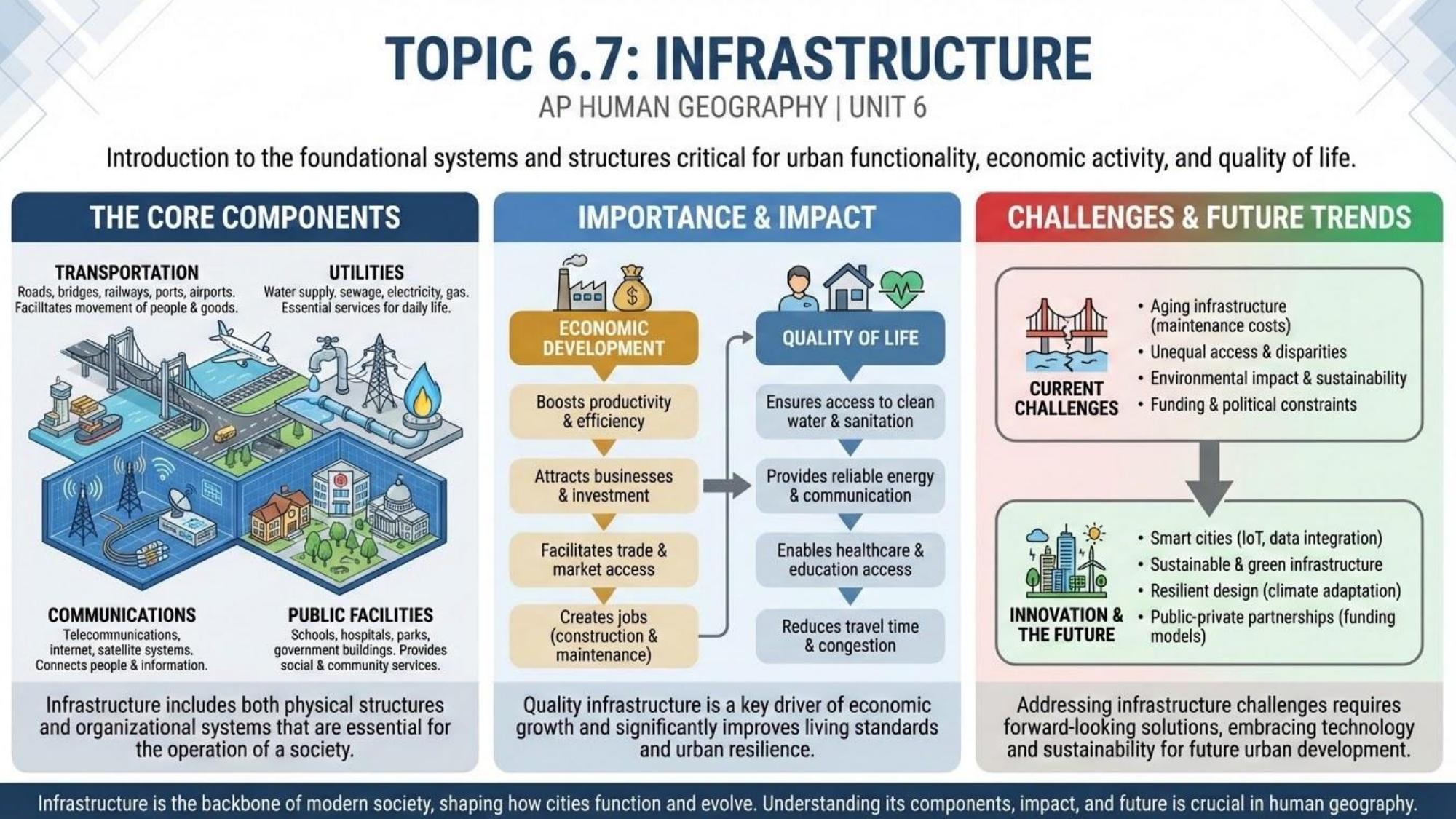
Informal, unplanned urban settlement lacking legal status and basic infrastructure.
Developing World Cities
Global City
City serving as a major node in the global economy (New York, London, Tokyo).
Urban Economy
Smart Growth
Planning strategy promoting compact, walkable, transit-oriented development.
Urban Planning
Edge City
Large suburban node of offices, retail, and entertainment developed outside traditional CBDs.
Suburban Development
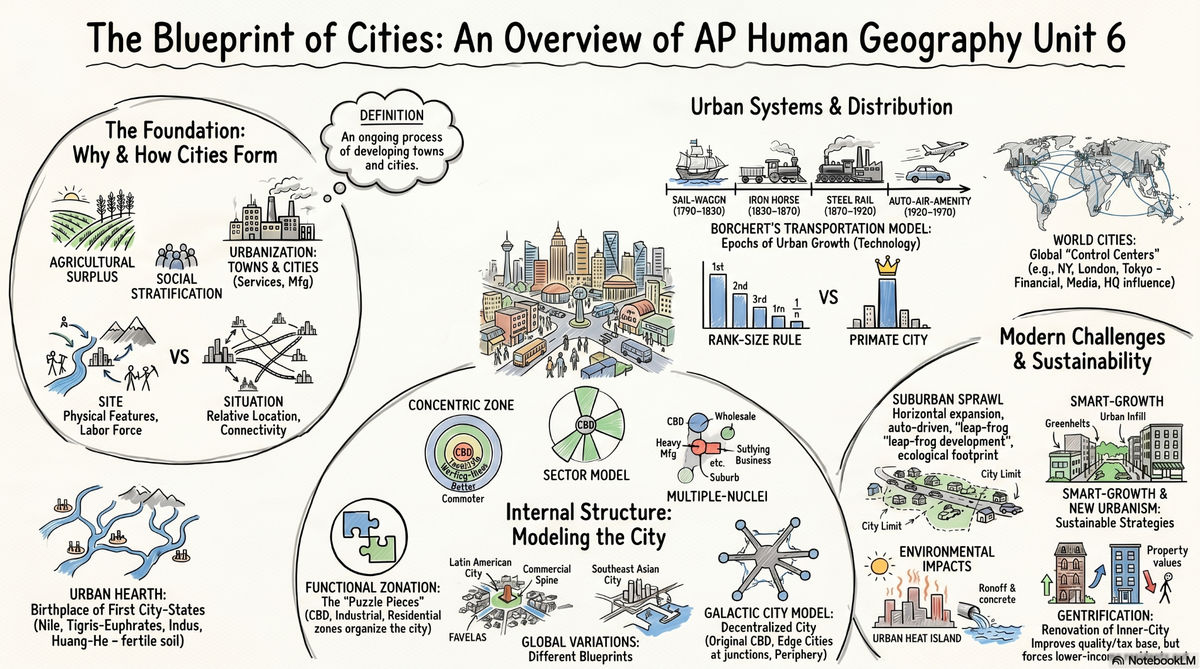
Big Idea 1
Cities are where most humans now live — and that changes everything
For the first time in history, more than half the world's population lives in cities. Urbanization is the dominant demographic trend of our era, reshaping land use, economies, environments, and social structures globally.
Urbanization Demographics Global Change
Big Idea 2
Urban land use models reveal — and conceal — spatial patterns
Burgess, Hoyt, and the Multiple Nuclei Model each capture different aspects of urban structure. No single model fits all cities — American cities, Latin American cities, and Southeast Asian cities have distinct patterns reflecting their histories and development contexts.
Urban Models Spatial Structure Comparison
Big Idea 3
Urban inequality is geography's most visible challenge
The contrast between global cities with luxury towers and informal settlements with no running water captures the spatial inequality at the heart of urbanization. Gentrification, squatter settlements, and the urban-rural divide are all manifestations of this fundamental tension.
Inequality Informal Settlements Gentrification
Big Idea 4
Cities in the developing world are growing fastest — with different patterns
The fastest urbanization is happening in sub-Saharan Africa and South Asia, where cities lack the infrastructure to absorb growth. These cities often lack the concentric ring pattern of North American models — understanding their distinct geography is essential for AP HuGe.
Global South Development Urban Planning
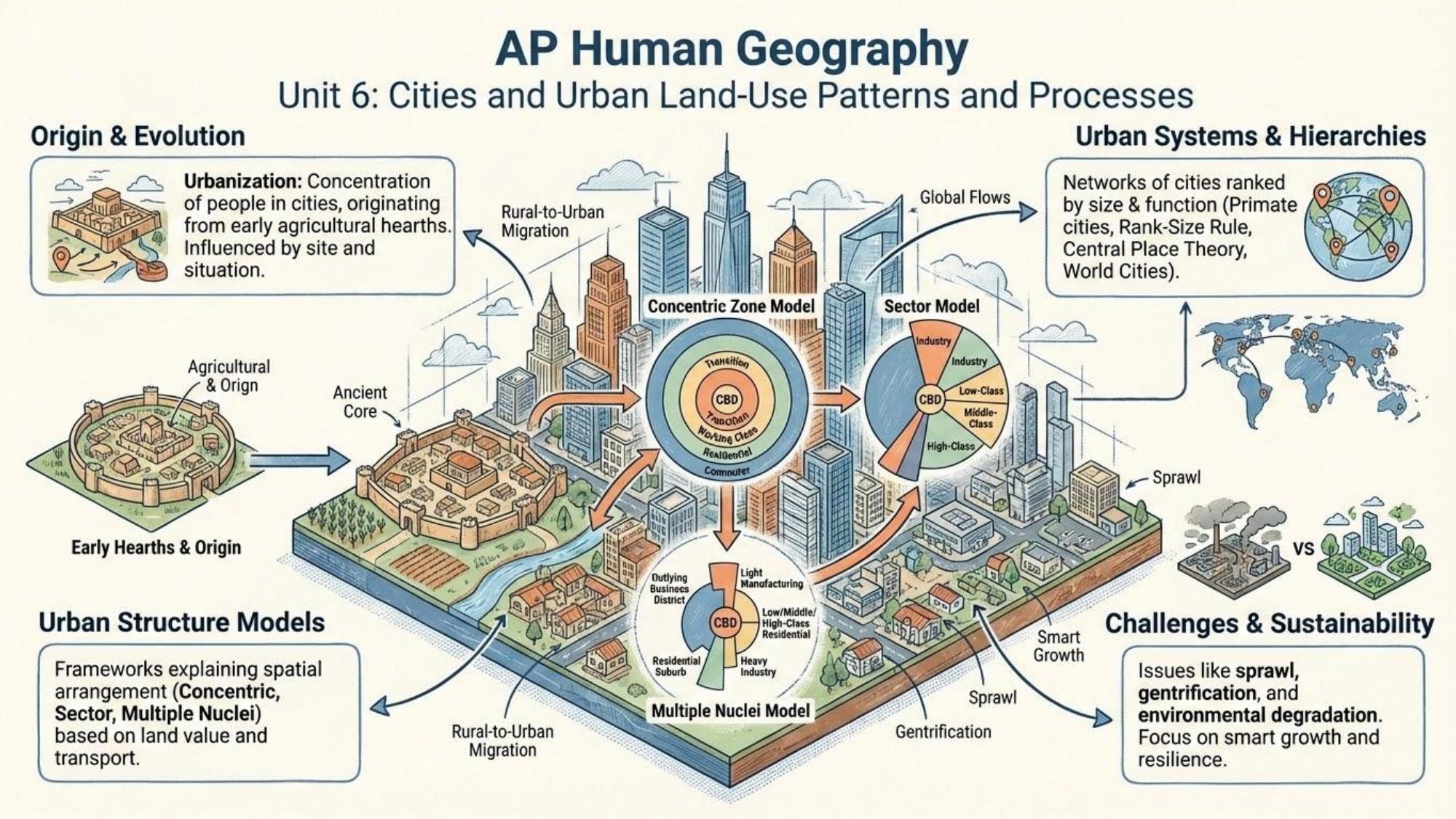
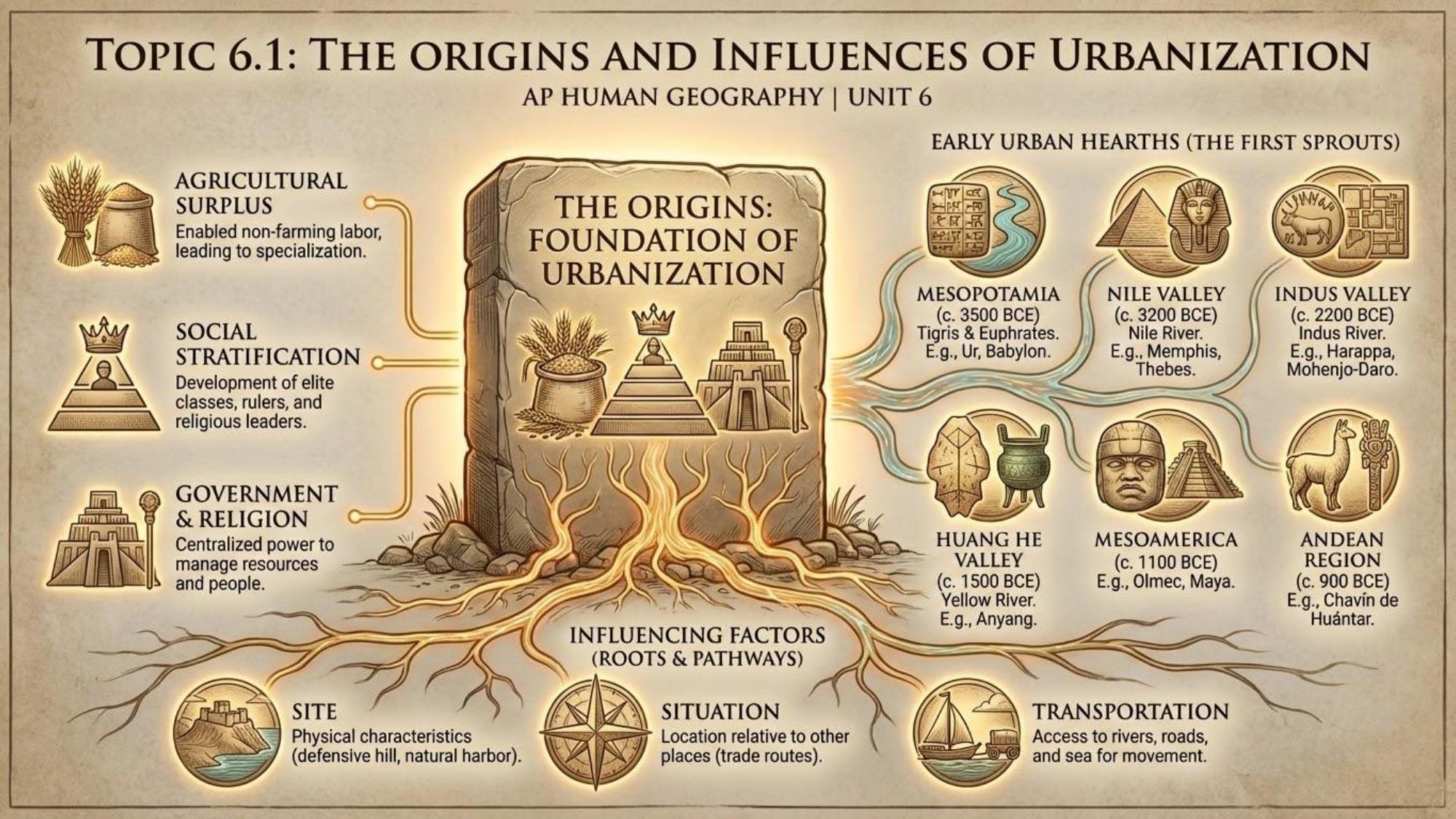
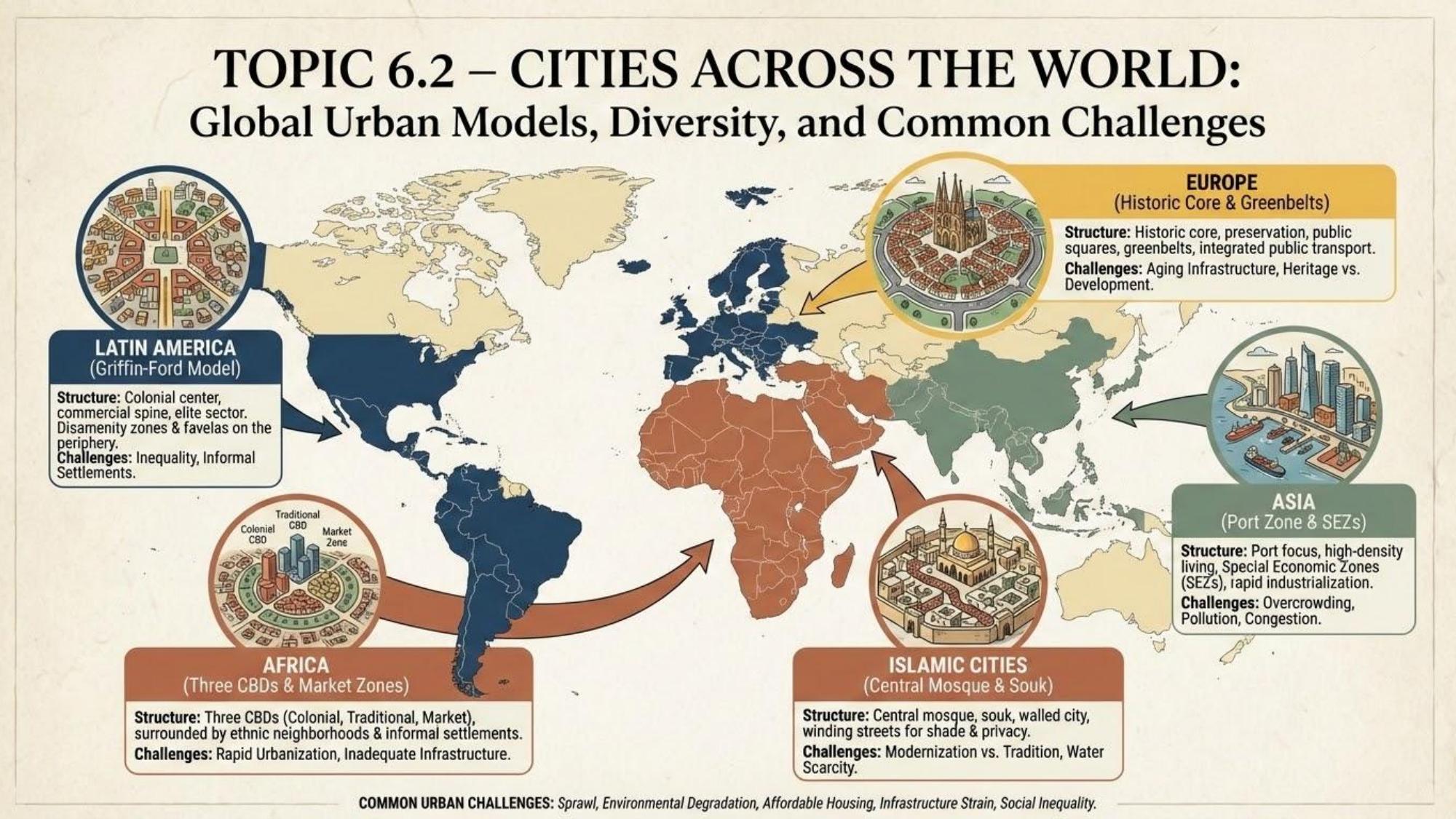
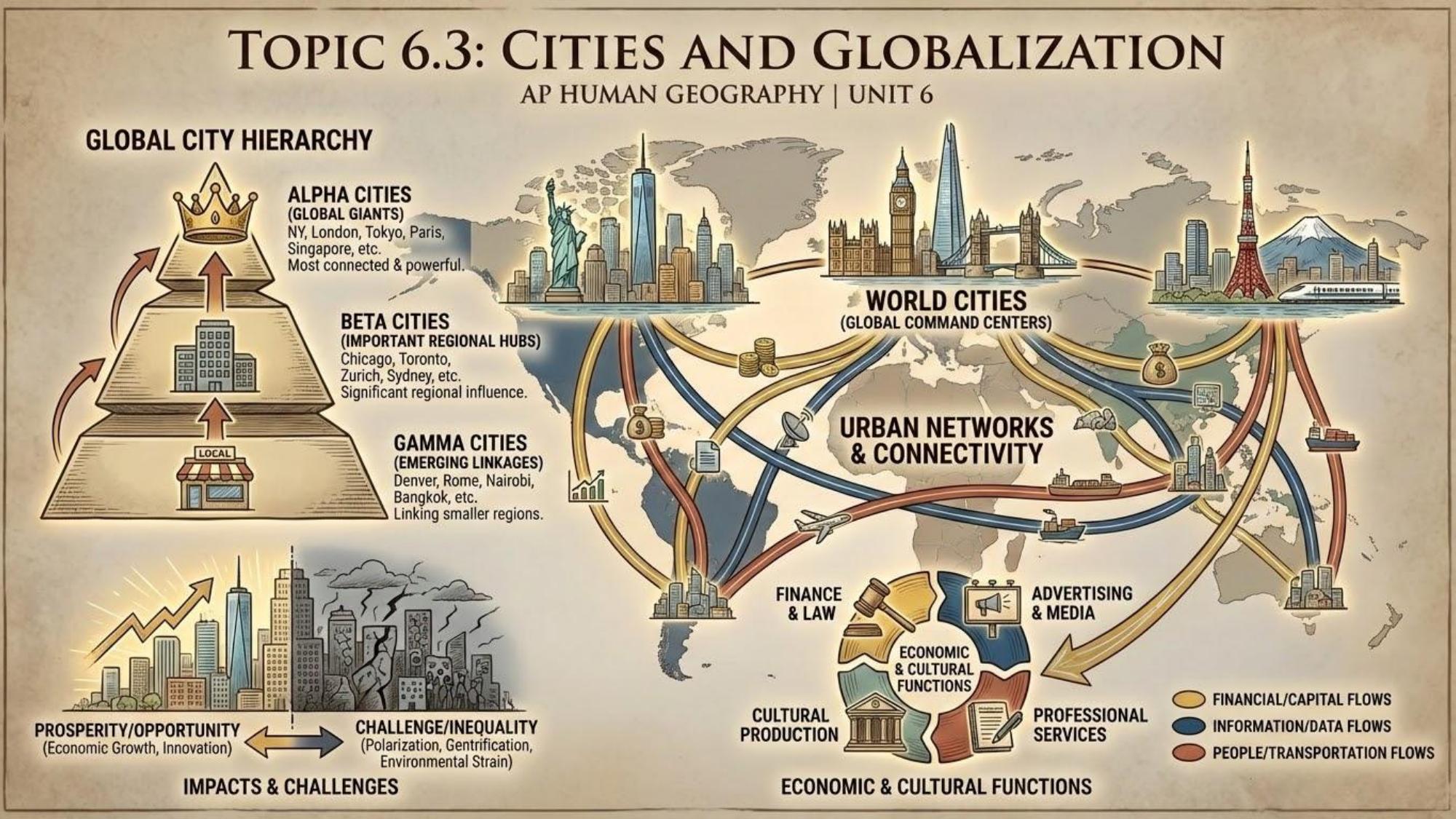
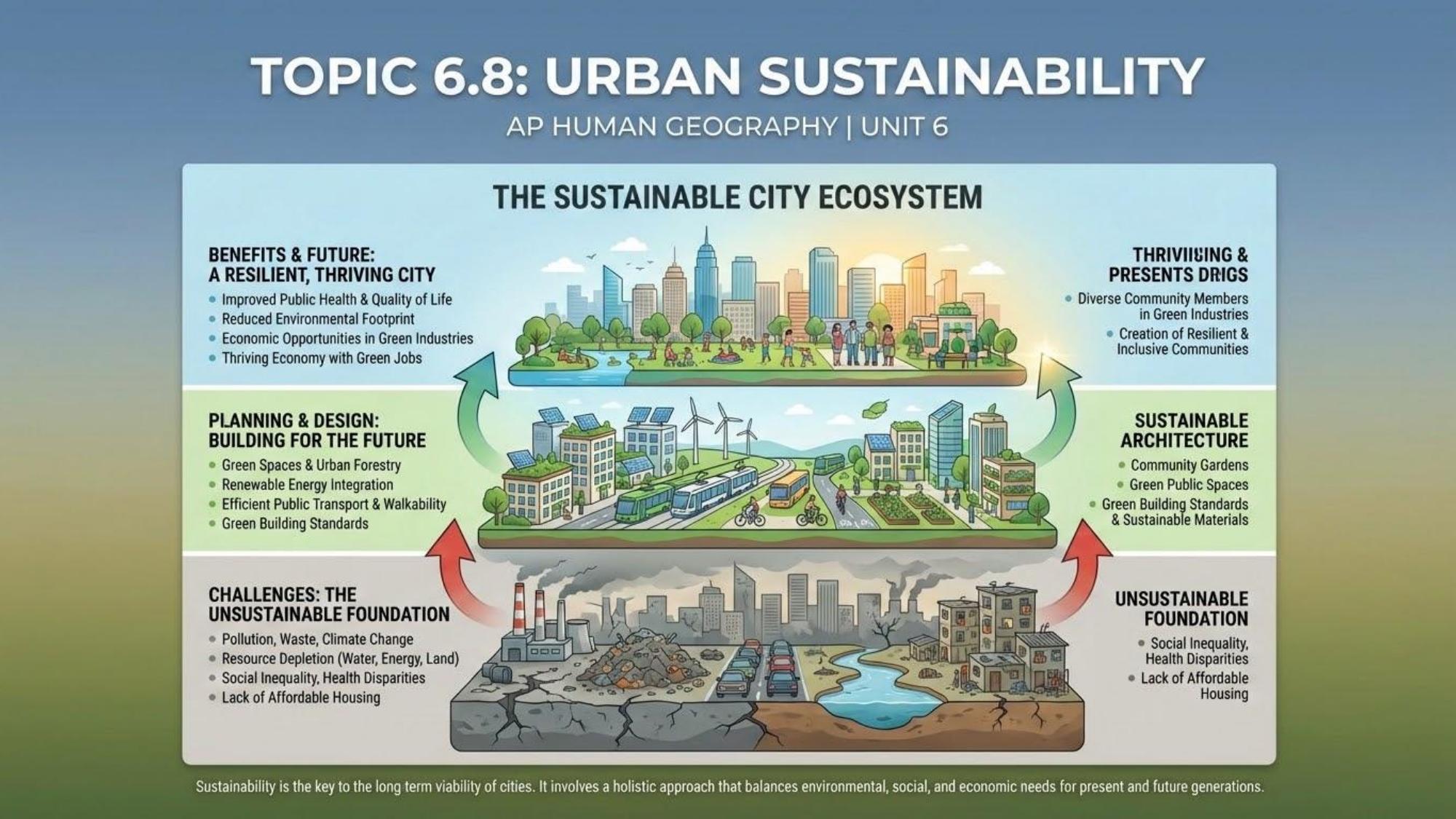
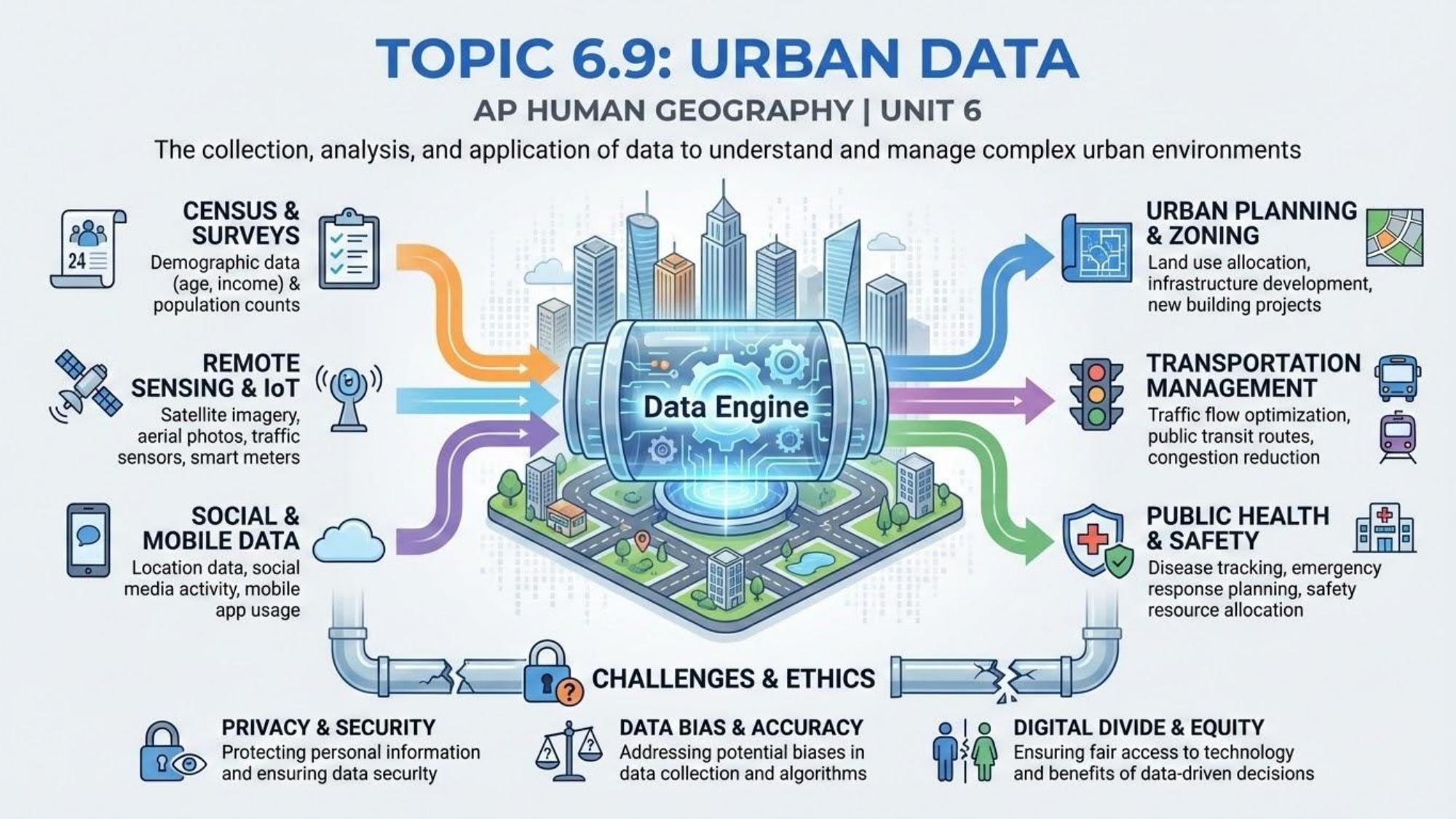
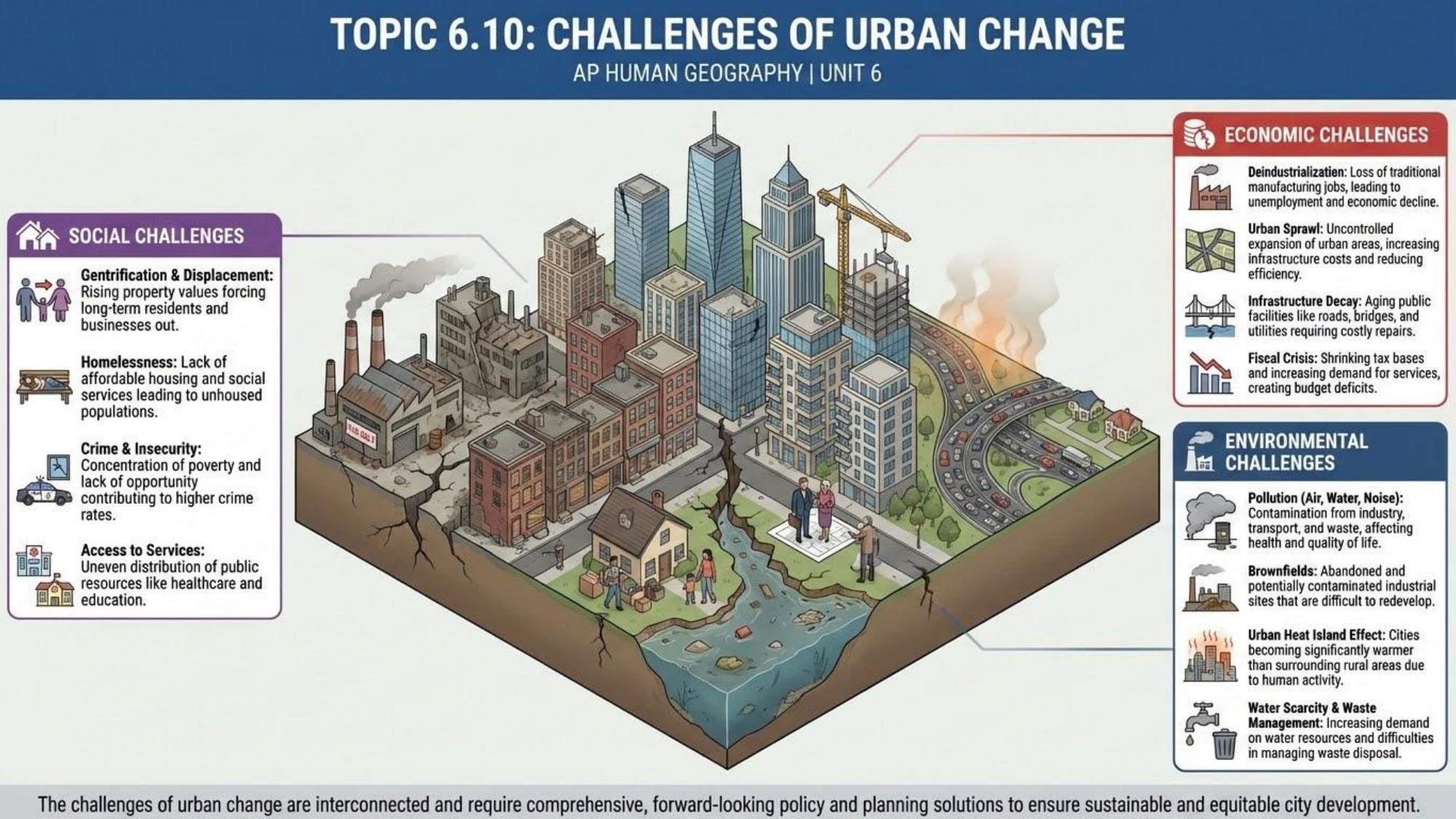
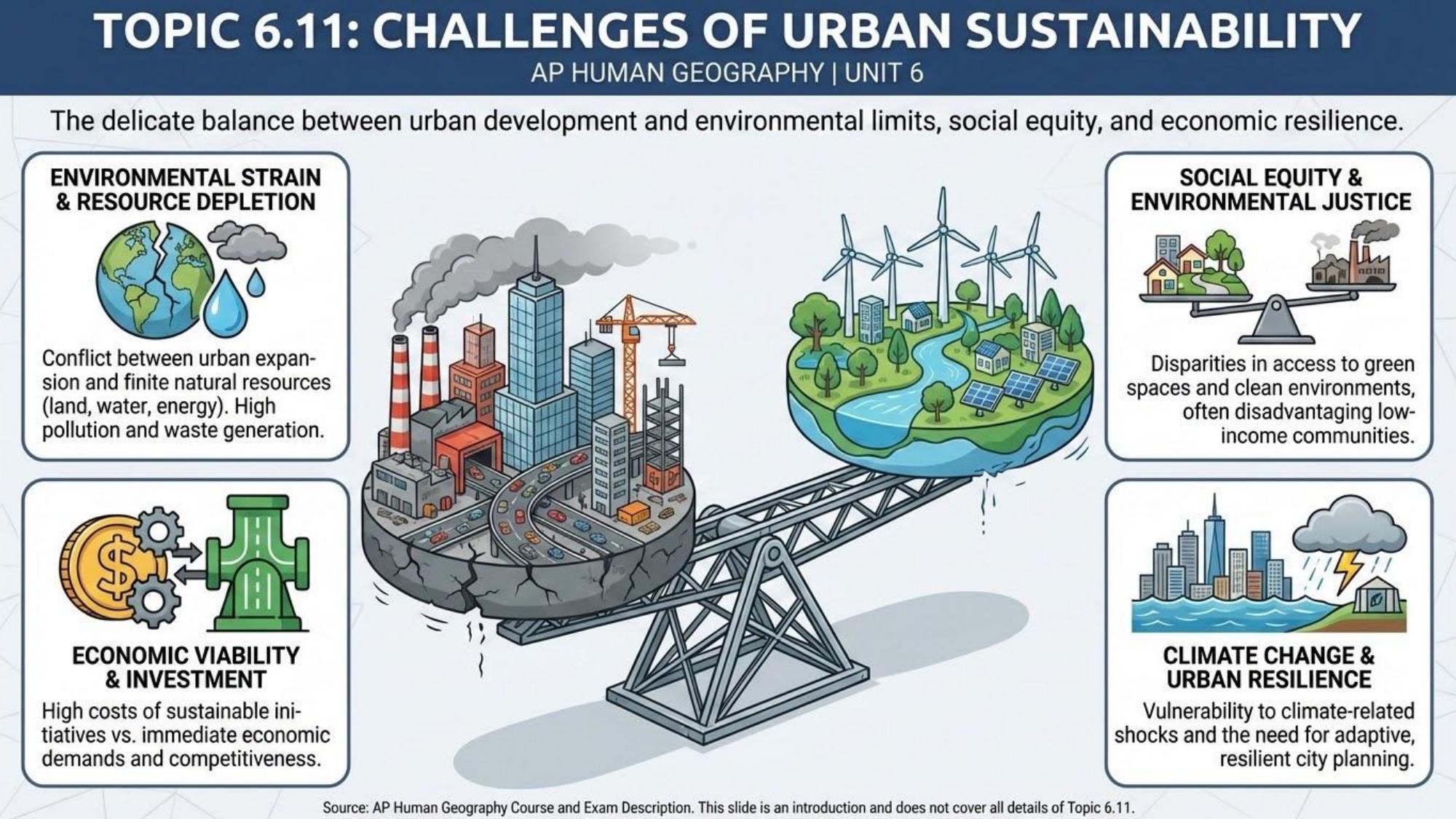
Unit 6: Cities & Urban Land Use Patterns and Processes infographic
Unit visual review slide 1 Unit visual review slide 2 Unit visual review slide 3 Unit visual review slide 4 Unit visual review slide 5 Unit visual review slide 6 Unit visual review slide 7 Unit visual review slide 8 Unit visual review slide 9 Unit visual review slide 10 Unit visual review slide 11 Unit visual review slide 12
1 / 12
7
Unit 7

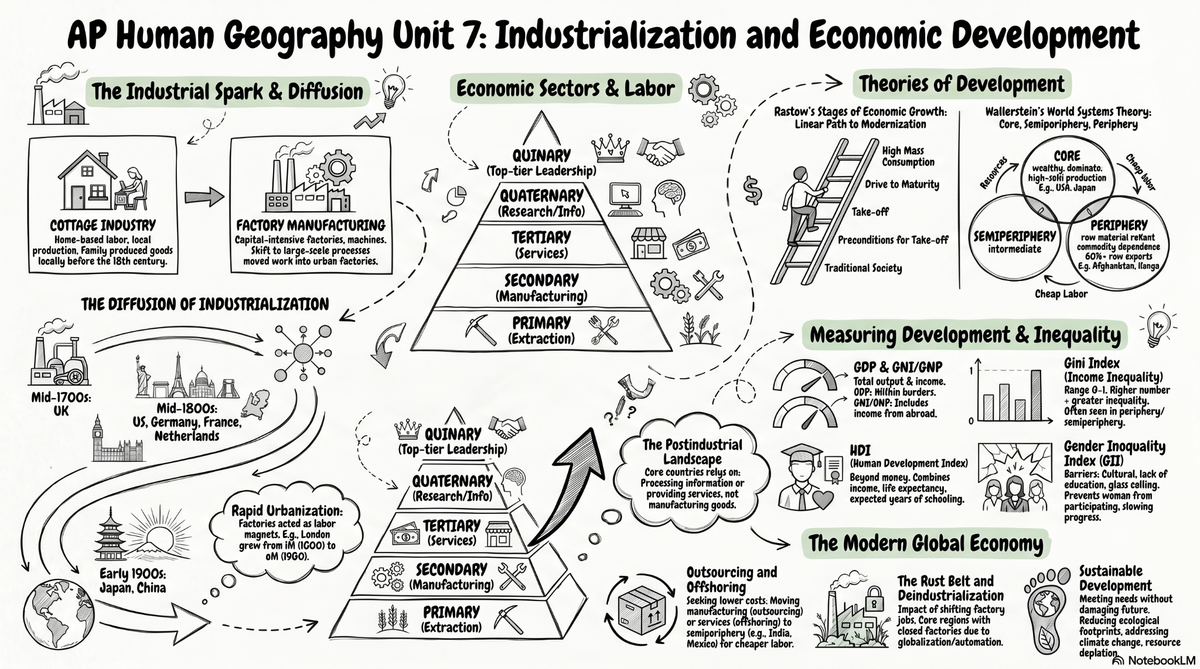
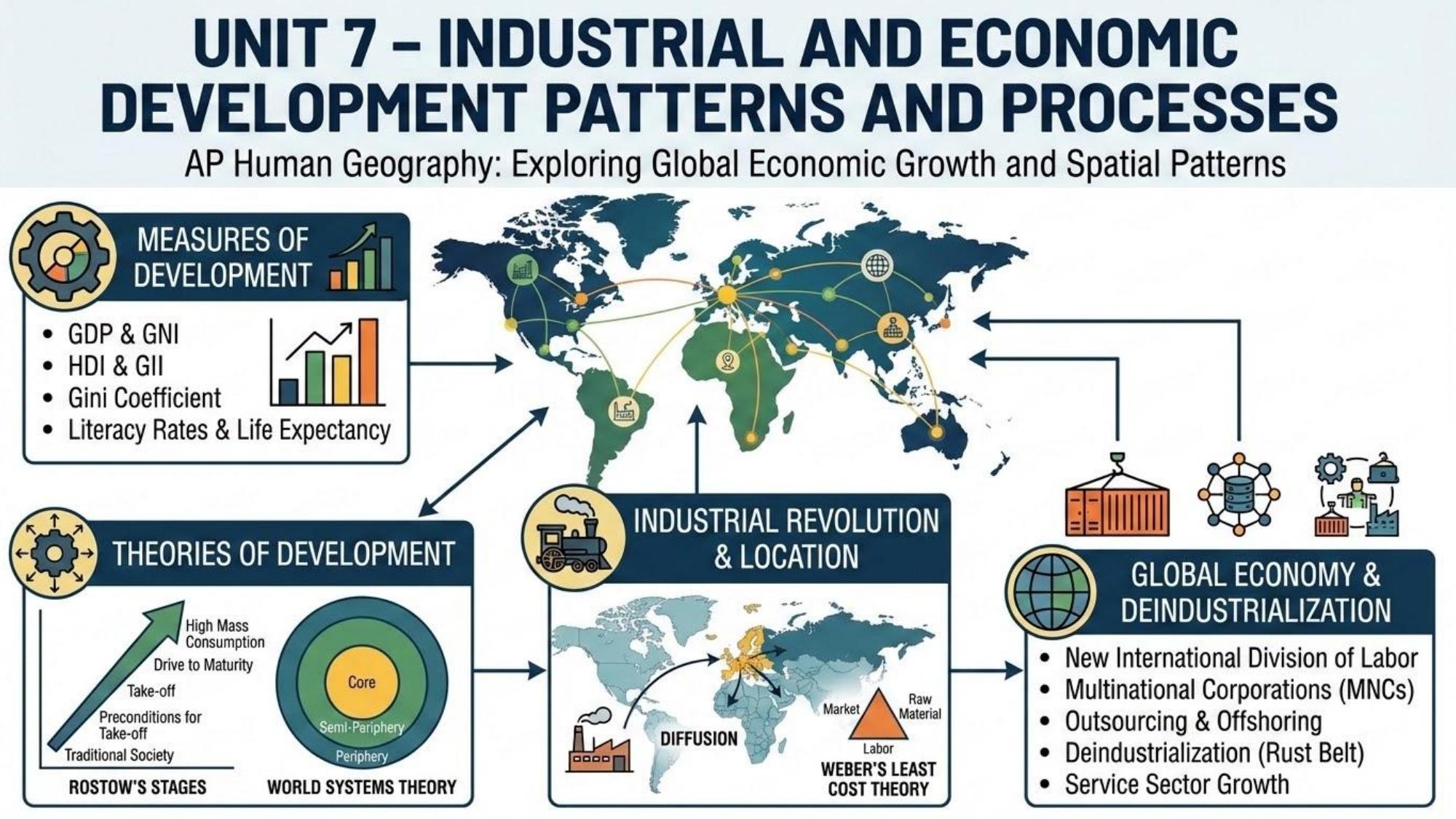
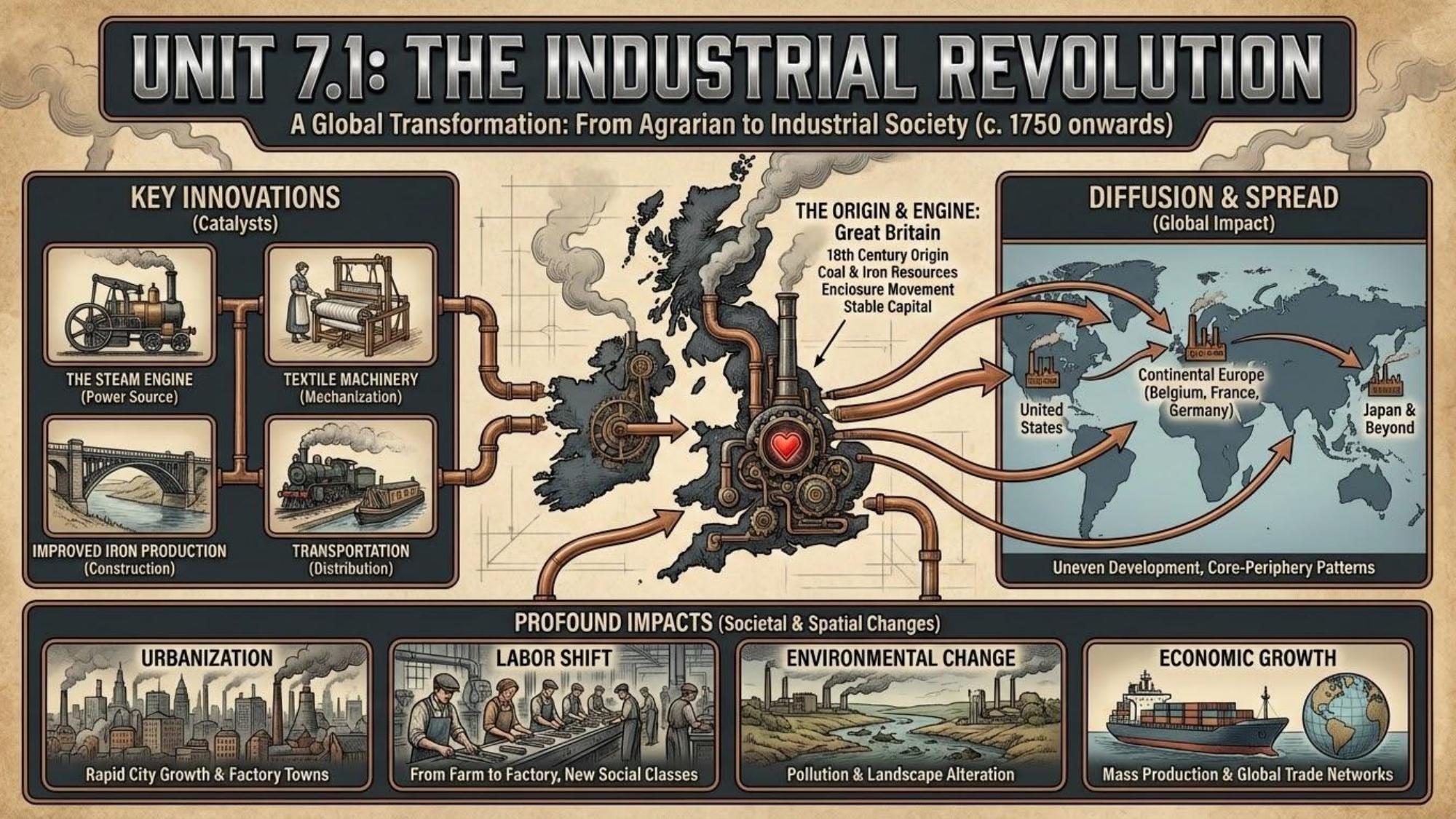
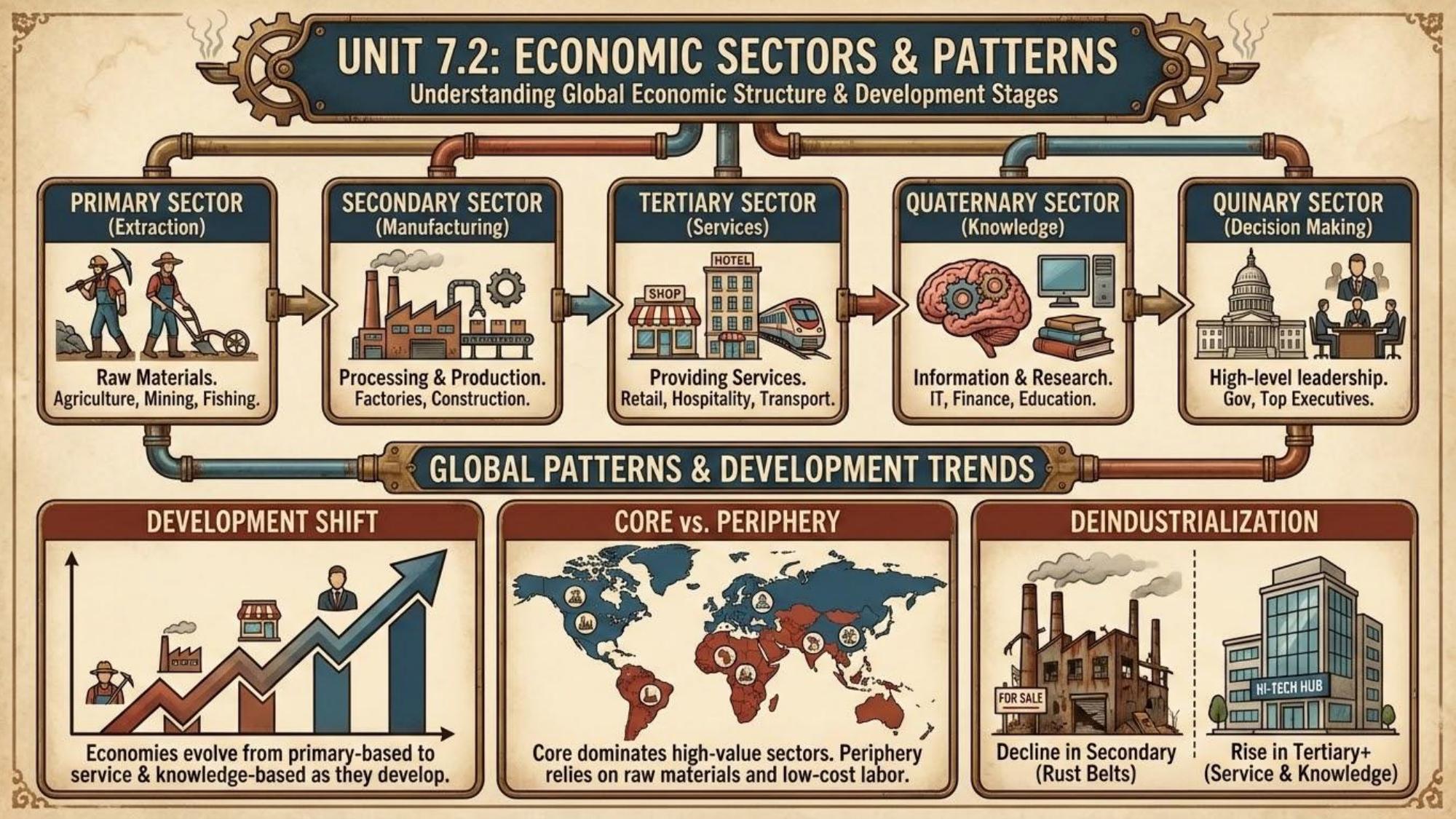
Industrial & Economic Development Patterns and Processes

approx. 12–17% of exam
🎙

Unit 7: Industrial & Economic Development Patterns and Processes

Economic development models, industrialization, trade patterns, global supply chains, and the geography of wealth and poverty.

🎙 Episode 7  ·  25:35
0:0025:35
Question
What is Rostow's Stages of Economic Growth Model?
Unit 7 · Industrial & Economic Developm
tap to flip
Answer
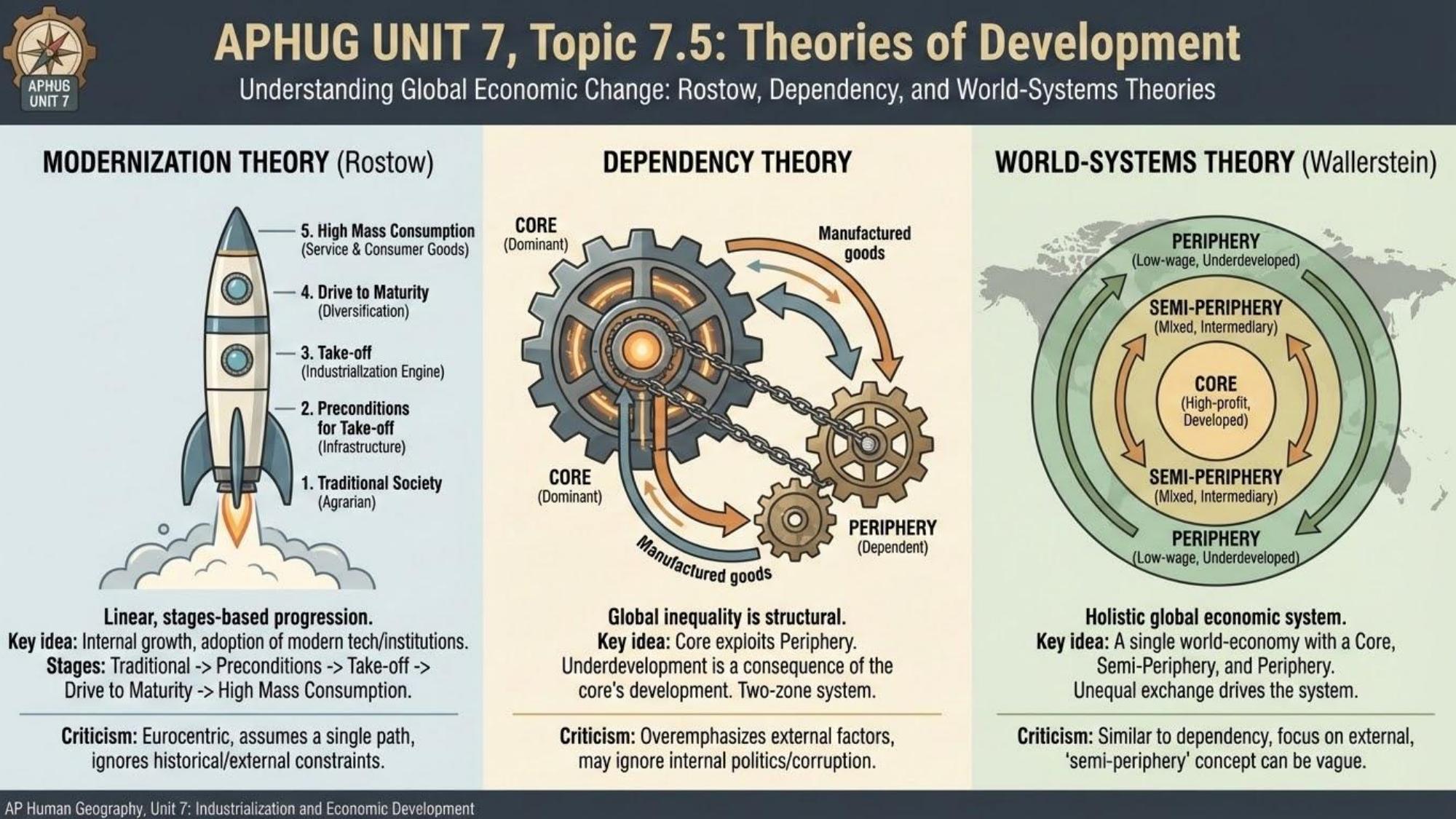
A five-stage linear model of development: traditional society, preconditions for takeoff, takeoff, drive to maturity, high mass consumption. Criticized for assuming all countries follow the same path.
Card 1 of 12
Question 1 of 5 Score: 0/5
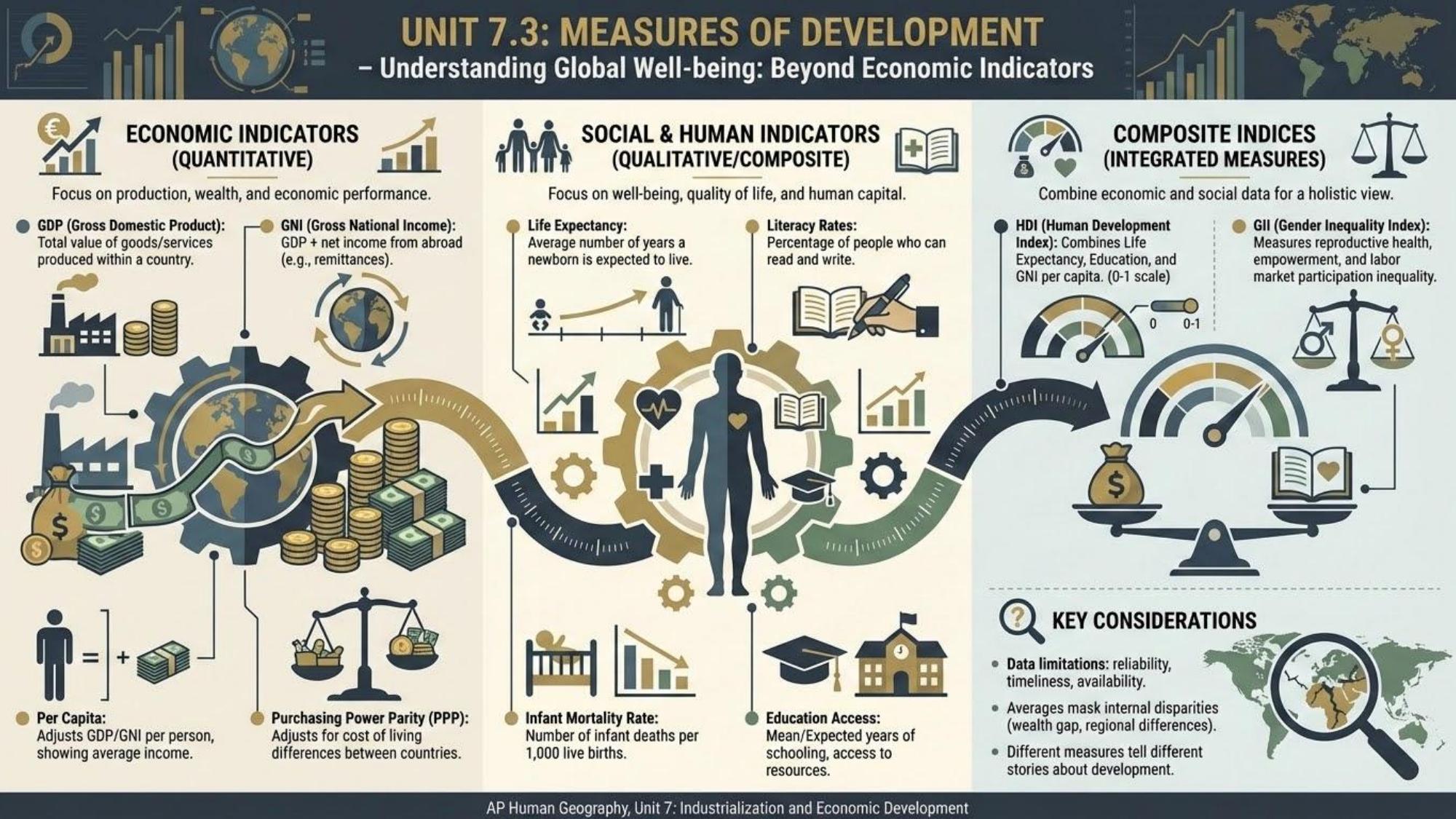
GDP (Gross Domestic Product)
Total value of goods and services produced within a country's borders in a year.
Economic Measures
HDI (Human Development Index)
Composite development measure combining life expectancy, education, and income.
Development Measures
Rostow's Stages of Economic Growth
Five-stage linear model of economic development from traditional to mass consumption society.
Development Models
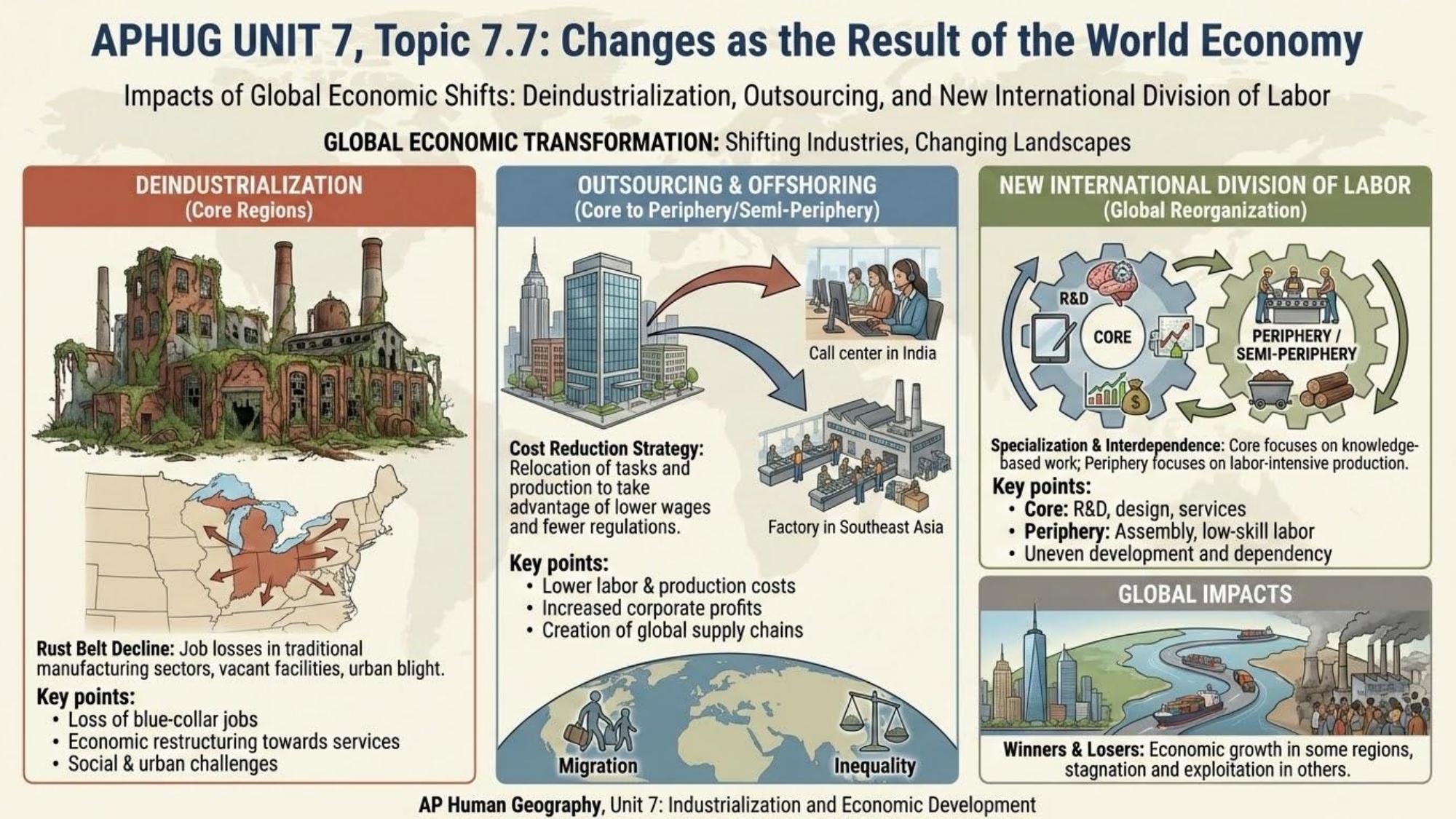
Core-Periphery Model
Wallerstein's model dividing world into wealthy core, industrializing semi-periphery, and poor periphery.
Development Models
Comparative Advantage
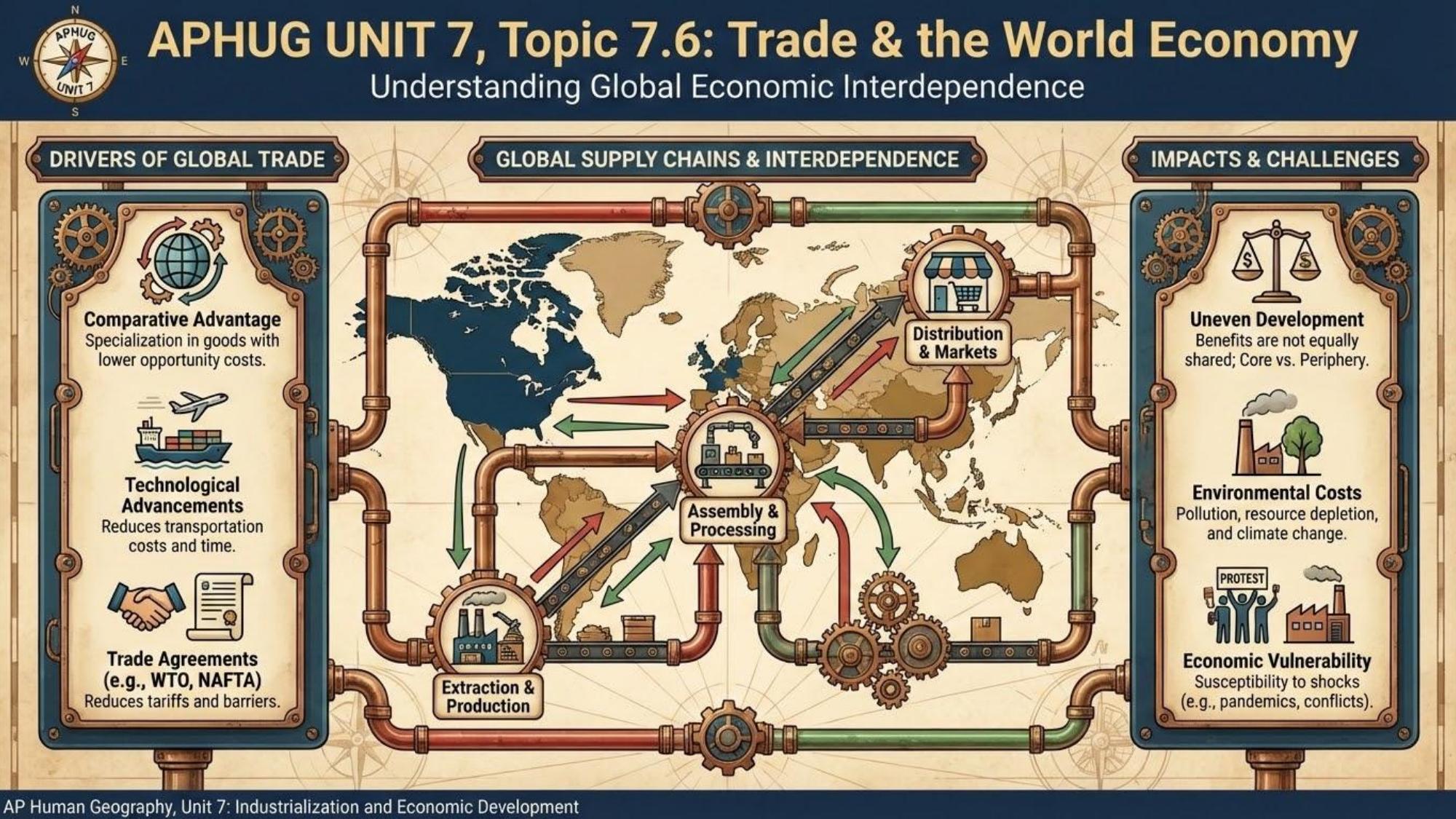
Principle that countries should specialize in what they produce most efficiently and trade for the rest.
Trade Theory
Deindustrialization
Decline of manufacturing in a region as industries relocate to lower-cost areas.
Economic Change
Special Economic Zone (SEZ)
Area with special regulations to attract foreign investment — lower taxes, relaxed rules.
Development Strategies
Outsourcing
Relocating business processes or production to lower-cost locations or companies.
Global Economy
Multinational Corporation (MNC)
Company operating in multiple countries, typically headquartered in the core.
Global Economy
Dependency Theory
Theory that Global South underdevelopment results from historical core exploitation, not natural development stages.
Development Theory
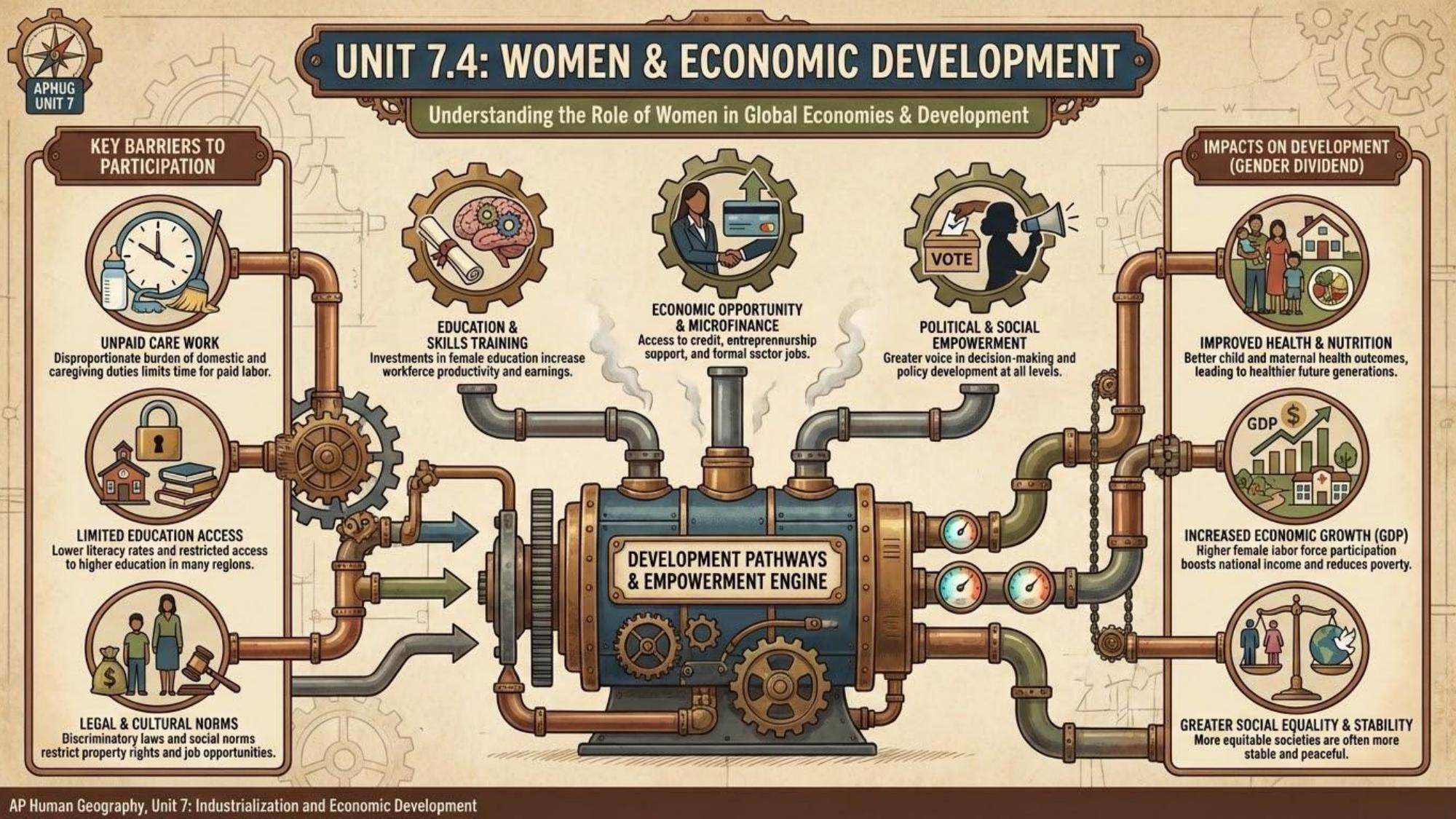
Microfinance
Small loans to low-income entrepreneurs lacking access to traditional banking.
Development Strategies
Gender Inequality Index (GII)
Measure of gender-based disadvantage in health, empowerment, and labor market participation.
Development Measures
Formal Economy
Officially recognized economic activity subject to government regulation and taxation.
Economic Systems
Informal Economy
Economic activity outside government regulation — unregistered, untaxed, but often essential in developing cities.
Economic Systems
Big Idea 1
Development is uneven — geography explains why
The Global North's wealth and the Global South's poverty are not accidents of nature but products of historical processes: colonialism, trade patterns, and structural inequalities embedded in the global economy. Core-periphery theory helps explain these persistent patterns.
Development Inequality Core-Periphery
Big Idea 2
Development models reveal assumptions about progress
Rostow's linear model assumes all countries can follow the same path as Western industrialized nations. Dependency theory challenges this, arguing the global system is structured to keep periphery nations underdeveloped. Both perspectives are important for the AP exam.
Development Models Theory Criticism
Big Idea 3
Industrialization shifts geographically in search of lower costs
Manufacturing has moved from the US and Europe to East Asia, Southeast Asia, and Latin America as companies seek lower labor costs. This deindustrializes core regions while industrializing periphery ones — reshaping both landscapes and livelihoods globally.
Industrialization Deindustrialization Global Supply Chains
Big Idea 4
Development requires more than economic growth
GDP alone doesn't capture human wellbeing. The HDI, gender inequality index, and other composite measures reveal that economic growth doesn't automatically improve health, education, or equality. True development requires attention to all dimensions of human flourishing.
HDI Wellbeing Inequality
Unit 7: Industrial & Economic Development Patterns and Processes infographic
Unit visual review slide 1 Unit visual review slide 2 Unit visual review slide 3 Unit visual review slide 4 Unit visual review slide 5 Unit visual review slide 6 Unit visual review slide 7 Unit visual review slide 8 Unit visual review slide 9
1 / 9